
10-bit 1-channel 2.6 kSPS SAR ADC
IP 250iHP_ADC_09 is 10-bit 2.6 kSPS ADC employs high-performance single ended successive approximation architecture with embedded…
Overview
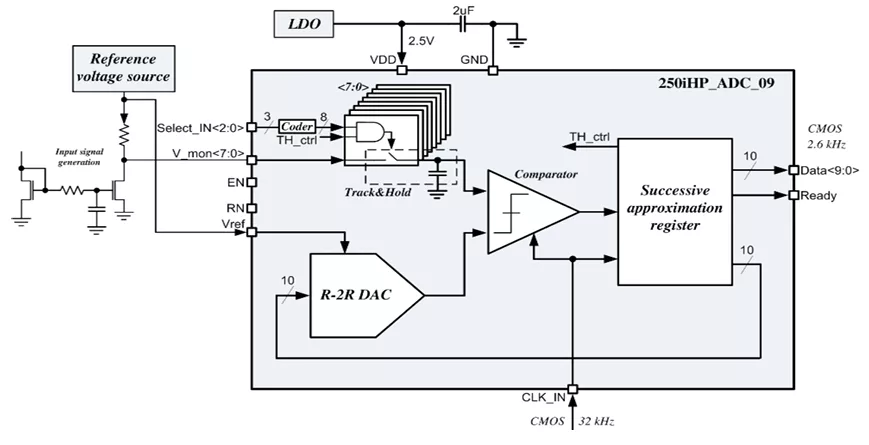
IP 250iHP_ADC_09 is 10-bit 2.6 kSPS ADC employs high-performance single ended successive approximation architecture with embedded 8-input signal multiplexer. The ADC operates with sampling rate 2.6 kSPS and corresponding input clock 32 kHz. The ADC supports standby mode and features low power consumption, compact area.
Key features
- iHP SiGe BiCMOS 0.25 um
- Resolution 10 bit
- Sampling rate 2.6 kSPS
- Rail-to-rail input voltage range
- 2.5 V supply voltage
- Low-power dissipation: 0.25 mW at 2.6 kSPS
- Standby mode
- Compact die area 0.04 mm2
Block Diagram
Applications
- On chip temperature measurement
- On chip voltage measurement
What’s Included?
- Schematic or NetList
- Layout or blackbox
- Verilog, lef and lib files
- Extracted view (optional)
- GDSII
- DRC, LVS, antenna report
- Test bench with saved configurations (optional)
- Documentation
Specifications
Identity
Analog
Files
Note: some files may require an NDA depending on provider policy.
Provider
Learn more about ADC IP core
Time Interleaving of Analog to Digital Converters: Calibration Techniques, Limitations & what to look in Time Interleaved ADC IP prior to licensing
Three ways of looking at a sigma-delta ADC device
Specifying a PLL Part 1: Calculating PLL Clock Spur Requirements from ADC or DAC SFDR
Save power in IoT SoCs by leveraging ADC characteristics
High Speed ADC Data Transfer
Frequently asked questions about ADC IP cores
What is 10-bit 1-channel 2.6 kSPS SAR ADC?
10-bit 1-channel 2.6 kSPS SAR ADC is a ADC IP core from NTLab listed on Semi IP Hub.
How should engineers evaluate this ADC?
Engineers should review the overview, key features, supported foundries and nodes, maturity, deliverables, and provider information before shortlisting this ADC IP.
Can this semiconductor IP be compared with similar products?
Yes. Buyers can compare this product with similar semiconductor IP cores or IP families based on category, provider, process options, and structured technical specifications.