EDA AI Agents: Intelligent Automation in Semiconductor & PCB Design

The next era of semiconductor and PCB design will be defined by two parallel imperatives: making core engines faster and making engineers more productive. On the engine side, the industry is embedding machine learning and reinforcement learning directly into EDA tools — enabling, for example, local models built from a small set of SPICE simulations to dramatically accelerate verification while maintaining near-SPICE accuracy. Simultaneously, leading EDA vendors are partnering with hardware companies such as NVIDIA to GPU-accelerate core algorithms, unlocking vastly higher throughput across simulation, design exploration, coverage analysis, and OPC. Addressing the second imperative of engineering productivity demands a fundamentally different kind of AI solution.
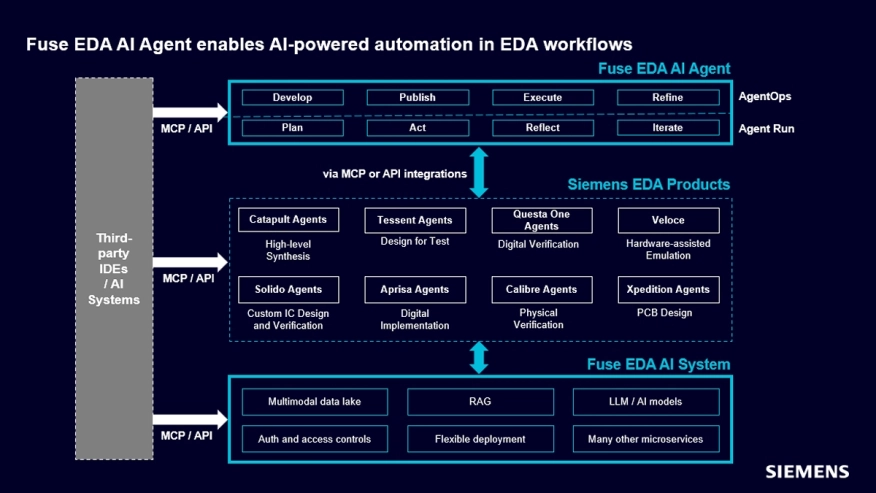 For faster engineers, generative EDA AI copilots were the industry’s first answer — but they are no longer sufficient. As design complexity and tool fragmentation accelerate, manual scripts and isolated point solutions fail to scale. Engineers need more than a chatbot; they need autonomous systems capable of intelligent reasoning, multi-step execution, and real-time adaptation across diverse EDA tools. This is the promise of agentic automation: a unified orchestration layer that delivers expert-level decision-making across the complete design lifecycle. Realizing it, however, requires overcoming domain-specific hurdles that generic AI frameworks are simply not equipped to handle.
To read the full article, click here
Related Semiconductor IP
- UCIe D2D Adapter & PHY Integrated IP
- Low Dropout (LDO) Regulator
- 16-Bit xSPI PSRAM PHY
- MIPI CSI-2 CSE2 Security Module
- ASIL B Compliant MIPI CSI-2 CSE2 Security Module
Related Blogs
- What is the EDA problem worth solving with AI?
- Teaching AI Agents to Speak Hardware
- Reimagining Chip Design - From Spec to Signoff with Cadence AI Super Agents
- EDA Industry: Consolidation Remains a Priority
Latest Blogs
- RISC-V and GPU Synergy in Practice: A Path Towards High-Performance SoCs from SpacemiT K3
- EDA AI Agents: Intelligent Automation in Semiconductor & PCB Design
- Why Security Can't Exist Without Trust
- Universal Browser Support for JPEG XL: Is Your Hardware Ready for the New Standard?
- The Future of Storage: From eMMC to the Blazing Speeds of UFS 5.0