A Bench-to-In-Field Telemetry Platform for Datacenter Power Management

Introducing Aeonic Insight™ PDNIQ 2
Today, Movellus is announcing Aeonic Insight PDNIQ 2, a bench-to-in-field telemetry platform for datacenter power management that enables SoCs to run at their true power and performance limits across the full bench-to-in-field cycle.
PDNIQ 2 provides high-resolution voltage telemetry with spatial granularity and temporal context, along with embedded analytics that enable on-die bench characterization and in-field telemetry from a single unified engine. At its core, PDNIQ 2 acts as an on-die oscilloscope: it determines PDN voltages at nanosecond resolution and stores them in a trace buffer that silicon teams can retrieve from the bench or in the field. Power is now the limiting constraint on datacenter compute. The PDNIQ 2 provides SoCs with a level of PDN visibility and monitoring not previously possible, enabling platforms to be monitored and optimized for power, performance, and reliability throughout the system life cycle.
The Mismatch Between Silicon Timelines and Workload Evolution
NVIDIA's Blackwell platform delivered roughly 15% lower energy and 13% higher throughput[1]. Those gains came from hardware-firmware co-design that matches operating points to each workload, not a new process node. Most SoCs do not adapt: their margins are set and frozen the day silicon ships, based on the workloads measured at the bench.
Software evolves in months, use cases change weekly, while silicon takes years. The era of relying solely on bench characterization is over. To meet this challenge, power optimization must become a continuous cycle rather than a one-time event.
Large-scale deployments expose complexities that the bench can't fully capture, such as workload evolution after deployment and silicon variation across the fleet. Silicon teams have responded by sizing margins conservatively or by disabling advanced power management, such as DVFS and thermal throttling[2].
Bench V-F Characterization and PDN Analysis
V-F characterization and PDN analysis mark the beginning of the power-management cycle. Engineers sweep voltage and frequency across “representative” workloads of interest, establishing margins based on the worst-case they observed on the bench, plus a test-and-yield guardband. Modern SoCs have dozens of regions and long workload lists. PDNIQ 2 automates on-die sweeping, with each region reporting its own V-F behavior rather than collapsing into a die-level view.
Voltage behavior on the PDN shifts faster than external instrumentation can see. Transient events arrive and resolve in nanoseconds. Monitoring from system-level samples at microsecond intervals, three orders of magnitude slower than the event, makes these “invisible.” PDNIQ 2 closes that gap by acting as an on-die oscilloscope: it determines voltage at each sensor, at nanosecond resolution, and stores the samples in a trace buffer. Silicon teams can retrieve the waveform for debug, characterization, or system optimization on the bench or in the field at rack-scale. The trace enables PDN analysis to attribute a failure to a specific workload, at a specific time, in a specific location, with quantitative details on the magnitude.
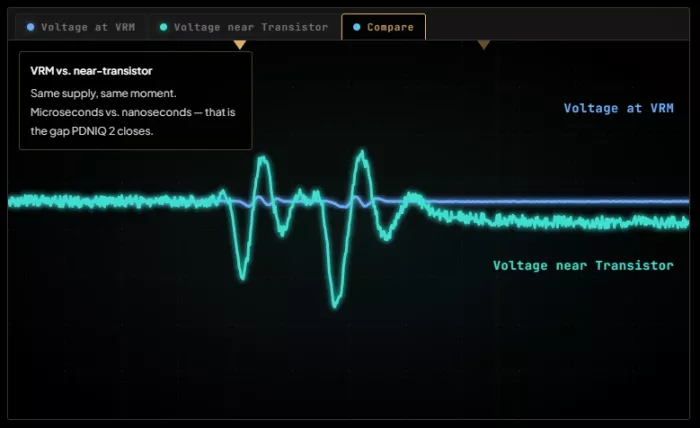
Figure 1. A VRM-level monitor sees the supply as smooth; the on-die sensor captures the full nanosecond droop and ringing at the transistor. Hover the channels to isolate.
Voltage is not uniform across a die. Execution units, caches, and buffers behave differently, and process variation adds more spread. PDNIQ 2 enables deep-voltage-transient monitoring within hotspots that a system-level monitor cannot see. PDNIQ 2 gives more than a detailed V-F grid; it delivers slew rates, digitized waveforms, and per-region histograms, allowing post-silicon teams to establish regulator set points based on the voltage transients the logic actually saw.
Closing the Cycle: In-Field Characterization and Dynamic Adjustment
Software will always move faster than silicon. By the time a new frontier model has dropped, your team's bench characterization could be obsolete. When new frontier models reach silicon, design teams must go back to the bench and restart characterization for the new workload. In modern data centers, that loop is too slow.
With PDNIQ 2, once a workload crosses pre-set Vmin/Vmax thresholds, PDNIQ 2 can be used to re-run the characterization loop on the deployed silicon, against that new workload, without leaving the rack. This process can provide new Vmin and Vmax watermarks, live waveforms, and voltage-specific telemetry on production systems, in the field.
Conclusion
Power management is now a continuous cycle. Bench characterization sets the starting points, and in-field monitoring keeps those points current as workloads evolve. Closing that loop requires hardware that produces high-resolution waveform-grade voltage data across the system lifecycle.
PDNIQ 2 does that work. On the bench, it sharpens V-F setpoints by resolving voltage behavior per region and correlates nanosecond-resolution traces to the workloads that produced them. In the field, it raises watermark alerts, triggers alerts to and enables re-characterization against workloads the silicon team never ran at design time, and returns waveforms and analytics to the design team without a round-trip.
Join us for our next blog where we explore the Vmin search with PDNIQ 2.
Citations
-
S. Narayanaswamy, P. Patel, I. Karlin, A. Gupta, S. Saripalli, and J. Guo, Datacenter Energy Optimized Power Profiles, NVIDIA, 2024
-
R. E. Grant, S. D. Hammond, J. H. Laros III, M. Levenhagen, S. L. Olivier, K. Pedretti, H. L. Ward, and A. J. Younge, Enabling Power Measurement and Control on Astra: The First Petascale Arm Supercomputer, Sandia National Laboratories, SAND2022-11546J, 2022.
Related Semiconductor IP
- NPU IP
- JPEG XL Encoder
- I2C Master/Slave Controller Core
- NVMe Validation Test Suite
- Hybrid Memory Cube Verification IP
Related Blogs
- Post-quantum security in platform management: PQShield is ready for SPDM 1.4
- Media Tablet & Smartphones to generate $6 Billion market in... power management IC segment by 2012, says IPnest
- POWER FIRST - "Subduing The Power Management Storm"
- Power Management of PCIe PIPE Interface
Latest Blogs
- Tape-Out Readiness Checklist: Engineering Decisions That Prevent Costly Respins
- How Cadence DSPs Put In-Cabin AI Audio On-Chip in SemiDrive's X10
- The Fastest Path to Scalable Photonic Systems: Using Proven IP for both PIC and EIC designs
- Building Trusted AI Agents from the Silicon Root of Trust
- Heterogeneous Computing in Space