MEMTECH announces MemoryEmu, a software-ready pre-silicon memory emulation platform
JEDEC-timing-accurate SystemC/TLM memory models and a QEMU SoC emulator let firmware, BIOS and diagnostics teams start memory software months before silicon — on a standard workstation.
 Cupertino, Calif. — November 24, 2026 — California Memory Technologies, Inc. (MEMTECH) today announced MemoryEmu, a software-ready pre-silicon memory emulation platform that lets AI accelerator, edge AI, automotive and advanced SoC teams develop and regress memory firmware, calibration software and diagnostics before silicon exists. MemoryEmu is available now for DDR3, DDR4, DDR5, LPDDR4x/4, LPDDR5x/5 and MRAM-DDR4, with HBM models to follow.
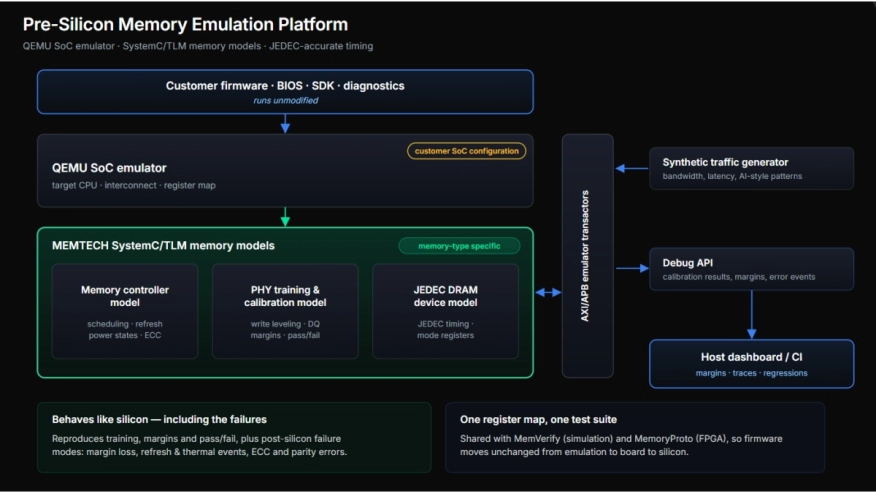
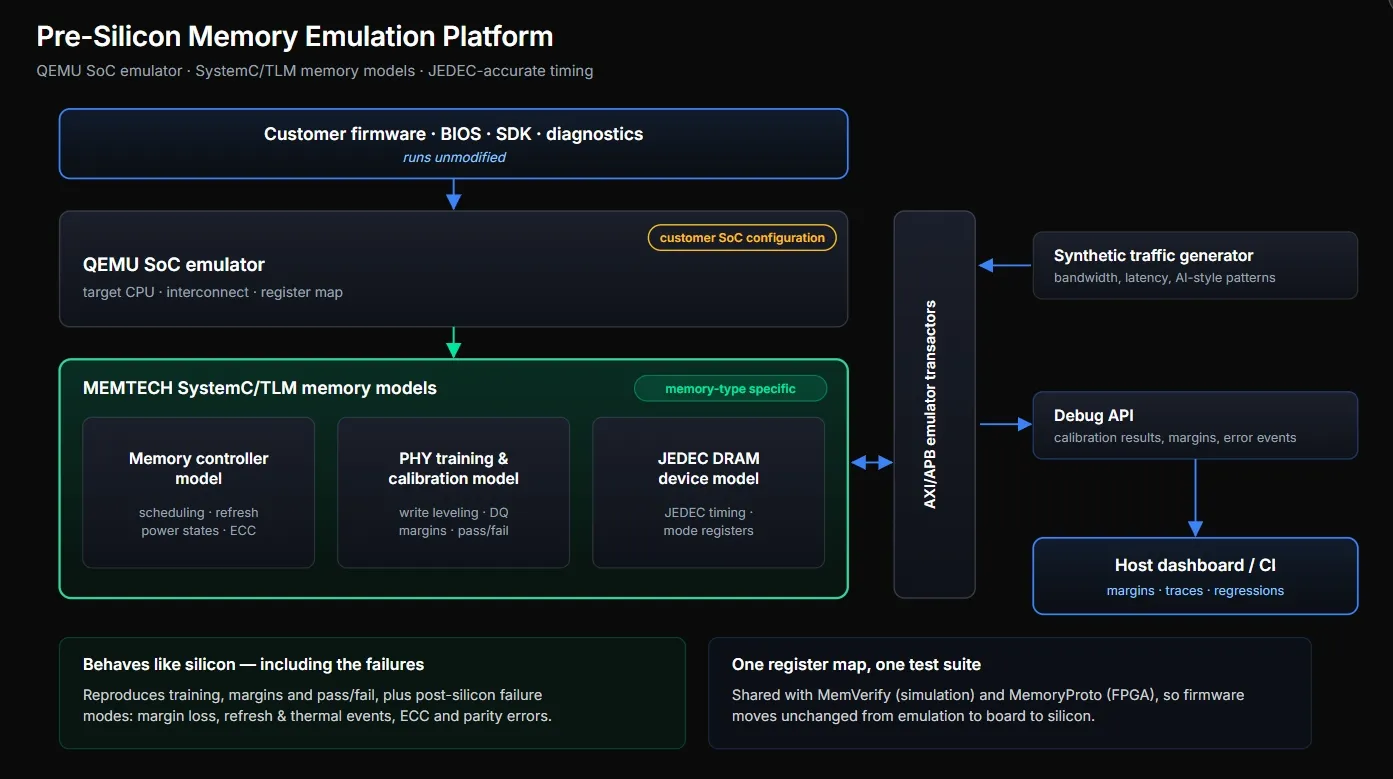
MemoryEmu combines SystemC/TLM memory controller models with JEDEC-accurate timing, a QEMU-based SoC emulator, memory initialization and calibration flow models, register models, firmware hooks, a debug API, AXI/APB emulator transactors and synthetic memory traffic generation in one environment that runs on a standard Linux workstation. Customer firmware, boot code and SDKs run unmodified on the emulated SoC while the memory subsystem beneath them trains, calibrates and fails the way silicon does.
Memory software is on the critical path of every AI accelerator program, yet it is usually the last code written: teams wait for first silicon, or for scarce time on expensive EDA emulators, to exercise initialization, calibration and error handling against a memory subsystem that behaves realistically. MemoryEmu removes that wait. Firmware teams begin on day one of the program, regress calibration flows in continuous integration, and arrive at silicon bring-up with code that has already booted thousands of times.
“Every memory bring-up we have been part of was gated by software that could not be written until silicon arrived. MemoryEmu models the calibration behavior, the JEDEC timing and the failure modes we have seen across more than 150 production memory chips, and puts them on an engineer’s workstation. The firmware that passes in MemoryEmu is the firmware that boots on the FPGA board and on silicon.”
Saswat Mishra, Founder and CEO, California Memory Technologies, Inc.
Key capabilities of MemoryEmu
- SystemC/TLM memory controller models with JEDEC-accurate timing for DDR3, DDR4, DDR5, LPDDR4x/4, LPDDR5x/5 and MRAM-DDR4
- QEMU-based SoC emulator running the customer’s firmware, BIOS and SDK unmodified on a standard workstation
- Memory initialization and calibration flow models that reproduce silicon training, margins and pass/fail behavior
- Register models, firmware hooks and a debug API that stream calibration results, margins and error events to a dashboard or CI system
- AXI/APB emulator transactors and synthetic memory traffic generation, including AI-style access profiles
- Post-silicon failure-mode models: training failures, margin loss, refresh and thermal events, ECC and parity errors
- One register map and one test suite shared with MemVerify (simulation) and MemoryProto (FPGA prototyping)
- Architecture designed to extend to HBM
MemoryEmu is the second of MEMTECH’s memory platforms, alongside MemVerify for memory simulation and verification, MemoryProto for FPGA prototyping and MemoryChannel for package and signal-integrity readiness. Together they form a single path from RTL to lab, built on the Memory Intelligence Infrastructure (MII), the memory co-processor and intelligence stack that also goes inside MEMTECH’s Custom XPU and VAYU AI-Driven Memory Accelerator silicon, and backed by the company’s Yield Improvement services and vendor-neutral DDR Test Solutions.
Availability
MemoryEmu is available now for customer evaluation and technical review under NDA through California Memory Technologies, Inc. To request evaluation access or a 30-minute technical review, visit memtech.ai/products/memory-platforms/memoryemu/ or contact contact@memtech.ai.
Explore MEMTECH IP:
About MEMTECH
California Memory Technologies, Inc. (MEMTECH), founded in 2020 in Cupertino, California, works exclusively on memory. We run three businesses — Custom XPU for the AI Server Stack, AI-Driven Memory Accelerators (the VAYU family of CXL chips, with reference platforms and software), and DDR Test Solutions & Services — plus OpenDDR, our open-source initiative for research and education. All are built on the Memory Intelligence Infrastructure (MII), the memory co-processor and intelligence stack nobody else has, backed by a yield practice that lifted a customer’s AI SoC from 21% to 99% and vendor-neutral DDR test platforms. One team, four design centers, 150+ production memory chips.
Related Semiconductor IP
- Memory Simulation & Verification Platform
- LPDDR5X PHY
- LPDDR5X Memory Model
- LPDDR5X Synthesizable Transactor
- LPDDR5X Controller IIP
Related News
- MEMTECH announces MemVerify-LPDDR5x memory simulation & verification platform
- MEMTECH announces MemoryProto, an FPGA memory prototype platform
- OPENEDGES Collaborates with Renesas on Memory Subsystem IPs for Next-Generation MPU Platform Development
- M31 Advances AIoT Innovation with Ultra Low Power Memory Compilers on TSMC N6e Platform
Latest News
- MEMTECH announces MemoryProto, an FPGA memory prototype platform
- MEMTECH announces MemoryEmu, a software-ready pre-silicon memory emulation platform
- Nuclei Releases the NI1000 Series General-Purpose Compute Core with Support for the VME Matrix Extension
- OIF Publishes Common Electrical I/O (CEI) 6.0 IA with New 224G Long Reach and Medium Reach Specifications
- EnSilica to develop resilient GNSS ASIC for US$80 million programme