Arm-based NVIDIA RTX Spark is redefining PCs for the agentic era
By Chris Bergey, Executive Vice President, Edge AI Business Unit, Arm
For decades, PCs were designed around people using applications. Agentic AI changes that model as apps become more autonomous, with users prompting their agents to observe, reason, plan, and act across workflows.
This evolution is creating demand for two broad classes of AI-enabled computing:
- Efficient performance for all-day battery life, mobility, and AI-enhanced productivity.
- Extreme performance for advanced AI workloads, content creation, software development, gaming, and local inference.
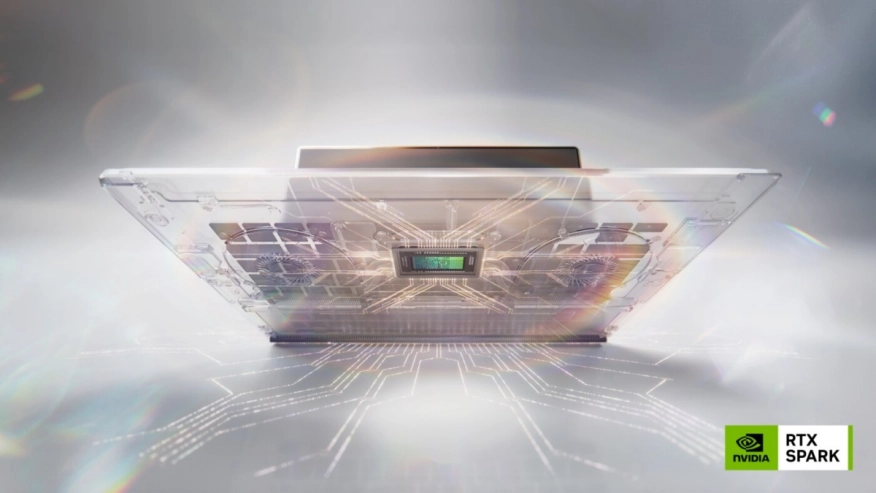 Nothing demonstrates this transformation more powerfully than the new Arm-based NVIDIA RTX Spark.
Arm is excited to partner with NVIDIA on introducing a new generation of Arm-based silicon, setting the pace of premium performance Windows PCs, with intelligent, responsive, always-ready computing that brings advanced AI performance directly to developers, creators and gamers.
Arm-based NVIDIA RTX Spark shows a new PC era taking shape
Announced at COMPUTEX 2026, NVIDIA RTX Spark marks a huge step in the evolution of PCs.
“Agents require tight integration and optimization of GPU, CPU, and memory architectures to deliver responsive, efficient on device AI experiences,” said Kaustubh Sanghani, vice president, product management at NVIDIA. “With an Arm-based Grace CPU tightly coupled with NVIDIA’s Blackwell RTX GPU and unified memory, RTX Spark combines NVIDIA’s leadership in accelerated computing and AI to reinvent personal computing for creators, AI developers, and gamers.”
RTX Spark combines powerful on-device AI, advanced graphics, and blazing-fast responsiveness in one efficient platform. Together, NVIDIA DGX Spark and RTX Spark show how the market is expanding beyond traditional PCs toward a broader class of platforms incorporating Arm’s latest technology. DGX Spark points to a new class of compact AI development systems, while RTX Spark brings AI acceleration to Windows PCs for creators, developers, and gamers. Together, they represent one of the clearest examples of the emerging agentic PC era, powered by the Arm compute platform.
Agents need powerful, efficient compute
With artificial intelligence, we are seeing an explosion of new use cases, moving towards a world of autonomous, multi-step AI workflows. The next wave of PC experiences brings agentic code generation, multi-stage reasoning, planning, dynamic workflows, agentic RAG, and personal AI assistants with continual task execution. To fulfil the promise of these exciting advances, more CPU and GPU cores are required.
As the latest models use an ever greater number of tokens, cost-per-task has been rising significantly. The path to reducing cost-per-task requires large on-device models to use tokens more efficiently. This yields lower, predictable costs, as well as data privacy for the user and enterprise.
This requires a platform that provides the acceleration for ultra-low latency inference, which is exactly what Arm has partnered with NVIDIA on for RTX Spark.
A defining moment for the Windows on Arm ecosystem
“Momentum for Windows on Arm continues to build with NVIDIA RTX Spark,” said Pavan Davaluri, executive vice president of Windows + Devices at Microsoft. “Microsoft and NVIDIA are bringing to life the world’s most powerful and efficient thin-and-light Windows PCs, and we’re partnering closely with the ecosystem and developers to expand support for Arm-based PCs, including top tools for creators and a deep catalogue of games.”
From efficient performance to extreme performance, that future is being built on the Arm compute platform.
Related Semiconductor IP
- NPU IP
- JPEG XL Encoder
- I2C Master/Slave Controller Core
- NVMe Validation Test Suite
- Hybrid Memory Cube Verification IP
Related News
- NVIDIA Expected to Launch RTX PRO 6000 Special Edition for China’s AI Market, Potentially Boosting Future GDDR7 Demand, Says TrendForce
- NVIDIA Joins the Windows on Arm Ecosystem, Driving Arm-Based AI Notebook Penetration to 34.2% by 2029, Says TrendForce
- USB 2.0 specification to spark new round of chips
- Atmel Produces Fourth-generation ARM-based System-on-Chip for M-Systems' Smart DiskOnKey Platform in Record Time
Latest News
- GF unveils roadmap to deliver the world’s most advanced FD-SOI platform for Physical AI
- GlobalFoundries marks Dresden expansion milestone, announces next-generation platform for Physical AI
- TSMC September 2026 Revenue Report
- Lattice Collaborates with Arm to Advance Secure, Adaptable AI Data Center Infrastructure
- ZLG Selects CAST CAN XL and TSN IP for Next-Generation Vehicle-Network Development and Test Tools