Why SAR Radar Is Driving Renewed Demand for C-Band GaN and GaAs Front-End IP

SAR - Synthetic Aperture Radar has been a mature technology for decades. Yet in the past three years, something unusual has happened: the SAR market has begun growing faster than almost any other segment of the defense and space electronics industry, and the growth is being driven not by military programs but by commercial remote sensing startups — and the demand for front-end RF IP that follows from this growth is only beginning to be felt in the IP marketplace.
What changed
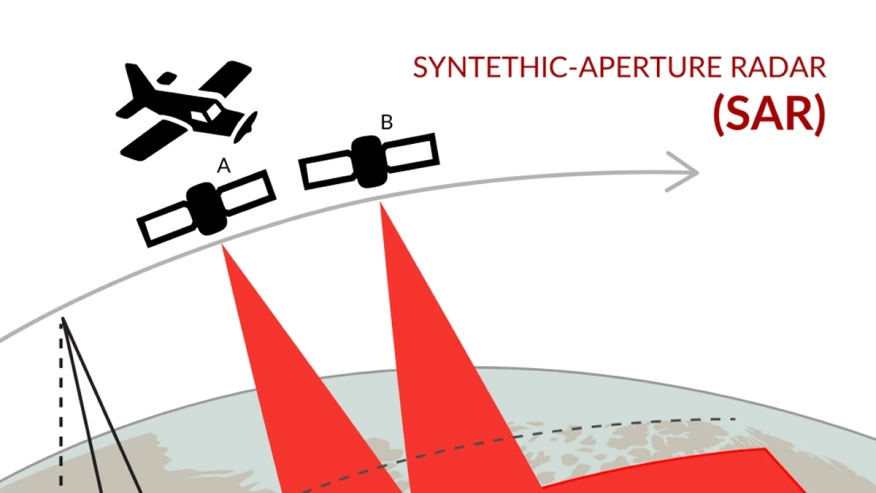 The traditional SAR satellite was a government-funded program: large, expensive, few in number, and built around bespoke electronics developed by defense primes. Sentinel-1 (ESA), RADARSAT (Canada), and COSMO-SkyMed (Italy) are the canonical examples — capable systems, but each representing a program cost measured in hundreds of millions of dollars and a development cycle measured in years.
Starting around 2020, a different model emerged. Companies like ICEYE (Finland), Capella Space (US), Umbra (US), and Synspective (Japan) began launching small-SAR constellations at a fraction of traditional program costs, using commercial smallsat buses and targeting commercial data subscription customers rather than government contracts. ICEYE alone had launched more than 30 satellites by mid-2025. The cumulative effect: the number of SAR-capable satellites in orbit has roughly tripled in five years, and the rate of new constellation deployments continues to accelerate.
This matters for RF front-end designers because every SAR satellite — regardless of size — requires the same fundamental building blocks: a phased array antenna with per-element T/R modules containing PA, LNA, T/R switch, and beam steering control. The smallsat form factor compresses the physical envelope, which increases integration pressure on the RF front-end. A tile that might have used 20 discrete components in a heritage design now needs to fit the same function in half the area at a third of the power consumption.
Why C-band specifically, and why now
X-band (9–10 GHz) and C-band (5–6 GHz) are the two dominant frequency bands in SAR satellite design, each with different application characteristics. X-band provides higher resolution imagery at smaller aperture size, making it preferred for detailed urban mapping, change detection, and military surveillance applications. C-band offers wider swath width at a given aperture, better penetration through vegetation and dry soil, and more established regulatory access in most markets — making it the default choice for agricultural monitoring, sea ice mapping, deforestation tracking, and most commercial earth observation applications.
The current wave of commercial SAR constellation deployments is heavily weighted toward C-band for exactly these reasons. Sentinel-1's data has created a global baseline in C-band that commercial customers know how to interpret and value. New constellations targeting the same application verticals are defaulting to C-band to be interoperable with that established data ecosystem.
The consequence for front-end IP: C-band T/R module components — HPA, LNA, beamformer IC — are in increasing demand from constellation builders who need to procure or license them at commercial timescales, not defense program timescales.
The RF front-end integration challenge at C-band
A C-band phased array for SAR satellite application has specific requirements that differ from ground-based radar systems of similar frequency. The duty cycle is typically low (5–15% chirp pulses) but the pulse must maintain exceptional phase and amplitude stability between pulses — because SAR imaging is a coherent process that depends on the relative phase relationship between successive returns to construct the synthetic aperture. Any drift in phase or amplitude between pulses, even at the fraction-of-a-degree level, directly degrades azimuth resolution.
This places demanding specifications on the beamformer IC: RMS phase error below 2.5° is a common requirement, with some constellation builders specifying below 2°. At the same time, the smallsat power budget means the front-end cannot afford the DC power overhead of separate phase calibration hardware — the BFIC accuracy needs to be intrinsic, maintained across the operating temperature range of the satellite orbit.
At the tile level, a typical C-band SAR tile uses 8–32 elements, with a beamformer IC controlling groups of 4 channels each. The LGA package format and SPI control interface are the standard integration assumptions. For constellation builders working on tight schedules, the availability of qualified beamformer IP with characterized phase error data from real silicon — rather than simulation — compresses the tile development timeline by months.
The supply chain gap
Despite growing demand, open-catalogue availability of C-band SAR front-end IP remains limited. The dominant compound semiconductor vendors active in this space — Qorvo, MACOM, Northrop Grumman Microelectronics Center — develop these components primarily for internal use or under restrictive program-specific licenses. A constellation builder outside the traditional US/European defense supply chain who needs C-band beamformer IC and HPA at commercial terms faces a sourcing problem that has not yet been comprehensively solved by the open IP market.
This gap is beginning to close as independent fabless RF IP vendors enter the space with silicon-proven designs on accessible foundry processes. The availability of qualified C-band IP — beamformer ICs with characterized phase accuracy, GaAs LNA with low noise figure, and GaN HPA covering the C-band radar allocation — through open licensing channels represents a meaningful change in the procurement options available to smallsat constellation builders.
Explore RF IP
A note from VSI
VSI's C-band portfolio directly addresses this demand. The VBF0644 C-band 4T4R GaAs beamformer IC (5–6 GHz, RMS phase error <2.3°, LGA 24×16 package) is silicon-proven with engineering samples available, and is designed specifically for the tile integration requirements of SAR satellite and ground radar applications. The VPA06100 C-band GaN HPA (5.2–5.7 GHz, >50 dBm Psat, PAE >45%) addresses the transmit chain requirement for both high-power ground-based fire control and satellite SAR downlink applications.
Both IPs are available through Design & Reuse with full characterization data and deliverables for licence customers. Engineers evaluating C-band front-end solutions for SAR constellation or radar programs are welcome to reach out directly for technical discussion and datasheet access.
Related Semiconductor IP
- 6 Mhz to 5.8Ghz RF Power Amplifer
- CC-100IP-RF Analog and RF Sensitivity Enhancement IP
- Wi-Fi 7(be) RF Transceiver IP in TSMC 22nm
- Wi-Fi 6 (ax)+BLEv5.4+15.4 Dual Band RF IP for High-End Applications.
- All Digital Fractional-N RF Frequency Synthesizer PLL in TSMC N6/N7
Related Blogs
- Why is Hard IP a Better Solution for Embedded FPGA (eFPGA) Technology?
- Breaking the Silence: What Is SoundWire‑I3S and Why It Matters
- Scale-Up and Scale-Out IP for Optical Interconnect for Accelerated Computing
- Rambus Announces Industry-Leading Ultra Ethernet Security IP Solutions for AI and HPC
Latest Blogs
- Tape-Out Readiness Checklist: Engineering Decisions That Prevent Costly Respins
- How Cadence DSPs Put In-Cabin AI Audio On-Chip in SemiDrive's X10
- The Fastest Path to Scalable Photonic Systems: Using Proven IP for both PIC and EIC designs
- Building Trusted AI Agents from the Silicon Root of Trust
- Heterogeneous Computing in Space