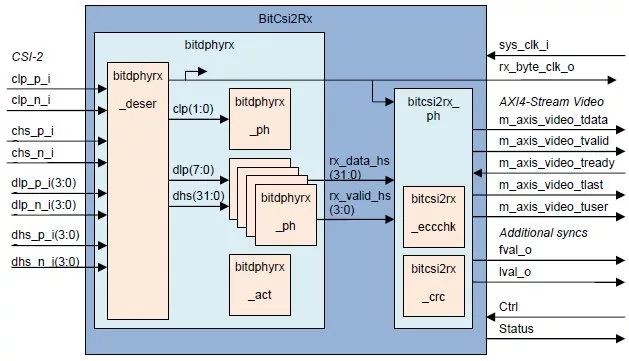
Overview
The BitCsi2Rx IP is a receiver for camera sensor signals, to be used in an FPGA or ASIC.
It receives camera signals in accordance with the MIPI CSI-2 and D-PHY specifications. BitCsi2Rx converts these signals to parallel video signals for AXI4- Stream Video standard. To make it easier to interface BitCsi2Rx with various other design blocks, it also outputs fval (frame valid) and lval (line valid) signals for synchronization.
Third generation of the IP, so it very compact, from only 500 LUTs/FFs, including the D-PHY.
A MIPI CSI-2 transmitter IP is also available from BitSim, BitCsi2Tx.
It has been used with SoCs like: i.MX8-series (NXP), OMAP (TI), MPSoC (Xilinx), Snapdragon (Qualcomm) and Xavier (Nvidia).
Learn more about MIPI IP core
Prevas has signed an agreement for the acquisition of 100 percent of BitSim NOW AB. BitSim NOW, with its 35 employees, is a consulting firm in Stockholm that focuses on product development.
The embedded system developers BitSim and NOW Electronics, with offices in Stockholm and Växjö, will merge their operation to form BitSim NOW with 40 employees and 15 sub-contractors.
At BitSim, we have a way to simplify and speed up the development cycle. In this document, we will discuss the issue of network load in an IoT environment as well as "our" way to speed up the development.
To simplify the development of your own customized camera without starting from scratch, BitSim has released embedded camera blocks which contains the signal chain from camera sensor interface via MJPEG video coding to the Ethernet interface in an FPGA. An RTP Video stream over Ethernet is generated that can be displayed on, for example, a media player such as VLC.
Flir Systems is using BitSim's FPGA-IP, Bit-MIPI CSI-2 in their newly launched advanced thermal cameras.
Lewel Group and BitSim starts cooperation where Lewel Group takes over BitSim employees.