
High Speed Data Recorder
A new IP Core from ASICS World Services, provides a complete high speed data recorder, in one easy to use block.
A ‘Dual-Role’ USB 2.0 On-The-Go IP Core that operates as both an USB 2.0 peripheral or as an USB 2.0 OTG host in a point-to-point…
A ‘Dual-Role’ USB 2.0 On-The-Go IP Core that operates as both an USB 2.0 peripheral or as an USB 2.0 OTG host in a point-to-point communications with another USB device.
The USB OTG IP Core is fully USB 2.0 and USB 2.0 On-The-Go Supplement compliant.
An USB OTG IP Core is ideal for applications where the target device must act as a peripheral and as a host, depending the situation. It provides portable devices with a cost-effective way of conducting point-to-point communications using the USB bus.
A good example is a PDA which has to be a peripheral that can sync with a host PC, but can also be a host when a peripheral, such as a keyboard or a camera, is connected to it.
ARCHITECTURE
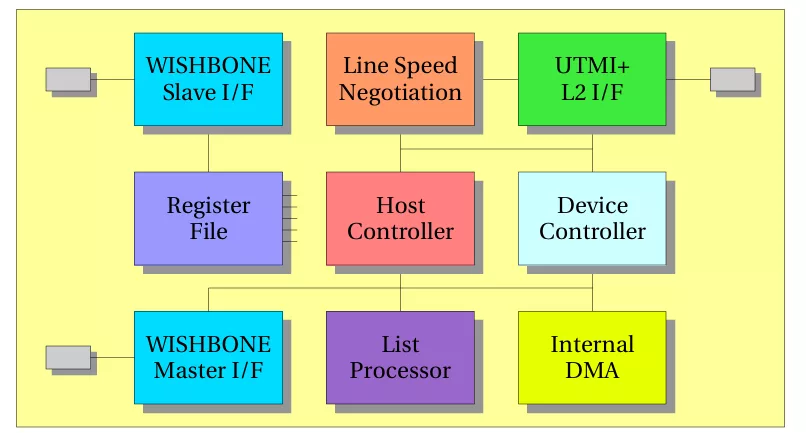
The USB 2.0 OTG IP Core supports Low Speed, Full Speed and High Speed operations. It will automatically perform the required negotiation to determine if it's counter part supports High Speed and fall back to Full Speed operation if it does not. The speed negotiation is supported in device and host modes.
UTMI+ L2 PHY Interface
The USB 2.0 OTG IP Core features an industry standard UTMI+ L2 interface. Any of-the-shelf UTMI+ L2 compliant PHY or PHY IP can be used with this IP Core.
ARCHITECTURE
The USB 2.0 OTG IP Core supports Low Speed, Full Speed and High Speed operations. It will automatically perform the required negotiation to determine if it's counter part supports High Speed and fall back to Full Speed operation if it does not. The speed negotiation is supported in device and host modes.
UTMI+ L2 PHY Interface
The USB 2.0 OTG IP Core features an industry standard UTMI+ L2 interface. Any of-the-shelf UTMI+ L2 compliant PHY or PHY IP can be used with this IP Core.
MCU Interfaces
The USB 2.0 OTG IP Core features two WISHBONE interfaces, which can be easily adapted to AMBA AHB bus interface with our WISHBONE/AMBA bridge.
The Slave Interface is used to access all core internal registers.
The Master Interface allows the USB 2.0 OTG IP Core to share the system memory for buffering data. It is also used to store Transfer Descriptors when operating in Host Mode.
Buffer Memory
The USB 2.0 OTG IP Core does not need dedicated buffer memory. It's WISHONE Master Interface and the internal DMA engine allow it to share the SoC's main memory for its buffers. Optionally we can also provide a WISHBONE bridge to attach standard dedicated SRAM.
The Host Controller block is active when the USB OTG IP core operates in a OTG host mode. In this mode it can control USB peripherals that are attached to it. It provides full support for session request and host negotiation protocols.
Note: some files may require an NDA depending on provider policy.
USB 2.0 On-The-Go IP Core, Compliance Certified is a USB IP core from ASICS World Services, LTD. listed on Semi IP Hub.
Engineers should review the overview, key features, supported foundries and nodes, maturity, deliverables, and provider information before shortlisting this USB IP.
Yes. Buyers can compare this product with similar semiconductor IP cores or IP families based on category, provider, process options, and structured technical specifications.