Overview
Small is beautiful...
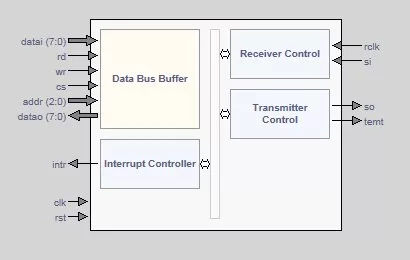
The DuART is one of the tiniest UART IP Cores available on the market.The DuART is a soft core of a Universal Asynchronous Receiver/Transmitter (UART). It performs serial-to-parallel conversion on data characters received from a peripheral device or a MODEM, and parallel-to-serial conversion on data characters received from the CPU. The CPU can read the complete status of the UART at any time during the functional operation. Reported status information includes the type and condition of the transfer operations performed by the UART, as well as any error conditions (overrun, framing). The DuART includes a programmable baud rate generator capable of dividing timing reference clock input by divisors of 1 to (216-1), and producing 16 × clock for driving internal transmitter logic. Provisions are also included to use this 16 × clock to drive receiver logic. The DuART has a processor-interrupt system. Interrupts can be programmed to user's requirements, minimizing computing required to handle the communications link.
The core is perfect for applications where the UART Core and microcontroller are clocked by the same clock signal and are implemented inside the same ASIC or FPGA chip, as well as for a standalone implementation, where several UARTs are required to be implemented inside a single chip and driven by some off-chip devices.
Learn more about UART IP core
DESPI eSPI Controller IP Core and DESPI eSPI IP Core Target deliver a complete, high-speed eSPI interface solution for FPGA and ASIC designs.
DCD-SEMI introduces a new CryptOne extension supporting EdDSA25519 signatures and X25519 key exchange, delivering high security, low latency, and efficient hardware implementation for modern SoC and FPGA designs.
DCD-SEMI, a provider of silicon-proven IP solutions, announces the availability of the DI3CM-HCI, an advanced MIPI I3C Host Controller Interface (HCI) IP Core designed to modernize peripheral connectivity in embedded, IoT, consumer, and industrial systems.
DAES IP Core is a high-performance solution that accelerates AES encryption and decryption for modern secure systems. Supporting 128- and 256-bit keys across multiple modes—including ECB, CBC, CFB, OFB, and CTR—DAES delivers ultra-fast throughput and easy integration.
DCD-SEMI today announced that its complete automotive IP Cores family — including Classical CAN, CAN FD, CAN XL but also LIN, PSI5 and SENT —is now available as Safety Element out of Context for ISO 26262 functional safety up to ASIL-D, the highest Automotive Safety Integrity Level.
Joining MIPI Alliance marks a significant step in DCD-SEMI’s commitment to delivering industry-compliant, high-performance IP cores to its global customers. As part of this initiative, DCD-SEMI will showcase its latest I3C IP core during the upcoming MIPI Plugfest, held in Warsaw on June 23-24, 2025.