Overview
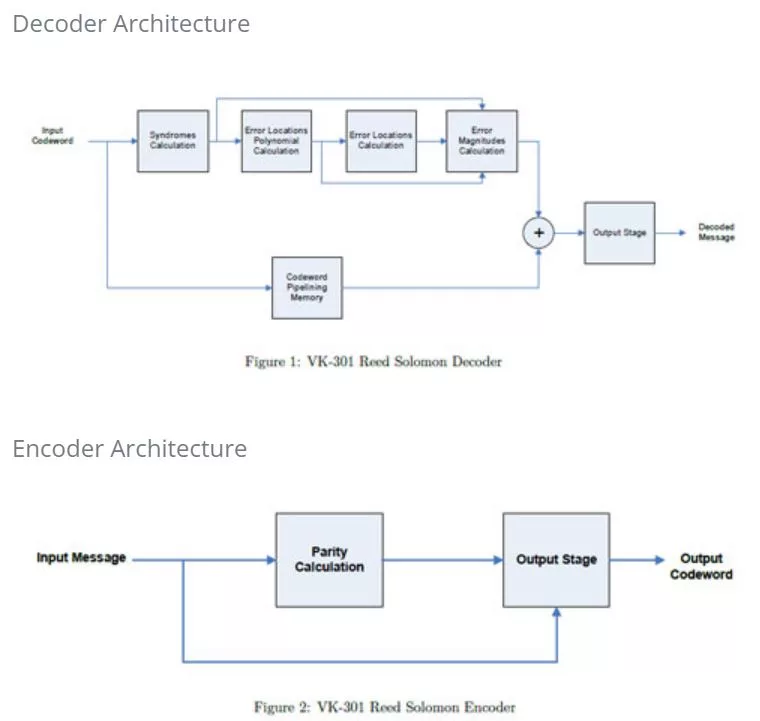
The Reed Solomon Encoder is fed with an input message of K information symbols, the Encoder appends 2T parity symbols to the input message in order to form the encoded codeword.
The Reed Solomon Decoder receives an (N=K+2T) codeword, and it can locate and correct up to 8 possible symbol errors or up to 14 erasures.
Both the Encoder and the Decoder support any input timing pattern, in the case of the Encoder; the output timing pattern will be the same as the input. In the case of the Decoder; the output timing pattern is fully controlled in order to support any desired pattern by the user.
The Reed Solomon Decoder keeps track of corrected errors. Input codewords with more than 8 errors are regarded as uncorrectable and are flagged.
The Implementation of VK-301 Reed Solomon IP Core targets very low latency, high speed, and low gate count with a simple interface for easy integration on SoC applications.
Learn more about Channel Coding IP core
T2M-IP, the global leader in semiconductor IP cores and technology expertise, is proud to announce the immediate availability of its partner's VESA-compliant DisplayPort v1.4 Rx PHY and Controller IP Cores.
T2M announces the availability of its partner’s Bluetooth V6.0 RF Transceiver IP Core in 22nm ULL and 40nm ULP.
Incorporating BroadR-Reach™ technology for Automotive Excellence, this PHY delivers exceptional performance for automotive and industrial applications, providing a superior alternative to traditional BaseT1 solutions.
Designed to meet the evolving needs of next-generation automotive and industrial applications, the CAN XL Controller IP offers superior performance and flexibility while maintaining backward compatibility with previous CAN standards.
T2MIP, a leading provider of semiconductor IP cores, proudly announces the immediate availability of their partner's H.264 and H.265 HEVC Codec IP cores.
T2M-IP is excited to announce that its state-of-the-art USB 3.0 IP, developed in the 22nm ULP (Ultra Low Power) and ULL (Ultra Low Leakage) process technologies, has been successfully licensed to over 10 customers worldwide in the past two years.