Beyond the CPU and GPU: SiFive in Datacenter Infrastructure
How embedded RISC-V processors in NICs, retimers, optics, switches, and security chips are overcoming modern scaling limits
SiFive Shield is a comprehensive portfolio of hardware security technologies designed for RISC-V processors and SoCs.
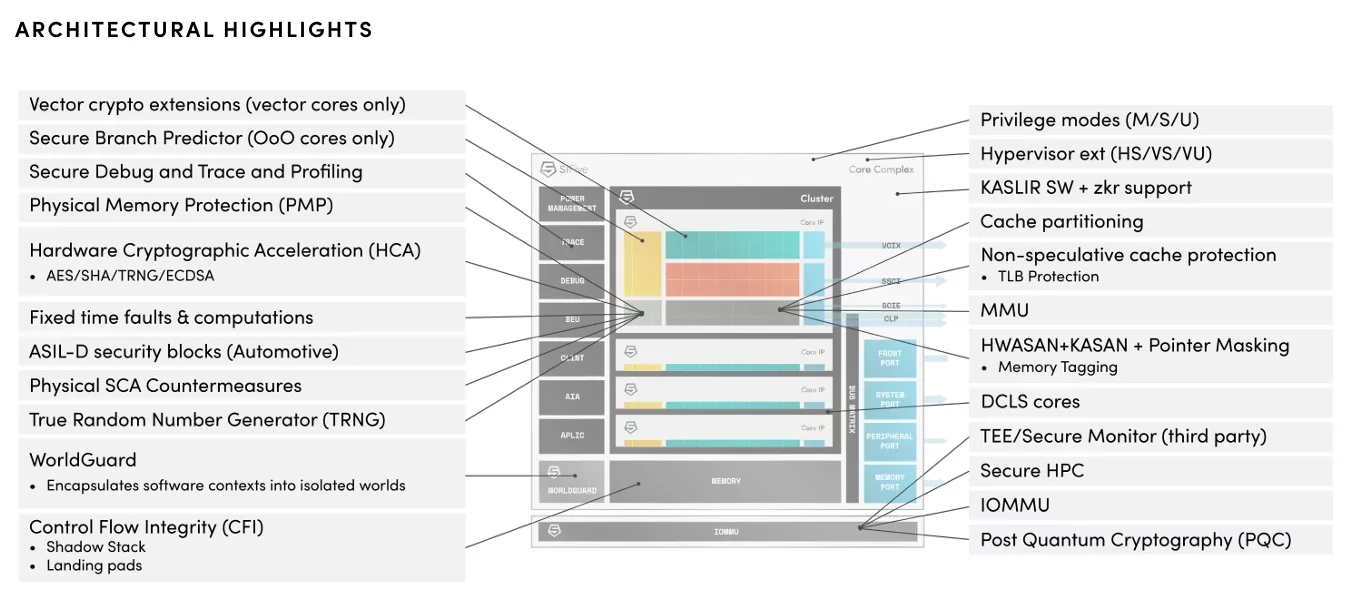
SiFive Shield is a comprehensive portfolio of hardware security technologies designed for RISC-V processors and SoCs. Combining the RISC-V open standard with proprietary innovations, Shield delivers essential capabilities across memory protection, isolation, advanced cryptography, and secure debug. This scalable portfolio establishes the foundation for scalable and extensive security in embedded, automotive, and datacenter platforms.
Challenge
Modern SoCs face escalating threats, from memory corruption to complex DMA attacks and microarchitectural vulnerabilities. Highly virtualized systems require robust hardware isolation and secure memory management that protect data without bottlenecking overall system performance.
Solution
SiFive Shield unites complementary defenses into a single, cohesive architecture. The portfolio includes privilege-based isolation, Physical Memory Protection (PMP, ePMP, SPMP), WorldGuard, and IOMMU support. It also integrates cryptography, Control Flow Integrity, and secure microarchitectural enhancements for comprehensive hardware enforced protection.
Impact
This unified portfolio simplifies the development of secure RISC-V systems. You can accelerate time-to-market, enforce strict logical isolation, and build resilient products that meet stringent security standards while maintaining the flexibility of open standard compute.
The SiFive Shield platform provides a comprehensive, pre-validated security architecture designed to harden high performance processor IP against sophisticated physical and logical threats. Instead of relying on fragmented, bolt on security patches, Shield unifies defensive microarchitecture extensions with turnkey cryptographic accelerators and a robust root of trust. This cohesive approach coordinates defenses across every layer of the compute environment, effectively eliminating single points of failure. For system architects, this delivers scalable security compliance while significantly accelerating overall time to market.
Note: some files may require an NDA depending on provider policy.

Open And Secure Distributed Security Architecture is a Root Of Trust IP core from Sifive, Inc. listed on Semi IP Hub.
Engineers should review the overview, key features, supported foundries and nodes, maturity, deliverables, and provider information before shortlisting this Root Of Trust IP.
Yes. Buyers can compare this product with similar semiconductor IP cores or IP families based on category, provider, process options, and structured technical specifications.