Vendor: Lattice Semiconductor Corp. Category: MIPI

One Input to Two Output MIPI DSI Display Splitter Bridge

Many new applications such as virtual reality, augmented reality, and digital cameras require expansion of the number of display …

Overview

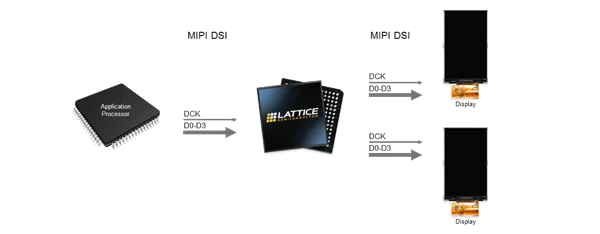
Many new applications such as virtual reality, augmented reality, and digital cameras require expansion of the number of display interfaces on applications processors. This often occurs when there is either not enough ports or some ports are used for other purposes on the application processor. Common examples are splitting one MIPI DSI port to two MIPI DSI ports and driving two displays. Another example is driving a high resolution display with two DSI ports with a single higher speed MIPI DSI interface.

Lattice CrossLink is a programmable video interface bridging device capable of providing multiple MIPI DSI interfaces at up to 6 Gbps per PHY. This bridge is available as free IP is available in Lattice Diamond for allowing easy configuration and setup.

Key features

  • Supports MIPI DSI up to 6 Gbps per MIPI D-PHY
    • 1, 2 or 4 Data Lanes
  • Provides one or two MIPI DSI outputs
    • MIPI DSI data replicated to each output port
  • Supports all MIPI DSI data types
    • RGB, YCbCr, User Defined
  • Provides a DCS (Display Command Set) controller to program the display, ROM data used only for DSI in HS or LPDT mode – ROM is programmable by user
  • Compliance with MIPI D-PHY Specification v1.1
  • Compliance with DSI Specification v1.1

Block Diagram

Specifications

Identity

Part Number
1Inputto2OutputMIPIDSIDisplaySplitterBridge
Vendor
Lattice Semiconductor Corp.
Type
Silicon IP

Files

Note: some files may require an NDA depending on provider policy.

Provider

Learn more about MIPI IP core

M31 High-Speed and Long-Channel MIPI C/D-PHY Solution on TSMC N3P/N3C

With the rapid growth of AR/VR and high-resolution imaging systems such as drones and action cameras, MIPI CSI (Camera Serial Interface) and MIPI DSI (Display Serial Interface) require both high data throughput and low power consumption. M31 provides a MIPI C-PHY and D-PHY IP combo solution implemented on TSMC N3P and N3C processes.

MIPI CCI over I3C: Faster Camera Control for SoC Architects

Imagine a camera subsystem that responds in microseconds, consumes less power, and offers a more straightforward route to time-to-market. For SoC architects and IP integration teams, that vision is increasingly possible with MIPI Camera Control Interface (CCI) over I3C.

MIPI MPHY 6.0: Enabling Next-Generation UFS Performance

High-speed chip-to-chip data transfer is continuously evolving to meet increasing performance demands. MIPI MPHY is a high-speed physical layer interface developed by the MIPI Alliance. This protocol is used for high-speed chip-to-chip interfaces, mainly in mobile and automotive devices.

MIPI: Powering the Future of Connected Devices

From the first monochrome mobile displays to today’s ultra-high-definition automotive dashboards and immersive AR/VR headsets, MIPI technology has quietly become the backbone of modern data connectivity. Let’s explore how MIPI standards have evolved, the markets they serve, and why Rambus is at the forefront of this transformation.

Frequently asked questions about MIPI IP cores

What is One Input to Two Output MIPI DSI Display Splitter Bridge?

One Input to Two Output MIPI DSI Display Splitter Bridge is a MIPI IP core from Lattice Semiconductor Corp. listed on Semi IP Hub.

How should engineers evaluate this MIPI?

Engineers should review the overview, key features, supported foundries and nodes, maturity, deliverables, and provider information before shortlisting this MIPI IP.

Can this semiconductor IP be compared with similar products?

Yes. Buyers can compare this product with similar semiconductor IP cores or IP families based on category, provider, process options, and structured technical specifications.

×
Semiconductor IP