Learn more about MIPI IP core
The imbalance between I/O speed and internal logic speed in integrated circuits has shifted in recent years in favor of the I/O. While in the past, the performance of integrated circuits was often limited by the I/O rate, today, in both ASICs and FPGAs, internal logic struggles to keep up with the I/O performance.
In this article, we show how fast video streams conforming to MIPI CSI2 rev2.0 over MIPI DPHY rev1.2 can be generated, using VLSI Plus’ SVTPlus-CSI2-F IP core, with simple off-FPGA analog front-end. The high bit rates can be achieved with a relatively slow FPGA clock frequency, trading off FPGA resources for simple timing closure.
VLSI Plus today announced the availability of the CSI2-MUX-A1-F – a MIPI® CSI2 transceiver, connecting to up to 4 CSI2 camera inputs, and outputting a multiplexed CSI2 stream with 4 data lanes, at up to 1.5Gbps per lane.
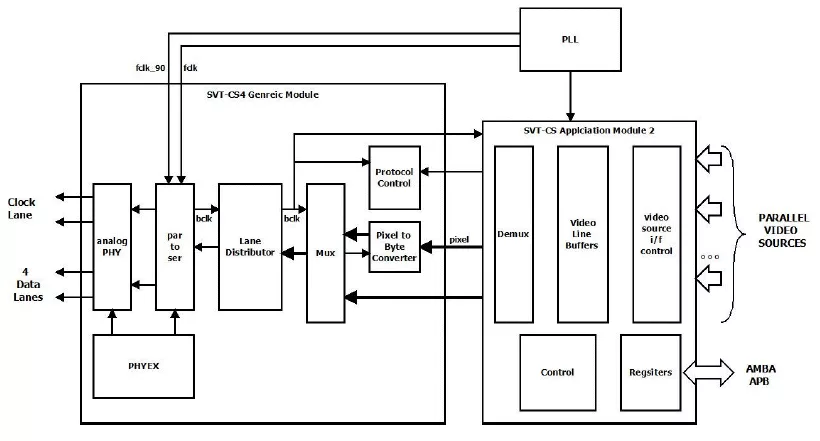
VLSI Plus today announced at the MWC conference the availability of the SVT-CS4-AP2 – a MIPI® CSI2 compliant serial video transmitter, supporting multiple concurrent video sources, and employing from 1 to 4 DPHY lanes at up to 1.5Gbps per lane.
VLSI Plus today announced the availability of Alias-DT option, which enables outputting multiple pixels per clock, in all its MIPI® CSI2 Receiver IP cores (the SVR family).
VLSI Plus today announced the availability of the SVRPlus-CSI2-F a 64 bit serial video receiver, supporting MIPI® CSI2 and extensions to CSI2 with up to 8 data lanes and two clock lanes, and outputting 1, 2 or 4 pixels per clock.