
What is Multi-format Video Deinterlacer?
Multi-format Video Deinterlacer is a Video Processing IP core from Zipcores Electronic Systems Engineering S.L. listed on Semi IP Hub.
The DEINTERLACER IP Core is a high quality 24-bit RGB video deinterlacer capable of generating progressive output video at up to …
The DEINTERLACER IP Core is a high quality 24-bit RGB video deinterlacer capable of generating progressive output video at up to 4096x4096 pixels in resolution. The design is fully customizable, supporting any desired interlaced video format.
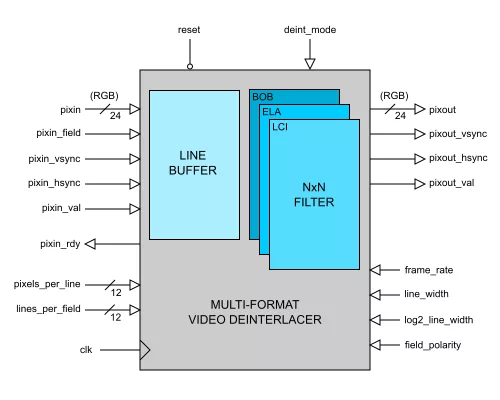
The deinterlacer allows for three possible filter algorithms - either BOB, ELA or LCI. All three methods are 'intra-field' methods that perform spatial filtering within the same field. For this reason, the output video is not subject to combing or tearing which is characteristic of a traditional 'weave' approach.
Each algorithm has it relative merits in terms of image quality and hardware complexity. In particular, the enhanced LCI algorithm provides excellent all-round performance with reduced image softening and crisp clean edges.
Pixels flow into the module in accordance with the valid-ready pipeline protocol. The pixel, sync flags and field number are transferred into the deinterlacer on a rising clock-edge when pixin_val and pixin_rdy are both active high. At the output interface, pixels and syncs are valid on a rising clock-edge when pixout_val is high.
Input lines are buffered and organised spatially before being filtered according to the chosen algorithm. Each input field is converted to a single output frame with twice the number of lines per field.
Note: some files may require an NDA depending on provider policy.
Multi-format Video Deinterlacer is a Video Processing IP core from Zipcores Electronic Systems Engineering S.L. listed on Semi IP Hub.
Engineers should review the overview, key features, supported foundries and nodes, maturity, deliverables, and provider information before shortlisting this Video Processing IP.
Yes. Buyers can compare this product with similar semiconductor IP cores or IP families based on category, provider, process options, and structured technical specifications.