
What is Motion-adaptive Video Deinterlacer IP Core?
Motion-adaptive Video Deinterlacer IP Core is a Video Processing IP core from Zipcores Electronic Systems Engineering S.L. listed on Semi IP Hub.
The DEINTERLACER_MA IP Core is a studio quality 24-bit RGB video deinterlacer capable of generating progressive output video at a…
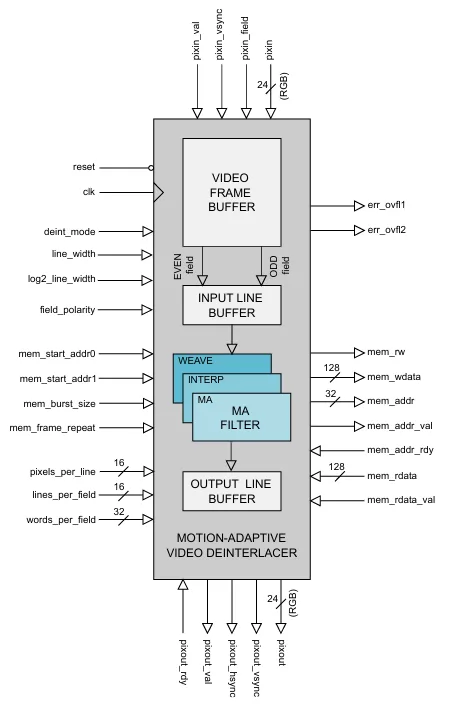
The DEINTERLACER_MA IP Core is a studio quality 24-bit RGB video deinterlacer capable of generating progressive output video at any resolution up to 216 x 216 pixels. The design is fully programmable and supports any desired interlaced video format.
The design allows for three possible deinterlacing schemes. These are: weave, bilinear interpolation or motion-adaptive interpolation. The weave approach applies no filtering and may be useful to obtain a 'raw' interlaced format for subsequent processing. The other two methods are classed as 'inter-field' interpolation methods as spatial filtering is performed between both odd and even fields to achieve a clean and progressive output. The relative merits and disadvantages of each scheme are discussed further into the document.
The deinterlacer core features a fully integrated video frame buffer. This buffer is completely 'elastic' and will dynamically skip and/or repeat frames depending on the input and output frame rates. All frame buffer management is handled internally with the provision of a simple memory interface for storing odd and even fields off-chip. The memory interface is 128-bits wide and is completely generic. All memory transfers are sequential bursts of N x 128-bit words and may be adapted for connection to a variety of memory types such as SDRAM, DDR2 or DDR3.
The input video interface is synchronous to the system clock. Input pixels are sampled on the rising clock-edge of clk with the signals pixin_field and pixin_vsync identifying the field number and the first pixel of each field. All signals are qualified by pixin_val asserted high. The input video interface is non-stallable.
Output pixels are also synchronous with the system clock and are generated in accordance with a simple valid-ready streaming protocol. The output pixels and sync flags are transferred at the deinterlacer outputs on a rising clock-edge when pixout_val and pixout_rdy are both active high. If required, the application circuit may assert pixout_rdy low to stall the flow of output pixels.
Note: some files may require an NDA depending on provider policy.
Motion-adaptive Video Deinterlacer IP Core is a Video Processing IP core from Zipcores Electronic Systems Engineering S.L. listed on Semi IP Hub.
Engineers should review the overview, key features, supported foundries and nodes, maturity, deliverables, and provider information before shortlisting this Video Processing IP.
Yes. Buyers can compare this product with similar semiconductor IP cores or IP families based on category, provider, process options, and structured technical specifications.