Arasan to demonstrate the industry's first MIPI SWI3S™ IP at the MIPI Member meet in Taipei
Arasan provides a Total SWI3S™ IP Solution including the SWI3S™ PHY which will be available on multiple foundry nodes 22nm and below.
MIPI M-PHY Specification Version 4.1 is a low pin count, power efficient, inter-chip serial interface with high bandwidth capabil…
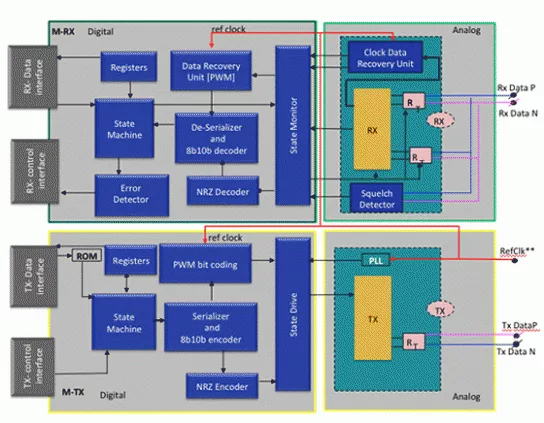
MIPI M-PHY Specification Version 4.1 is a low pin count, power efficient, inter-chip serial interface with high bandwidth capabilities. A M-PHY configuration (LINK) consists of a minimum of two unidirectional lanes along with associated lane management logic. Each of the M-PHY lanes consists of a lane module (M-TX) that communicates to a corresponding module (M-RX) on the other chip via a serial interconnect that consists of two differential lines. The differential lines can carry both High-Speed (HS) and Low-Speed (LS) signals.
The M-PHY is of Type 1, which apply to UFS, LLI, and CSI-3 protocols. The Multi-gear M-PHY 4.1 consists of analog transceivers, high-speed PLL, data recovery units as well as state-machine control — all in a single GDSII. The interface to the link protocol-specific controller (host or device) is compliant with the M-PHY RMMI specification, which allows seamless integration of the two IPs, namely the controller and the PHY, into the chip design.
The vendor follows a rigorous practice of co-verifying the controllers and their corresponding PHY’s to ensure that they operate together as intended. These, together with the vendor's software stacks, are mapped onto Arasan’s Hardware Validation Platforms, which are used for early compatibility and interoperability testing with the corresponding host/device platforms from the vendor and a number of MIPI contributor members. This minimizes end-to-end compatibility risk for customers.
Note: some files may require an NDA depending on provider policy.

MIPI M-PHY® 4.1 Analog Transceiver is a Multi-Protocol PHY IP core from Arasan Chip Systems Inc. listed on Semi IP Hub.
Engineers should review the overview, key features, supported foundries and nodes, maturity, deliverables, and provider information before shortlisting this Multi-Protocol PHY IP.
Yes. Buyers can compare this product with similar semiconductor IP cores or IP families based on category, provider, process options, and structured technical specifications.