Vendor: Arasan Chip Systems Inc. Category: Multi-Protocol PHY

MIPI M-PHY® 3.1 Analog Transceiver

MIPI M-PHY Specification Version 3.1 is a low pin count, power efficient, inter-chip serial interface with high bandwidth capabil…

Overview

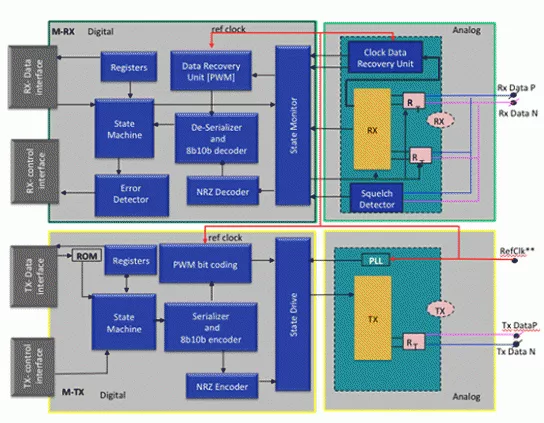
MIPI M-PHY Specification Version 3.1 is a low pin count, power efficient, inter-chip serial interface with high bandwidth capabilities. A M-PHY configuration (LINK) consists of a minimum of two unidirectional lanes along with associated lane management logic. Each of the M-PHY lanes consists of a lane module (M-TX) that communicates to a corresponding module (M-RX) on the other chip via a serial interconnect that consists of two differential lines. The differential lines can carry both High-Speed (HS) and Low-Speed (LS) signals.

The M-PHYs are of Type 1, which apply to UFS, LLI and CSI-3 protocols. The Multi-gear M-PHY 3.0 consists of analog transceivers, high speed PLL, data recovery units as well as the state-machine control — all in a single GDSII. The interface to the link protocol-specific controller (host or device) is compliant to the M-PHY RMMI specification, which allows seamless integration of the two IPs, namely the controller and the PHY, into the chip design.


Arasan follows a rigorous practice of co-verifying the controllers and their corresponding PHY’s to ensure that they operate together as intended. These, together with Arasan’s software stacks, are mapped onto Arasan’s Hardware Validation Platforms, which are used for early compatibility and interoperability testing with the corresponding host/device platforms from Arasan and a number of MIPI contributor members. This minimizes end-to-end compatibility risk for customers.
Key features

  • Compliant to MIPI Alliance Standard for M-PHY specification Version 3.1
  • Supports high speed data transfer G1A/B, G2A/B and G3A/B with data rates of up to 5830.4 Mbps
  • Supports M-PHY Type-I system
  • Support for reference clock frequencies of 19.2MHz/26MHz/38.4MHz/52MHz
  • Support for Clock and Data Recovery Options
  • Supports low speed transfer G0-G7 with a bit rate of up to 576 Mbps
  • PWM signalling for Low speed [LS] data
  • Supports error detection mechanism for sequence errors and contentions
  • Data lanes support transfer of data in high speed mode
  • Supports LS burst, HS burst, STALL, SLEEP, HIBERN8 states
  • Supports squelch detection
  • Has clock divider unit to generate clock for parallel data reception and transmission from and to the PIF (RMMI)
  • Activates and disconnects high speed terminators for reception and transmission
  • Supports standard PHY transceiver compliant to MIPI Specification
  • Supports standard PIF (RMMI) interface compliant to MIPI Specification.
  • On-chip clock generation configurable for either transmitter or a receiver
  • Testability for Tx, Rx and PLL

Block Diagram

Benefits

  • Compliant with M-PHY and the relevant protocols standards
  • Seamless interface to Arasan’s host and device controllers for those standards
  • Configurable number of lanes
  • Area and power efficient

What’s Included?

  • User Guide and Integration Guides
  • GDS-II
  • CDL Netlist for LVS
  • LVS reports
  • DRC and Antenna reports
  • LIB files
  • LEF
  • Scan-inserted Netlist for DFT
  • Verification Environment with behavioral models

Specifications

Identity

Part Number
MIPI M-PHY® 3.1 Analog Transceiver
Vendor
Arasan Chip Systems Inc.
Type
Silicon IP

Files

Note: some files may require an NDA depending on provider policy.

Provider

Learn more about Multi-Protocol PHY IP core

How a 16Gbps Multi-link, Multi-protocol SerDes PHY Can Transform Datacenter Connectivity

Increasingly, more of the focus on mobile has centered around cloud datacenters and the networking to get the data back and forth between these datacenters and the mobile device. Functions like voice recognition and mapping depend on the ability to split the functionality between the smartphone, for local processing like encryption and compression, and the back end, where a large number of servers can do the heavier lifting before returning the results.

One PHY, Zero Tradeoffs: Multi-Protocol PHY for Edge AI Interface Consolidation

The Cadence 10G multi-protocol PHY was architected to address this exact challenge. Designed to scale across multiple process nodes, it consolidates PCI Express (PCIe), USB, DisplayPort, Ethernet, and other interfaces into a single, compact, silicon-efficient block. What sets it apart is simultaneous multi-protocol support, which enables multiple data paths without duplicating hardware, requiring extra board connectors, or paying the area and power penalty of separate IP blocks.

Frequently asked questions about Multi-Protocol PHY IP cores

What is MIPI M-PHY® 3.1 Analog Transceiver?

MIPI M-PHY® 3.1 Analog Transceiver is a Multi-Protocol PHY IP core from Arasan Chip Systems Inc. listed on Semi IP Hub.

How should engineers evaluate this Multi-Protocol PHY?

Engineers should review the overview, key features, supported foundries and nodes, maturity, deliverables, and provider information before shortlisting this Multi-Protocol PHY IP.

Can this semiconductor IP be compared with similar products?

Yes. Buyers can compare this product with similar semiconductor IP cores or IP families based on category, provider, process options, and structured technical specifications.

×
Semiconductor IP