MIPI I3C Secondary Controller IP core
The MIPI I3C Controller IP is a optimized and technology agnostic implementation of the MIPI I3C v.1.1.1 standard targeting both …
Overview
The MIPI I3C Controller IP is a highly optimized and technology agnostic implementation of the MIPI I3C v.1.1.1 standard targeting both ASIC and FPGA technologies. The Chip Interfaces MIPI I3C IP is used to connect multiple Targets to one or more Controllers with Secondary controllers having the capability to take ownership of the bus. The IP can act as the Bus Controller or Secondary Controller with the inclusion of the Target Engine, it is also possible to set up as a simple Target or Composite Device with multiple Virtual Targets. The MIPI I3C IP from Chip Interfaces supports SDR and HDR transmission modes over a single or multiple lanes allowing it to reach transfer speeds of up to 100 Mbps. The Chip Interfaces MIPI I3C Controller IP is backward compatible with MIPI I3C versions 1.1 and 1.0, as well as with I2C. The Application data interface follows the TCRI v1.0 specification.
The Chip Interfaces MIPI I3C Controller IP core has been heavily tested in System Verilog random regression environment.
Secondary Controller Role
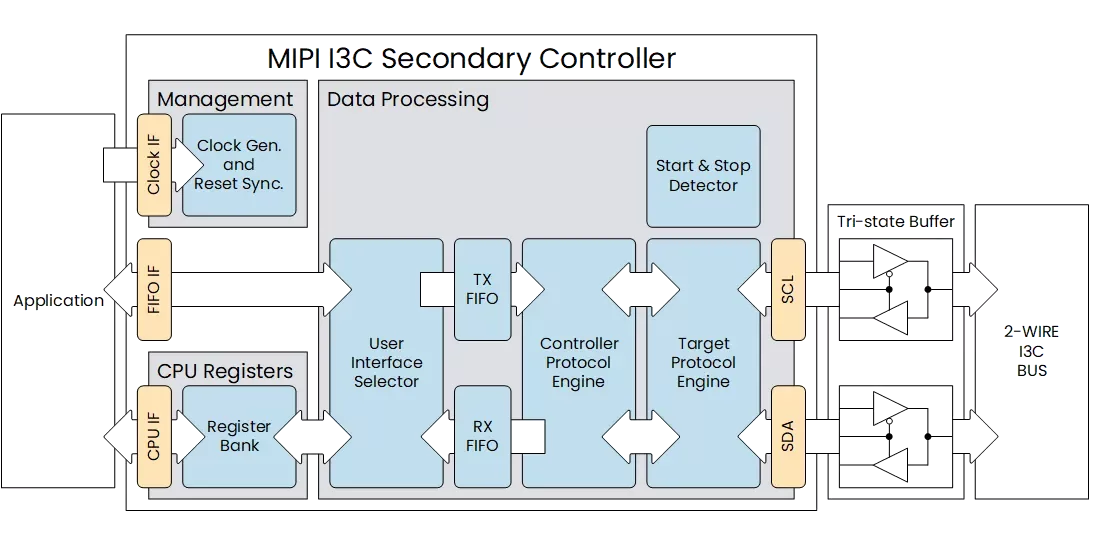
The MIPI I3C Controller IP core can perform the role of Secondary Controller, combining the functionality of Controller and Target. Initially acting as a target on the bus it can accept Controller role hand-off from the Primary controller assuming it’s new role as the bus controller.
Key features
- Delivering Performance
- Fully compliant with MIPI I3C v1.1.1 Specification
- TCRI v1.0 Compliant
- Supports Bus with Multiple Controllers
- Supports Hot Join mechanism
- Supports all I3C CCC common command codes
- Supports SDR, HDR-DDR, HDR-TSP/TSL, HDR-BT
- Supports Multi Lane operation (all formats)
- Supports Async Modes 0-3
- Supports Target Reset
- Supports Device to Device tunneling (D2DT)
- Supports Early Termination
- Supported Roles:
- Controller
- Secondary Controller
- Target
- Composite device with Virtual Targets
- Easy to use
- Solid documentation including an integration guide
- Easy to use RTL test environment
- No special software is required
- Strong engineering support for bring-up
Block Diagram
What’s Included?
- The IP Core can be delivered in Source code or Encrypted format.
- The following deliverables will be provided with the IP Core license:
- Solid documentation, including User Manual, Release Note and Quick Start Guide.
- Simulation Environment, including Simple Testbed, Test case, and Test Script.
- Basic RTL Test Bench
- Synthesis Scripts
- Timing Constraints in Synopsys SDC format.
- Access to support system and direct support from Chip Interfaces Engineers.
- Test Report, Synopsys SGDC Files and Synopsys Lint, CDC and Waivers available on request
Specifications
Identity
Files
Note: some files may require an NDA depending on provider policy.
Provider
Learn more about I2C / I3C IP core
Maximizing the Usability of Your Chip Development: Design with Flexibility for the Future
MIPI I3C v1.1 - A Conversation with Ken Foust
How to Connect Sensors with I3C
MIPI CCI over I3C: Faster Camera Control for SoC Architects
Arasan I3C PHY - Ternary vs. Non-Ternary
Frequently asked questions about I2C / I3C IP cores
What is MIPI I3C Secondary Controller IP core?
MIPI I3C Secondary Controller IP core is a I2C / I3C IP core from Chip Interfaces ApS listed on Semi IP Hub.
How should engineers evaluate this I2C / I3C?
Engineers should review the overview, key features, supported foundries and nodes, maturity, deliverables, and provider information before shortlisting this I2C / I3C IP.
Can this semiconductor IP be compared with similar products?
Yes. Buyers can compare this product with similar semiconductor IP cores or IP families based on category, provider, process options, and structured technical specifications.