Overview
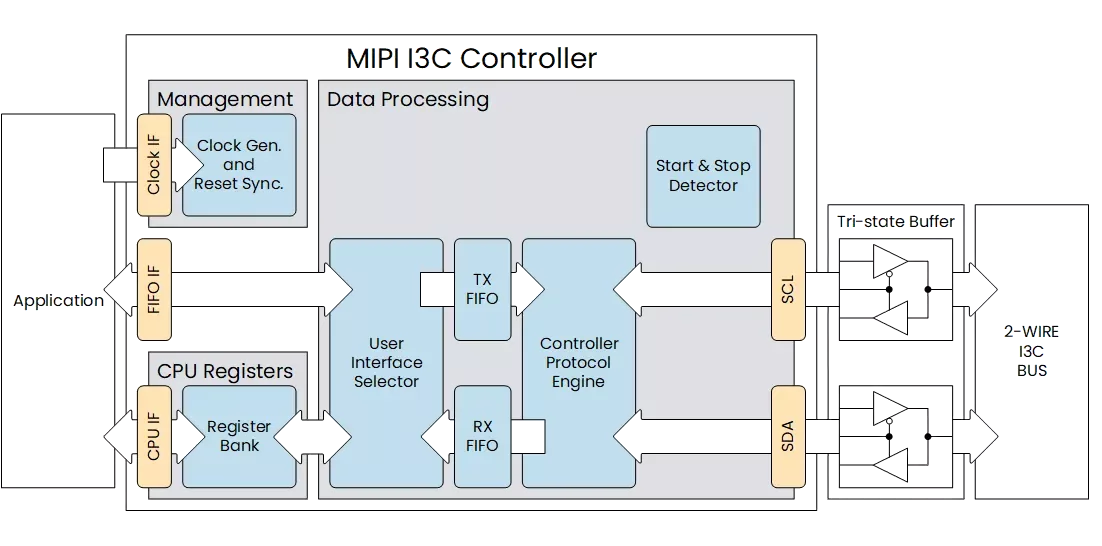
The MIPI I3C Controller IP is a highly optimized and technology agnostic implementation of the MIPI I3C v.1.1.1 standard targeting both ASIC and FPGA technologies. The Chip Interfaces MIPI I3C IP is used to connect multiple Targets to one or more Controllers with Secondary controllers having the capability to take ownership of the bus. The IP can act as the Bus Controller or Secondary Controller with the inclusion of the Target Engine, it is also possible to set up as a simple Target or Composite Device with multiple Virtual Targets. The MIPI I3C IP from Chip Interfaces supports SDR and HDR transmission modes over a single or multiple lanes allowing it to reach transfer speeds of up to 100 Mbps. The Chip Interfaces MIPI I3C Controller IP is backward compatible with MIPI I3C versions 1.1 and 1.0, as well as with I2C. The Application data interface follows the TCRI v1.0 specification.
The Chip Interfaces MIPI I3C Controller IP core has been heavily tested in System Verilog random regression environment.
Controller Role
The MIPI I3C Controller IP core is a highly optimized Silicon Agnostic implementation of the MIPI I3C protocol version 1.1.1 and MIPI TCRI v1.0. It is used to connect I3C and I2C target devices over a shared 2-wire bus, targeting both ASIC and FPGAs. It delivers all features of the standard and allows for the ability to configure included features.
The IP supports Multiple Controllers on the bus with proper Controller handoff procedures to Secondary Controllers as well as I2C and I3C target devices making it possible to build the most complex of systems.
Learn more about I2C / I3C IP core
Under the agreement, Avant Technology will distribute Chip Interfaces’ full interface IP portfolio across Taiwan and China, with local pre-sales and technical support available from its Hsinchu headquarters and its Shanghai office strengthening Chip Interfaces’ position across Data center, AI, Aerospace & Wireless.
Understand the role of the UCIe D2D Adapter in enabling reliable, scalable, multi-protocol die-to-die communication for chiplet architectures.
The JESD204 Transport Layer oversees converter data mapping onto a set of JESD204 Lanes. The nature of these lanes is dependent on the version of the JESD204 standard and a function of the PCS and over the years despite the Serdes technology changing with ever increasing line rates, the function and features of the Transport Layer remained the same
Ultra Accelerator Link (UA Link) standard has been specified to enable the creation of systems comprised of multiple nodes targeting AI applications.
This article will introduce the main concepts of the Digital Intermediate Frequency Interoperability (DIFI) standard including the new features introduced in version 1.3. With no assumptions of prior knowledge from the reader this should serve as an introduction to the standard but also for those familiar with DIFI raise awareness of the added features of link establishment in new standard version.
Bitstream alignment is a function of the Receiver (RX), as seen in the figure below it is the first functional block of the receiver right after the clock domain crossing (CDC) and gear boxing which are quite generic Serdes adaptation layer that can be found in almost every design working with a Serdes.