Vendor: SmartDV Technologies Category: MIPI

MIPI DSI-2 Receiver IIP

MIPI DSI-2 Receiver interface provides full support for the two-wire MIPI DSI-2 Receiver synchronous serial interface, compatible…

Overview

MIPI DSI-2 Receiver interface provides full support for the two-wire MIPI DSI-2 Receiver synchronous serial interface, compatible with MIPI DSI and MIPI DSI 2 Specification version 1.3. Through its MIPI DSI-2 Receiver compatibility, it provides a simple interface to a wide range of low-cost devices. MIPI DSI-2 Receiver IIP is proven in FPGA environment.The host interface of the MIPI DSI-2 Receiver can be simple interface or can be AMBA APB, AMBA AHB, AMBA AHB-Lite, AMBA AXI, AMBA AXI-Lite, VCI, OCP, Avalon, PLB, Tilelink, Wishbone or Custom protocol.

MIPI DSI-2 Receiver IIP is supported natively in Verilog and VHDL

Key features

  • Compliant with MIPI DSI-2 specification v1.3
  • Compliant with D - PHY Specification v1.1,v1.2,v2.0,v2.1
  • Compliant with C - PHY Specification v0.7,v1.2
  • Compliant with Display Pixel Interface (DPI -2) v 2.0
  • Compliant with Display Bus Interface (DBI) v 2.0
  • Compliant with Display Command Set (DCS) v 1.3
  • Supports full MIPI DSI-2 Receiver functionality supporting CPHY and DPHY
  • Supports Multi lane merging and also lanes can be configured up to 4 lanes for C - PHY and 4 lanes for D - PHY
  • Supports Data rate up to 4.5 Gbps per data lane of D – PHY. 18 Gbps in 4 Lanes
  • Supports Data rate up to 3 Gsps per trio using C – PHY. 17 Gbps in 3 Trios
  • Supports up to 4 Virtual channels
  • Supports PPI interface to connect to C - PHY / D – PHY
  • Supports all types of Short and Long packets
  • Supports all Virtual channel identifier
  • Supports both Video and Command modes
  • Supports Multiple packets per transmission
  • Supports Deskew mechanism
  • Supports 1-bit Error Correction and 2 bit Error Detection using ECC (6bit) for Packet header
  • Supports Error Detection techniques for active data using Checksum(16 bit)
  • Interrupt support for indicating internal status and error information
  • Supports Sync event payloads
  • Supports Burst, Non-Burst, Pulse and Event mode transfer over DPI Interface
  • Supports Generic read / write over DBI Interface
  • Supports display stream compression (DSC)
  • Supports all BTA (Bi directional Turn around) commands
  • Supports forward and reverse communication
  • Supports both High speed and Low power packet reception
  • Supports following formats
    • YCbCr Data type - YCbCr422-20bit loosely packed pixel stream, YCbCr422-24bit packed pixel stream, YCbCr422-16bit packed pixel stream,YCbcr420-12bit packed pixel stream
    • RGB Data type – RGB-30bit packed pixel stream, RGB565-16bit packed pixel stream, RGB666-18bit packed pixel stream, RGB888-24bit packed pixel stream, RGB666-18bit loosely packed pixel stream
  • Fully synthesizable
  • Static synchronous design
  • Positive edge clocking and no internal tri-states
  • Scan test ready
  • Simple interface allows easy connection to microprocessor/microcontroller devices

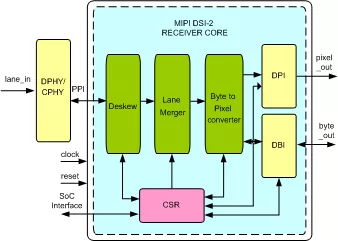
Block Diagram

Benefits

  • Single Site license option is provided to companies designing in a single site.
  • Multi Sites license option is provided to companies designing in multiple sites.
  • Single Design license allows implementation of the IP Core in a single FPGA bitstream and ASIC.
  • Unlimited Designs,license allows implementation of the IP Core in unlimited number of FPGA bitstreams and ASIC designs.

What’s Included?

  • The MIPI DSI-2 Receiver interface is available in Source and netlist products.
  • The Source product is delivered in verilog. If needed VHDL, SystemC code can also be provided.
  • Easy to use Verilog Test Environment with Verilog Testcases
  • Lint, CDC, Synthesis, Simulation Scripts with waiver files
  • IP-XACT RDL generated address map
  • Firmware code and Linux driver package
  • Documentation contains User's Guide and Release notes.

Specifications

Identity

Part Number
MIPI DSI-2 Receiver IIP
Vendor
SmartDV Technologies
Type
Silicon IP

Files

Note: some files may require an NDA depending on provider policy.

Provider

Learn more about MIPI IP core

M31 High-Speed and Long-Channel MIPI C/D-PHY Solution on TSMC N3P/N3C

With the rapid growth of AR/VR and high-resolution imaging systems such as drones and action cameras, MIPI CSI (Camera Serial Interface) and MIPI DSI (Display Serial Interface) require both high data throughput and low power consumption. M31 provides a MIPI C-PHY and D-PHY IP combo solution implemented on TSMC N3P and N3C processes.

MIPI CCI over I3C: Faster Camera Control for SoC Architects

Imagine a camera subsystem that responds in microseconds, consumes less power, and offers a more straightforward route to time-to-market. For SoC architects and IP integration teams, that vision is increasingly possible with MIPI Camera Control Interface (CCI) over I3C.

MIPI MPHY 6.0: Enabling Next-Generation UFS Performance

High-speed chip-to-chip data transfer is continuously evolving to meet increasing performance demands. MIPI MPHY is a high-speed physical layer interface developed by the MIPI Alliance. This protocol is used for high-speed chip-to-chip interfaces, mainly in mobile and automotive devices.

MIPI: Powering the Future of Connected Devices

From the first monochrome mobile displays to today’s ultra-high-definition automotive dashboards and immersive AR/VR headsets, MIPI technology has quietly become the backbone of modern data connectivity. Let’s explore how MIPI standards have evolved, the markets they serve, and why Rambus is at the forefront of this transformation.

Frequently asked questions about MIPI IP cores

What is MIPI DSI-2 Receiver IIP?

MIPI DSI-2 Receiver IIP is a MIPI IP core from SmartDV Technologies listed on Semi IP Hub.

How should engineers evaluate this MIPI?

Engineers should review the overview, key features, supported foundries and nodes, maturity, deliverables, and provider information before shortlisting this MIPI IP.

Can this semiconductor IP be compared with similar products?

Yes. Buyers can compare this product with similar semiconductor IP cores or IP families based on category, provider, process options, and structured technical specifications.

×
Semiconductor IP