Vendor: Mixel, Inc. Category: MIPI

MIPI C‑PHY/D‑PHY IP on TSMC N2P

The MXL_CSI2_RX_USL_CDPHY_ECM_T_2N2P is a high-frequency, low-power, low-cost, source-synchronous, physical Layer supporting the …

PHY MIPI CSI2 MIPI CSI-2 TSMC 2nm N2P Available on request View all specifications

Overview

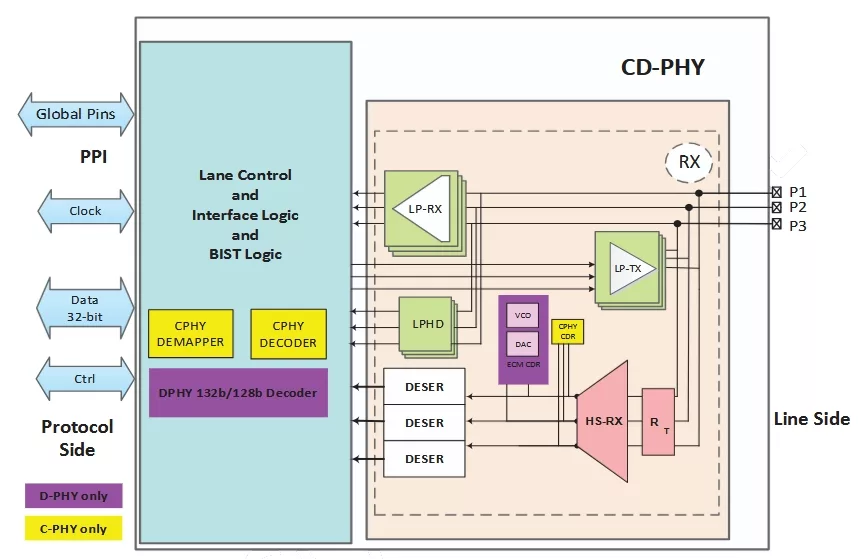
The MXL_CSI2_RX_USL_CDPHY_ECM_T_2N2P is a high-frequency, low-power, low-cost, source-synchronous, physical Layer supporting the MIPI Alliance Specification for D-PHY v3.6 and C-PHY v2.1. The PHY can be configured as MIPI Slave supporting camera interface CSI-2. The PHY supports mobile, IoT, virtual reality, and automotive applications.

Key features

  • Dual mode PHY Supports MIPI Alliance Specification D-PHY v3.6 & C-PHY v2.1
  • Consists of 1 Data lane in D-PHY ECM
  • Consists of 1 Data lane in C-PHY mode
  • Supports both low-power mode and high-speed mode
  • 750 Mbps to 3.00 Gbps data rate in high-speed D-PHY ECM mode
  • 80 Msps to 3.00 Gsps symbol rate per lane in high-speed C-PHY mode
  • Supports High Speed RX CTLE
  • 10 Mbps data rate in low-power mode
  • Low power dissipation
  • Testability support

Block Diagram

Silicon Options

Foundry Node Process Maturity
TSMC 2nm N2P Available on request

Specifications

Identity

Part Number
MXL_CSI2_RX_USL_CDPHY_ECM_T-N2P
Vendor
Mixel, Inc.
Type
Silicon IP
Controller / PHY
PHY

Standards & Interfaces

Video Standard
MIPI CSI2
MIPI Protocol
MIPI CSI-2

Files

Note: some files may require an NDA depending on provider policy.

Provider

HQ: USA

Learn more about MIPI IP core

MIPI deployment in ultra-low-power streaming sensors

This article focuses on low-power scenarios with streaming sensors connected to a processor via MIPI. After a short overview of low-duty cycle sensor principles, we explore how a streaming image sensor leverages those principles, show how one semiconductor company uses MIPI CSI-2® and D-PHY interfaces in their imaging solution, and touch on use cases for ultra-low-power streaming sensors deploying MIPI.

MIPI in next generation of AI IoT devices at the edge

One of the original benefits of processing in the cloud in was simply to expand beyond the limited capacity of on-site processing. With advancements in AI, more and more decisions can be made at the edge. It is now clear that edge and cloud processing are complementary technologies; they are both essential to achieve optimal system performance. Designers of connected systems must ask, what is the most efficient system partitioning between the cloud and edge?

MIPI Drives Performance for Next-Generation Displays

In this white paper, we will explore the history of MIPI display technology, (DSI and DSI-2), MIPI display markets, and the emerging bandwidth gap given the performance requirements of next- generation displays.

Demystifying MIPI C-PHY / DPHY Subsystem

The newest member of the MIPI® PHY family, the C-PHY, arrived in October 2014 to a mixture of excitement and apprehension. How would this new C-PHY compare to the MIPI D-PHY and M-PHY®? What would differentiate the C-PHY, and would it be compatible enough with the D-PHY so that both could coexist in a hybrid subsystem? Now, years later, the answers are clear.

Frequently asked questions about MIPI IP cores

What is MIPI C‑PHY/D‑PHY IP on TSMC N2P?

MIPI C‑PHY/D‑PHY IP on TSMC N2P is a MIPI IP core from Mixel, Inc. listed on Semi IP Hub. It is listed with support for tsmc Available on request.

How should engineers evaluate this MIPI?

Engineers should review the overview, key features, supported foundries and nodes, maturity, deliverables, and provider information before shortlisting this MIPI IP.

Can this semiconductor IP be compared with similar products?

Yes. Buyers can compare this product with similar semiconductor IP cores or IP families based on category, provider, process options, and structured technical specifications.

×
Semiconductor IP