Overview
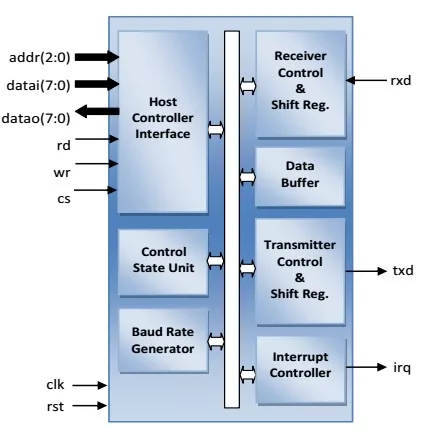
The LIN is a soft core of the Local Interconnect Network (LIN). This interface is a serial communication protocol, designed primarily to be used in automotive applications. Compared to CAN, LIN is slower, but thanks to its simplicity, is much more cost effective. Our Core is ideal for a communication in intelligent sensors and actuators, where the bandwidth and versatility of CAN is not required. The LIN core provides an interface between a microprocessor/microcontroller and a LIN bus. It can work as master or slave LIN node, depending on a work mode, determined by the microprocessor/microcontroller. Our controller supports transmission speed between 1 and 20kb/s, which allows it to transmit and receive LIN messages compatible to LIN 1.3. LIN 2.1 and the newest 2.2. The reported information status includes the type and condition of transfer operations being performed by the LIN, as well as a wide range of LIN error conditions (overrun, framing, parity, timeout). Our Core includes programmable timer, which allows to detect timeout and synchronization error. The LIN is described at RTL level, empowering the target use in FPGA and ASIC technologies.
Learn more about LIN IP core
T2M-IP, the global leader in semiconductor IP cores and technology expertise, is proud to announce the immediate availability of its partner's VESA-compliant DisplayPort v1.4 Rx PHY and Controller IP Cores.
T2M announces the availability of its partner’s Bluetooth V6.0 RF Transceiver IP Core in 22nm ULL and 40nm ULP.
Incorporating BroadR-Reach™ technology for Automotive Excellence, this PHY delivers exceptional performance for automotive and industrial applications, providing a superior alternative to traditional BaseT1 solutions.
Designed to meet the evolving needs of next-generation automotive and industrial applications, the CAN XL Controller IP offers superior performance and flexibility while maintaining backward compatibility with previous CAN standards.
T2MIP, a leading provider of semiconductor IP cores, proudly announces the immediate availability of their partner's H.264 and H.265 HEVC Codec IP cores.
T2M-IP is excited to announce that its state-of-the-art USB 3.0 IP, developed in the 22nm ULP (Ultra Low Power) and ULL (Ultra Low Leakage) process technologies, has been successfully licensed to over 10 customers worldwide in the past two years.