
Frame Rate Converter
TMC’s frame rate converter uses an original frame interpolation technology and creates highly accurate interpolation frames with compact circuit resources.
Overview
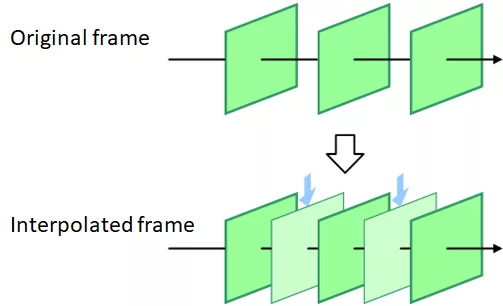
TMC’s frame rate converter uses an original frame interpolation technology and creates highly accurate interpolation frames with compact circuit resources. Smooth motion videos are achieved by inserting this interpolated frame between the original frames.
Specification
| Input/Output Format | YCbCr 4:2:0 |
| Conversion Rate | 2 Times |
| Frame Rate | 60fps/120fpsInput: 30/60 fpsOutput: 60/120 fps |
| Resolution | 2K or less |
| Input/Output Interface | YCbCr Raster Scan Format (Customizable) |
This IP supports both color spaces of YCbCr and YUV.
Key features
- Less disturbance interpolated images achieved by the “interpolated frame generation algorithm” optimized by DMNA
- External configuration parameters can be set to interpolation frame for getting desired image quality
- Compact design to be implemented in an inexpensive FPGA (Example: Cyclone IV series, Artix7 series)
- 120fps of high speed operation
Block Diagram
Specifications
Identity
Files
Note: some files may require an NDA depending on provider policy.
Provider
Learn more about Video Processing IP core
Configurable Processors for Video Processing SOCs
FPGA-based video surveillance comes of age
Picking the right MPSoC-based video architecture: Part 1
Video encoding with low-cost FPGAs for multi-channel H.264 surveillance
Analysis: ARC's Configurable Video Subsystems
Frequently asked questions about Video Processing IP
What is Frame Rate Converter?
Frame Rate Converter is a Video Processing IP core from Techno Mathematical Co., Ltd. listed on Semi IP Hub.
How should engineers evaluate this Video Processing?
Engineers should review the overview, key features, supported foundries and nodes, maturity, deliverables, and provider information before shortlisting this Video Processing IP.
Can this semiconductor IP be compared with similar products?
Yes. Buyers can compare this product with similar semiconductor IP cores or IP families based on category, provider, process options, and structured technical specifications.