FPGA Lock IP
The FPGA Lock is a small FPGA IP core that uses the $0.52 Microchip ATSHA204A hardened crypto authentication IC and one FPGA pin …
Overview
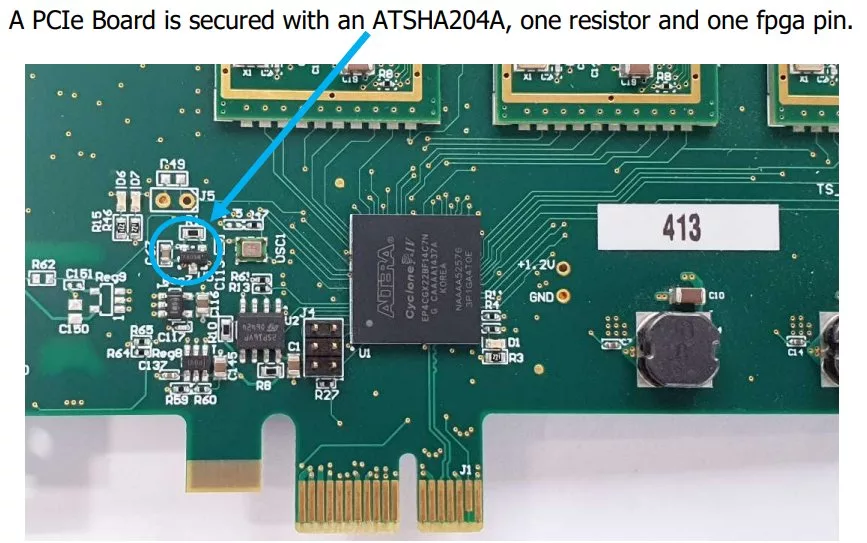
The FPGA Lock is a small FPGA IP core that uses the $0.52 Microchip ATSHA204A hardened crypto authentication IC and one FPGA pin to lock down FPGAs and hardwareto stop IP theft and prevent CEM hardware counterfeiting. It can also be used to guarantee hardware integrity in Military/Defence or Medical applications.
When triggered the core reads the ATSHA204a unique ID then generates a random 256 bit ‘challenge’ and sends this to the device. The IC performs an SHA256
hash on the challenge, a 256 bit secret key that has been programmed into it and its unique ID. The result of this hash is then returned to the FPGA Lock core.
The core then internally performs the same SHA256 hash with the challenge, secret key (which it knows) and the device ID.
If the hash result returned from the ATSHA204a matches the values calculated by the core, then an ATSHA204a programmed with the correct secret key is present
and full FPGA functionality is enabled. If not then FPGA functionality is disabled.
Counterfeit protection is provided by providing a CEM with the correct number of pre-programmed devices. Alternatively an FPGA could delay the ‘check’ trigger to allow full
manufacturing test to be performed before functionality is disabled (the internal ‘Enable’ defaults to ‘1’ at power on). When assembled boards are received from the CEM
the on board ATSHA204a devices are programmed (with the Key Write core) to permanently enable full functionality.
The FPGA Lockcore has a small logic footprint (~720 registers) and only uses one FPGA pin for communication with the ATSHA204A. Communication is via a bidirectional
‘open drain’ link to the device that just requires a pull up to VCC IO.
The entire hardware implementation is the SOT23-3 ATSHA204a, a pull up resistor on the interface and capacitor across the ATSHA204a power pins if required.
The Core is provided in clear VHDL so customers have complete functional visibility, a simple VHDL testbench is provided, this illustrates two consecutive HASH tests.
An accompanying Key Writer core is provided separately to allow users to program their custom secret keys into the ATSHA204A device in assembled boards.
An FPGA image with the Key Writer will program the device in a fraction of a second when programmed into the FPGA.
Example designs targeted at the Cyclone10 LP Evaluation Kit and the Digilent ‘ARTY’ Artix 7 evaluation boards are provided.
The cores use generic Intel altsyncram and Xilinx 7 series Blockram macros so should be easily built into almost any Intel FPGA or Xilinx 7 series FPGA.
These example designs include the FPGA Lock and Key Writer cores, this allows a device to be programmed then an FPGA Lock test performed to verify the key has been programmed correctly.
Block Diagram
Specifications
Identity
Videos
Files
Note: some files may require an NDA depending on provider policy.
Provider
Learn more about Root Of Trust IP core
Root of Trust: A Security Essential for Cyber Defense
Tailoring Root Of Trust Security Capabilities To Specific Customer Needs
Rambus CryptoManager Root of Trust Solutions Tailor Security Capabilities to Specific Customer Needs with New Three-Tier Architecture
Rambus RT-660 Root of Trust IP Achieves FIPS 140-3 Certification
Extending Security IP leadership with FIPS 140-2 CMVP Certification for Root of Trust IP
Frequently asked questions about Root of Trust IP cores
What is FPGA Lock IP?
FPGA Lock IP is a Root Of Trust IP core from Nial Stewart Developments Ltd listed on Semi IP Hub.
How should engineers evaluate this Root Of Trust?
Engineers should review the overview, key features, supported foundries and nodes, maturity, deliverables, and provider information before shortlisting this Root Of Trust IP.
Can this semiconductor IP be compared with similar products?
Yes. Buyers can compare this product with similar semiconductor IP cores or IP families based on category, provider, process options, and structured technical specifications.