Overview
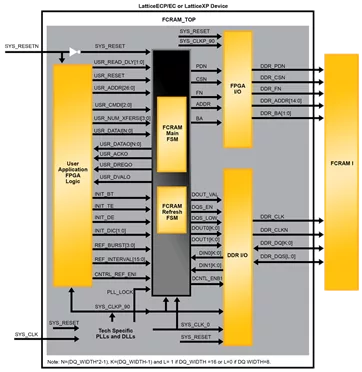
Fast Cycle RAM (FCRAM) is a DRAM technology with a specialized memory core technology that achieves faster random access times and offers lower power consumption than traditional DRAMs. FCRAM is a trademark of Fujitsu Ltd., Japan. As faster applications emerge in the networking and communications markets, there is a need for higher performance memories to meet the architectural requirements of these emerging applications. FCRAM memory technology addresses the needs of some of these emerging applications. For applications that require DRAM densities with random cycle performance approaching SRAM speeds, FCRAM provides a cost effective solution.
Lattice's FCRAM I controller core provides a simple and flexible solution to interfacing different FCRAM I memories to user application logic. On the memory side, the FCRAM I controller core interfaces to FCRAM I data bus widths with (configurable) 8 or 16 bit DDR memory interfaces. On the user side the core provides a simple command interface that accepts read, write, and refresh commands. The core interfaces to 256 Mbit FCRAM I devices (speed grades -60/CAS latency 3 and 4 and -55/CAS latency 3).
Learn more about DDR IP core
Extending Lattice's post-quantum cryptography leadership from silicon to a complete platform security stack, Lattice Sentry now delivers CNSA 2.0-aligned, NIST-compliant protection across AI data centers, and critical infrastructure, giving system designers a validated, production-ready path to quantum-resistant security.
Combining Arm® AGI CPU server platforms with Lattice FPGAs and AMI firmware creates a solution that provides advanced security, manageability, connectivity, and flexibility for next-generation AI data center infrastructure.
Lattice Prompt pairs with AI agentic tools developers already use, combining them with Lattice design tools, knowledge base, and documentation to turn natural language inputs into validated responses, dramatically accelerating FPGA development while optimizing design performance and capability.
First announced on May 4, 2026, the acquisition creates the industry's most complete secure management and control platform.
The acquisition brings together Lattice’s industry-leading low power FPGAs with AMI’s industry‑leading platform firmware and infrastructure manageability solutions for cloud and AI to create a complete portfolio of secure management and control solutions.
The collaboration demonstrates a real-time AI sensor fusion architecture that integrates TI mmWave radar and camera sensors using NVIDIA Holoscan Sensor Bridge running on Lattice’s low power FPGA. The FPGA acts as a companion chip delivering synchronized sensor data directly into GPU-accessible memory to enable low-latency and robust perception for robotics and industrial edge AI applications.