Vendor: PUFsecurity Category: Root Of Trust

External NAND flash protection, designed to secure stored assets with a local key from PUF

The Flash Protection Series is a suite of enhancements available for PUFcc and PUFrt, extending the Hardware Root of Trust to pro…

Overview

The Flash Protection Series is a suite of enhancements available for PUFcc and PUFrt, extending the Hardware Root of Trust to protect critical assets in the commodity flash. The Flash Protection Series can widen an SoC’s secure boundary based on our highly reliable PUF technology widely available across all major foundries.

Key features

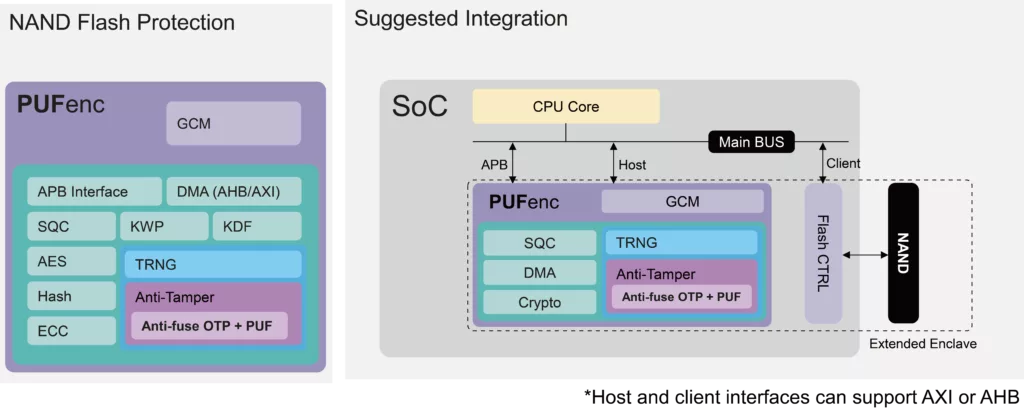
  • PUFenc is designed to protect external flash memory and its stored assets.
  • The IP provides asset encryption, such as a learning model for AI or firmware for the chip with a local key from the PUF.
  • It adds an additional layer of security by avoiding using the global key, which is a shared key among ICs after the chip leaves the manufacturing floor.

Block Diagram

What’s Included?

  • Datasheet
  • Release Notes
  • Integration Guidelines
  • Timing .lib File
  • LEF
  • GDS Phantom File
  • Verilog HDL File (Behavior Model)
  • Verilog HDL File (FPGA)
  • Application Note
  • Reference Scripts
  • Hard Macro Release Note
  • Test Methodology
  • Testbench

Specifications

Identity

Part Number
PUFenc
Vendor
PUFsecurity
Type
Silicon IP

Files

Note: some files may require an NDA depending on provider policy.

Provider

HQ: Taiwan

Learn more about Root Of Trust IP core

Embracing a More Secure Era with TLS 1.3

TLS 1.3 offers attractive speed and security improvement benefits that are hard to ignore. The handshake phase was sped up by removing one or more roundtrips (back and forth messaging between client and server) in TLS 1.3 – with “or more” meaning that for certain cases, roundtrips can be entirely eliminated (0-RTT).

The Challenge of Automotive Hardware Security Deployment

A complete reinvention of the automotive industry is currently underway. Autonomous driving, connected vehicles, and the electrification of the powertrain all represent a once-in-a-generation shift in the manufacturing process.

Why Hardware Root of Trust Needs Anti-Tampering Design

The hardware root of trust (HRoT) provides the trust base (root key), hardware identifier (UID), hardware unique key (HUK), and entropy required for the secure operation of the entire chip and therefore is often the focus of hacker attacks. If the design can’t effectively resist attacks, hackers can easily obtain the secrets of the entire chip. Attackers can use the secrets to crack identity authentication and data encryption and steal product design know-how, causing application security problems.

TPM 2.0-Ready: Top Security with PUFcc

The rising security threats endangering our connected world, from the chip to the cloud, are among the biggest challenges facing us today. Microsoft recently addressed some of these concerns by mandating the inclusion of TPM 2.0 (Trusted Platform Module) in all devices running its latest Windows 11 operating system. I

Solving Chip Security's Weakest Link

With the invention of Physical Unclonable Functions (PUF), we can now create a unique, inborn, unclonable key at the hardware level. The natural follow-up question to this is, “but how do we protect this key?” It is like storing your key to secrets in a drawer, a surefire way to break the secure boundary and create vulnerabilities.

Frequently asked questions about Root of Trust IP cores

What is External NAND flash protection, designed to secure stored assets with a local key from PUF?

External NAND flash protection, designed to secure stored assets with a local key from PUF is a Root Of Trust IP core from PUFsecurity listed on Semi IP Hub.

How should engineers evaluate this Root Of Trust?

Engineers should review the overview, key features, supported foundries and nodes, maturity, deliverables, and provider information before shortlisting this Root Of Trust IP.

Can this semiconductor IP be compared with similar products?

Yes. Buyers can compare this product with similar semiconductor IP cores or IP families based on category, provider, process options, and structured technical specifications.

×
Semiconductor IP