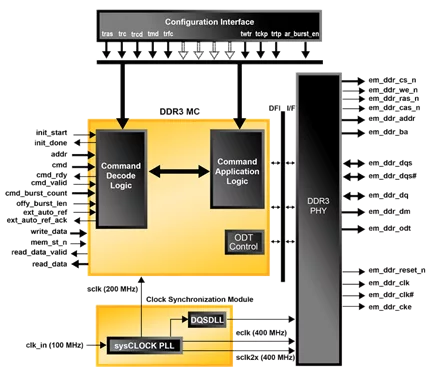
Overview
The Lattice Double Data Rate (DDR3) Synchronous Dynamic Random Access Memory (SDRAM) Controller is a general-purpose memory controller that interfaces with industry standard DDR3 memory devices/modules compliant with JESD79-3, DDR3 SDRAM Standard, and provides a generic command interface to user applications. The DDR3 SDRAM is the next-generation DDR SDRAM memory technology which features faster speed, mitigated SSO, and reduced routing due to “fly-by” routing signals to SDRAM instead of low skew tree distribution. This core reduces the effort required to integrate the DDR3 memory controller with the remainder of the application and minimizes the need to directly deal with the DDR3 memory interface.
DDR3 SDRAM Controller IP Core Pinout Generation Utility
The DDR3 Pinout Generation Utility is a GUI tool capable of generating the pinout and preference files that contain information for a design that uses the DDR3 SDRAM Controller IP core. More information about this utility, including downloads and documentation is available here.
Learn more about DDR IP core
Combining Arm® AGI CPU server platforms with Lattice FPGAs and AMI firmware creates a solution that provides advanced security, manageability, connectivity, and flexibility for next-generation AI data center infrastructure.
Lattice Prompt pairs with AI agentic tools developers already use, combining them with Lattice design tools, knowledge base, and documentation to turn natural language inputs into validated responses, dramatically accelerating FPGA development while optimizing design performance and capability.
First announced on May 4, 2026, the acquisition creates the industry's most complete secure management and control platform.
The acquisition brings together Lattice’s industry-leading low power FPGAs with AMI’s industry‑leading platform firmware and infrastructure manageability solutions for cloud and AI to create a complete portfolio of secure management and control solutions.
The collaboration demonstrates a real-time AI sensor fusion architecture that integrates TI mmWave radar and camera sensors using NVIDIA Holoscan Sensor Bridge running on Lattice’s low power FPGA. The FPGA acts as a companion chip delivering synchronized sensor data directly into GPU-accessible memory to enable low-latency and robust perception for robotics and industrial edge AI applications.
Sets new standard for secure control FPGAs with full CNSA 2.0-compliant post-quantum cryptography, crypto-agility, and hardware Root of Trust for next-generation infrastructure