Overview
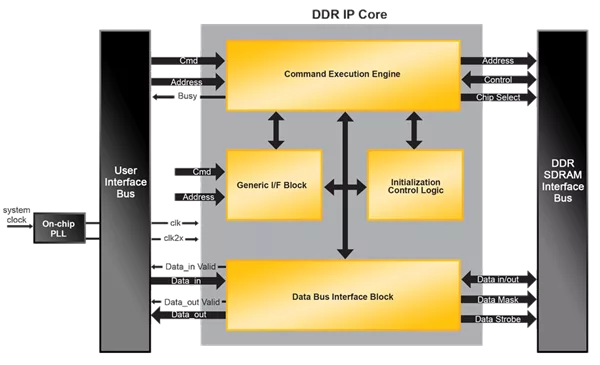
This version of the Lattice DDR SDRAM Controller does not have pipelining, and is significantly smaller than the pipelined version. DDR (Double Data Rate) SDRAM was introduced as a replacement for SDRAM memory running at bus speeds over 75MHz. DDR SDRAM is similar in function to the regular SDRAM but doubles the bandwidth of the memory by transferring data twice per cycle on both edges of the clock signal, implementing burst mode data transfer.
The DDR SDRAM Controller is a parameterized core giving users the flexibility for modifying data widths, burst transfer rates and CAS latency settings in a design. In addition, the DDR core supports intelligent bank management, which is done by maintaining a database of "all banks activated" and the "rows activated" in each bank. With this information, the DDR SDRAM Controller decides if an active or pre-charge command is needed. This effectively reduces the latency of read/write commands issued to the DDR SDRAM.
Learn more about DDR IP core
Combining Arm® AGI CPU server platforms with Lattice FPGAs and AMI firmware creates a solution that provides advanced security, manageability, connectivity, and flexibility for next-generation AI data center infrastructure.
Lattice Prompt pairs with AI agentic tools developers already use, combining them with Lattice design tools, knowledge base, and documentation to turn natural language inputs into validated responses, dramatically accelerating FPGA development while optimizing design performance and capability.
First announced on May 4, 2026, the acquisition creates the industry's most complete secure management and control platform.
The acquisition brings together Lattice’s industry-leading low power FPGAs with AMI’s industry‑leading platform firmware and infrastructure manageability solutions for cloud and AI to create a complete portfolio of secure management and control solutions.
The collaboration demonstrates a real-time AI sensor fusion architecture that integrates TI mmWave radar and camera sensors using NVIDIA Holoscan Sensor Bridge running on Lattice’s low power FPGA. The FPGA acts as a companion chip delivering synchronized sensor data directly into GPU-accessible memory to enable low-latency and robust perception for robotics and industrial edge AI applications.
Sets new standard for secure control FPGAs with full CNSA 2.0-compliant post-quantum cryptography, crypto-agility, and hardware Root of Trust for next-generation infrastructure