Vendor: Lattice Semiconductor Corp. Category: Protocol Bridge

CSIX Level 1

As stated by the CSIX Forum, the CSIX standard defines the physical and message layers of the interconnect between traffic manage…

Overview

As stated by the CSIX Forum, the CSIX standard defines the physical and message layers of the interconnect between traffic managers (TM) and the switching fabric. The CSIX interface is designed to support a wide variety of system architectures and markets; and provides a framework with a common set of mechanisms for enabling a fabric and a TM to communicate. This includes unicast addressing for up to 4096 fabric ports, and multiple traffic classes that isolate data going to the same fabric port. Link level flow control is in-band and broken into a data and a control queue to isolate traffic based on this granular type. Flow control between the fabric and TM is defined and is relative to both fabric port and class. Three multicast approaches are defined. The interface assumes cell segmentation in the TM, but allows compression of the transfer.

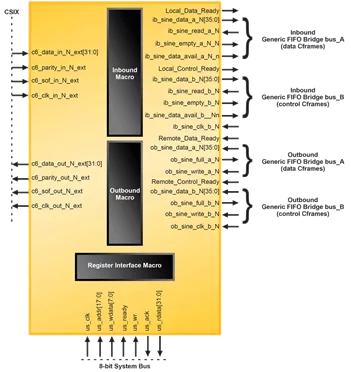
Lattice Semiconductor’s CSIX Level 1 IP core links a compliant CSIX-L1 interface to Lattice’s Generic FIFO Bridge interface (a simple FIFO interface). Inbound control and data frames from the CSIX port are deposited into the core's inbound FIFOs; CSIX frames stored in the core’s outbound FIFOs are driven onto the outbound CSIX interface. The Generic FIFO Bridge interface directly accesses the core's inbound and outbound FIFOs.

Key features

  • Implements a CSIX-L1-to-Generic FIFO Bridge
  • Supports 32-Bit, 100MHz CSIX-L1 Interface
  • Up to Four Paramaterizable 32-bit Channel Instantiations
  • Paramaterizable Channel Aggregation (32-Bit to 128-Bit)
  • Paramaterizable FIFO Size (Up to 2048 Bytes)
  • Programmable FIFO Thresholds
  • Supports MAX_FRAME_PAYLOAD_SIZE from 1 to 256 Bytes
  • Transports Unicast, Multicast, Broadcast, and Flow Control Frames
  • Filters Idle Frames (Not Transported Through Core)
  • Delineates Cframes at Generic FIFO Bridge Interface with Start/End Flags (SOF and EOF)
  • Passes Entire CSIX Frame Structure Across Generic FIFO Bridge Interface
  • Passes CSIX Link Level Control Directly to Generic FIFO Bridge (Bypasses FIFOs)
  • Supports CSIX-L1 Link Layer Flow Control (XON/XOFF)
  • Programmable Horizontal and Vertical Parity Check Enables
  • Internal Register Set for Control and Status Management
  • 8-Bit Register Interface Compatible with ORCA System Bus

Block Diagram

Specifications

Identity

Part Number
CSIX-LEV1
Vendor
Lattice Semiconductor Corp.
Type
Silicon IP

Files

Note: some files may require an NDA depending on provider policy.

Provider

Learn more about Protocol Bridge IP core

Using FPGAs to build a compact, low cost, and low power Ethernet-to-Network Processor bridge

As carriers and cable providers begin rolling out triple-play and VoD services to their customers, OEMs are increasing their development efforts to roll out IP- (Internet Protocol) based systems, including PONs, CMTS, IP DSLAMs and other access and last-mile equipment. The common underlying physical layer for this is the ubiquitous Ethernet technology, now coupled with sophisticated QoS (Quality of Service) overlays.

A comparison of Network-on-Chip and Busses

This whitepaper summarizes the limitations of traditional bus-based approaches, introduces the advantages of the generic concept of NoC, and provides specific data about Arteris’ NoC, the first commercial implementation of such architectures

Frequently asked questions about Protocol Bridge IP cores

What is CSIX Level 1?

CSIX Level 1 is a Protocol Bridge IP core from Lattice Semiconductor Corp. listed on Semi IP Hub.

How should engineers evaluate this Protocol Bridge?

Engineers should review the overview, key features, supported foundries and nodes, maturity, deliverables, and provider information before shortlisting this Protocol Bridge IP.

Can this semiconductor IP be compared with similar products?

Yes. Buyers can compare this product with similar semiconductor IP cores or IP families based on category, provider, process options, and structured technical specifications.

×
Semiconductor IP