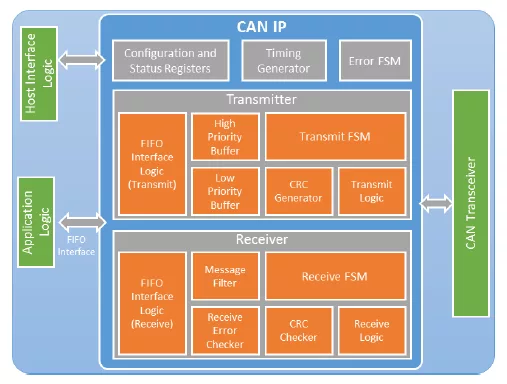
Overview
CAN is part of HCL’s IP offerings and supports Version 2.0, PART B specification released by Bosch. This IP supports standard FIFO interface at application side and standard interface that would get connected to CAN Transceiver. It offers a simple register interface for communication with host. This register interface can be customized quickly if needed, for other leading industry standard bus interface to host such as Avalon, AXI4 – Lite, AHB, and APB. This IP is efficient and functionally verified and well tested design for the CAN (Version 2.0, PART B) and can be immediately used in SoC designs in need of the CAN Interface.
Learn more about CAN / CAN-FD / CAN-XL IP core
HCLTech, a leading global technology company, has been selected as a Design Solution Partner (DSP) under the Samsung Advanced Foundry Ecosystem (SAFE™) program.
In this paper, we explain how we adopted the post processing method to make sure we check for signatures that are expected are present in the log files. This acted as a safety net when engineers made inadvertent mistakes and introduced issues in the code base.
HCLTech, a leading global technology company, and Arm, a leading technology provider of processor IP, announced their collaboration to augment custom silicon chips that support AI-driven business operations.
HCLTech, a leading global technology company, and Arm, a leading technology provider of processor IP, announced their collaboration to augment custom silicon chips that support AI-driven business operations.
This paper deals with the implementation of UPF for low power SoC design that can encompass several vendor IPs and custom IPs UPF constraints.
This paper discusses about the low power IP components from ARM can help one to realize the low power features in the SoC. It should be noted that this paper does not discuss about the low power concepts or design techniques. Rather, it focuses on the implementation approaches using ARM low power IP.