Overview
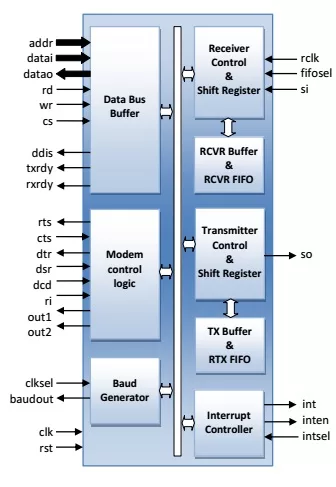
The D16950 is a soft core of a Universal Asynchronous Receiver/Transmitter (UART), functionally identical to the OX16C950. It allows serial transmission in two modes: UART and FIFO. In the FIFO mode, internal FIFOs are activated, allowing 128 bytes (plus 3 bits of error data per byte in the RCVR FIFO) to be stored in both receive and transmit modes. Our efficient Core performs a serial-to-parallel conversion on data characters received from a peripheral device or a MODEM, but also parallel-to-serial conversion on data characters received from the CPU. The processor can read a complete status of the UART at any time during the functional operation. Status information reported includes the type and condition of transfer operations being performed by the UART, as well as any error conditions (parity, overrun, framing or break interrupt). The D16950 includes a programmable baud rate generator, which is capable to divide the timing reference clock input by divisors of 1 to (216-1) and produce a n × clock for driving the internal transmitter logic. Provisions are also included to use this n × clock to drive the receiver logic. We also equipped our core with a complete MODEM-control capability and a processor-interrupt system. Interrupts can be programmed in accordance to your requirements, minimizing computing required to handle the communications link. The D16950 core includes all (16450, 16550, 16650 and 16750) features and additional functions. The D16950 has ICR registers, which give additional capabilities of UART work configuration. The data transmission may be synchronized by an external clock connected to the RI (for receiver and transmitter) or the DSR (only for receiver) pin. The NMR register allows to enable a 9-bit mode transmission, with or without special character. Writing and reading from/to FIFO may be controlled by trigger level registers. Trigger level registers may be set any value from 1 to 127.
In the FIFO mode, there is a selectable autoflow control feature, that can significantly reduce software overload and automatically increase the system efficiency, by controlling serial data flow, through the RTS output and the CTS input signals.
The Core is perfect for applications, where the UART core and the microcontroller are clocked by the same clock signal and are implemented inside the same ASIC or FPGA chip. Nevertheless, it's also a proprietary solution for a standalone implementation, where several UARTs are required to be implemented inside a single chip and driven by some off-chip devices. Thanks to a universal interface, the D16950 core implementation and verification are very simple, just by eliminating a number of clock trees in the complete system. As all our UART Cores, the D16950 includes fully automated testbench with complete set of tests, allowing easy package validation at each stage of SoC design flow. This efficient solution is a technology independent design, that can be implemented in a variety of process technologies.
Learn more about UART IP core
T2M-IP, the global leader in semiconductor IP cores and technology expertise, is proud to announce the immediate availability of its partner's VESA-compliant DisplayPort v1.4 Rx PHY and Controller IP Cores.
T2M announces the availability of its partner’s Bluetooth V6.0 RF Transceiver IP Core in 22nm ULL and 40nm ULP.
Incorporating BroadR-Reach™ technology for Automotive Excellence, this PHY delivers exceptional performance for automotive and industrial applications, providing a superior alternative to traditional BaseT1 solutions.
Designed to meet the evolving needs of next-generation automotive and industrial applications, the CAN XL Controller IP offers superior performance and flexibility while maintaining backward compatibility with previous CAN standards.
T2MIP, a leading provider of semiconductor IP cores, proudly announces the immediate availability of their partner's H.264 and H.265 HEVC Codec IP cores.
T2M-IP is excited to announce that its state-of-the-art USB 3.0 IP, developed in the 22nm ULP (Ultra Low Power) and ULL (Ultra Low Leakage) process technologies, has been successfully licensed to over 10 customers worldwide in the past two years.