Vendor: Arasan Chip Systems Inc. Category: MIPI PHY

Combination MIPI CPHY-DPHY Analog Interface

The MIPI C-PHY V1.2 improves throughput over a bandwidth-limited channel, allowing more data without an increased signaling clock.

Overview

The MIPI C-PHY V1.2 improves throughput over a bandwidth-limited channel, allowing more data without an increased signaling clock. It is intended to be used for camera interface (CSI-2 v1.3) and display interface (DSI-2 v1.0). The signaling interface uses a 3-phase transceiver that encodes 3-bit symbols over 3 wires. This is different from the two-wire differential “lane” used in D-PHY.

C-PHY was designed to coexist on the same IC pins as D-PHY so that dual-mode devices could be developed with low power signaling similar to DPHY. Arasan’s CPHY-DPHY combination provides a 3 channel C-PHY v1.2 and a four-lane D-PHY v1.2 in a single IP core. This allows a seamless implementation allowing the interface to D-PHY based sensors or C-PHY based sensors.

Symbol encoding effectively transfers 2.286 bits per symbol compared to 1.0 bits per lane for D-PHY. The C-PHY (v1.2) operates at 3GS/s, whereas the D-PHY V1.2 (2.5Gb/s).

A four-lane D-PHY V1.2 provides 10Gbps which enables:

  • 4K video at 30fps
  • 1080p at 120fps

A 3 channel C-PHY V1.2 provides 17Gbps which enables:

  • 4K video at 60fps
  • 1080p at 240fps (for cool slow-motion videos)

Key features

  • Compliant to MIPI Alliance Standard for C-PHY specification Version 1.2
  • Compliant to MIPI Alliance Standard for D-PHY specification Version 1.2
  • Supports standard PHY transceiver compliant to MIPI Specification
  • Supports standard PPI interface compliant to MIPI Specification
  • Supports asynchronous transfer at high speed mode with a symbols rate of 80-3000 MS/s on CPHY mode.
  • Supports synchronous transfer at high speed mode with a bit rate of 80-1500 Mb/s without deskew calibration and upto 2500 Mb/s with deskew calibration on DPHY mode.
  • Supports asynchronous transfer at low power mode with a bit rate of 10 Mb/s on both CPHY and DPHY
  • Spaced one hot encoding for Low power [LP] data
  • Supports maximum of three data lanes on CPHY mode and four data lanes and clock lane on DPHY mode .
  • Supports error detection mechanism for sequence errors and contentions.
  • Data lanes support transfer of data in high speed mode.
  • Supports ultra low power mode, high speed mode and control mode.
  • Has clock divider unit to generate clock for parallel data reception and transmission from and to the PPI.
  • Activates and disconnects high speed terminators for reception and transmission.
  • On-chip clock generation configurable for transmitter.
  • Testability for Analog Tx, Rx and PLL and DFE.

Process & Foundry

  • Available in various foundry processes
  • No external (off-chip) components required
  • Can be ported to other processes

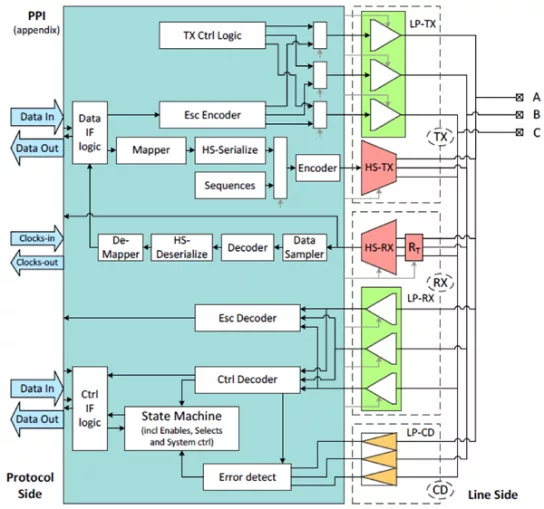
Block Diagram

Benefits

  • Silicon proven
  • Extensive Quality Methodology

What’s Included?

  • GDS-II Database
  • LVS Netlist
  • Physical Abstract Models (LEF)
  • Timing Models (LIB)
  • Process Specific Integration Guide

Specifications

Identity

Part Number
Combination MIPI CPHY-DPHY Analog Interface
Vendor
Arasan Chip Systems Inc.
Type
Silicon IP

Standards & Interfaces

MIPI PHY
MIPI D-PHY

Files

Note: some files may require an NDA depending on provider policy.

Provider

Learn more about MIPI PHY IP core

How Arasan’s SoundWire PHY Can Elevate Your Next Audio SoC

In the race to build smaller, smarter, and more efficient devices, audio system-on-chips (SoCs) must meet increasingly demanding requirements: high fidelity, low latency, low power, and seamless integration. The SoundWire PHY from Arasan Chip Systems is engineered to meet these challenges and elevate your next audio SoC design from standard to standout.

Vertically Integrated MIPI Solutions

The emerging MIPI standards are designed to ensure interoperability among devices and software that are used in products for the exploding hand-held market. The standards facilitate the interconnection of multiple, mixed-signal integrated circuit devices on a single hand-held product. Use of the standards ensures low power, low pin count and interoperability of all the devices in the system and easy integration.

UFS Goes Mainstream

UniversalFlash Storage (UFS) was created for mobile applications and computer systems requiring high performance and low power consumption. These systems typically use embedded Flash based on the JEDEC standard eMMC. UFS was defined by JEDEC as the evolutionary replacement for eMMC offering significantly higher memory bandwidth. The standard builds on existing standards such as the SCSI command set, the MIPI Alliance M-PHY and UniPro as well as eMMC form factors to simplify adoption and development.

Frequently asked questions about MIPI PHY IP

What is Combination MIPI CPHY-DPHY Analog Interface?

Combination MIPI CPHY-DPHY Analog Interface is a MIPI PHY IP core from Arasan Chip Systems Inc. listed on Semi IP Hub.

How should engineers evaluate this MIPI PHY?

Engineers should review the overview, key features, supported foundries and nodes, maturity, deliverables, and provider information before shortlisting this MIPI PHY IP.

Can this semiconductor IP be compared with similar products?

Yes. Buyers can compare this product with similar semiconductor IP cores or IP families based on category, provider, process options, and structured technical specifications.

×
Semiconductor IP