Overview
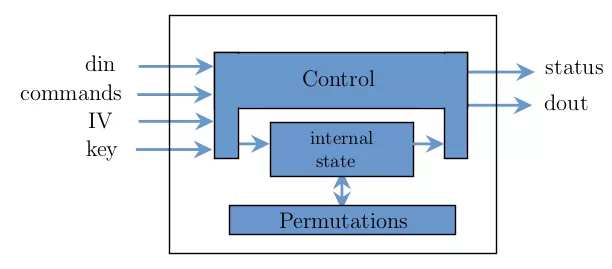
XIP2201B from Xiphera is an Intellectual Property (IP) core for Ascon authenticated encryption with associated data (AEAD) and hashing.
It supports three variants of AEAD as well as two variants of hashing and extendable output functions (XOF). Notably, XIP2201B provides three different cryptographic primitives all in one IP core. Ascon was selected by the National Institute of Standards and Technology (NIST) to be standardized as the lightweight cryptographic algorithm.
XIP2201B for authenticated encryption and decryption, hashing, and extendable output function operation for all Ascon variants defined in the standard.
Ascon was selected as the lightweight cryptographic algorithm by NIST and can thus be expected to see usage in the coming years. The algorithm itself is optimised to be small in size, support many features, and be especially efficient with small inputs.
The XIP2201B is optimised for both moderate resource usage and fast computation.
Learn more about Symmetric Crypto IP core
Xiphera announces the launch of nQrux® Root of Trust, the latest addition to its nQrux® product family. Designed for ASIC and SoC implementations, the new IP provides a hardware-based foundation of trust for secure hardware systems.
Trust is the foundation of any secure computing system, but that trust has to start somewhere. This article explores the role of a Hardware Root of Trust, why that starting point must be built into hardware, and why it matters more than ever as device lifecycles grow longer, the EU Cyber Resilience Act introduces new security requirements, and the transition to quantum-resistant cryptography moves forward.
Xiphera has achieved ISO/IEC 27001:2022 certification, the internationally recognised standard for information security management, following an independent audit conducted by Into Certification Oy, an accredited certification body and subsidiary of Into Security Oy.
Japan is a focus market for Xiphera’s cryptographic hardware security solutions, and we are pleased to welcome Yasuhiro Okumura as our new Country Manager for Japan. His appointment strengthens our local presence and supports our continued growth in the region.
The project will develop a high-speed security IP core for optical satellite links, enabling secure data transfer at speeds of up to 100 Gbit/s. The technology is intended to support future satellite constellations and space systems that require both high-performance communications and strong cybersecurity.
The integration of Xiphera’s digital cryptographic cores and Agile Analog’s agileSecure anti-tamper sensor IP creates a unified defense solution for the next generation of semiconductor security. This is particularly important as the industry transitions to Post-Quantum Cryptography (PQC).