Vendor: Silvaco, Inc. Category: I2C / I3C

APB I2C Master/Slave Controller

The I2C Interface provides full support for the two-wire I2C synchronous serial interface, compatible with the ACCESS.

Overview

The I2C Interface provides full support for the two-wire I2C synchronous serial interface, compatible with the ACCESS. Bus physical layer, with additional support for the SMBus protocol, including Packet Error Checking (PEC). Through its I2C compatibility, it provides a simple interface to a wide range of low-cost memories and I/O devices, including: EEPROMs, SRAMs, timers, A/D converters, D/A converters, clock chips, and peripheral drivers. The I2C is the same I2C Interface IP is proven in high-volume devices.

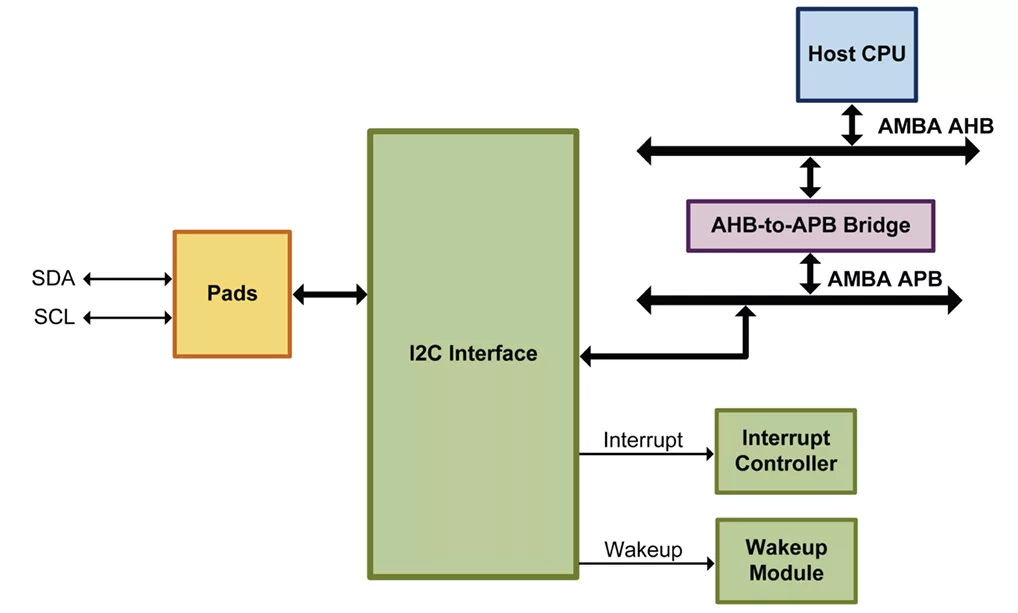
The host interface of the I2C Interface complies with the AMBA 2 APB protocol. Control registers provide CPU control of Serial Clock Line (SCL) frequency, start and stop condition generation, PEC byte generation, I2C address assignment, 7-bit or 10-bit addressing, and enabling/disabling interrupts. Status registers indicate current operating mode, packet error, and interrupt status. A serial data register shifts the serial I2C data into and out of the I2C Interface during receive and transmit operations.

The I2C serial interface consists of the standard bidirectional I2C signals: Serial Clock Line (SCL) and Serial Data Line (SDA). At the I2C IP level, there are separate unidirectional signals (scl_in_pin/scl_out and sda_in_pin/sda_out). To reduce chip-level pin count, the I2C bus interface signals can be shared with other on-chip functions through a General Purpose I/O (GPIO) Controller.

I2C Protocol

The I2C protocol uses a two-wire interface for bidirectional communications between the devices connected to the bus. The two interface lines, SCL and SDA, are connected to a positive supply through pull-up resistors. Any device connected to the bus uses open-collector or open-drain drivers and can only pull the respective bus line low. Therefore, both the SCL and SDA are wired AND type signals.

The device that initiates the transaction becomes the master of the bus. The bus master generates SCL and terminates the transaction once finished. One data bit is transferred on SDA during each pulse on SCL. Data is sampled during the high state of SCL and can change while SCL is low.

Each data transaction is composed of a start condition, a number of byte transfers, and a stop condition to end the transaction. Each byte is transferred with the Most Significant Bit (MSB) first. After each byte (8 bits), an acknowledge signal must follow.

A slave device can stall the master by extending the low period of the SCL clock while it handles the previous data or prepares new data. This process can occur after each bit is transferred or on a byte boundary. The slave stalls the bus by pulling SCL low to extend the clock-low period. Typically, slaves extend the first clock cycle of a transfer if a byte read has not yet been stored or if the next byte to be transmitted is not yet ready.

 SMBUS Features

 The SMBus protocol (supported by the I2C Interface) is a superset of the I2C protocol and adds the following features:

  • SCL Timeout detection – If the SCL low period exceeds the SCL timeout value, the device aborts the current operation
  • Packet Error Checking (PEC) through the use of a Cyclic Redundancy Check (CRC) byte
  • Alert Response Address, which provides slave-only devices an interrupt capability

 Interfaces

  • AMBA 2 APB host interface
  • 8-bit read/write data buses
  • 10-bit address bus
  • I2C bus interface pins (SCL and SDA) through chip I/O pads (optionally through a GPIO Controller)
  • System (APB) clock
  • One interrupt signal
  • One asynchronous reset input
  • One wakeup signal
  • Signals to control idle mode and halt mode
  • DFT signals

Key features

  • Compliant to SMBus (versions 1.1 and 2.0), ACCESS. Bus, and I2C (version 2.1)
  • Supports Standard Mode, Fast Mode (F/S), and High Speed (Hs) Mode
  • Programmable master or slave operation
  • Multi-master capable
  • One software-defined slave address
  • 7-bit or 10-bit slave addressing
  • Global Call (broadcast) address support
  • Specific SMBus features:
  • SCL Timeout detection
  • Packet Error Checking (PEC)
  • Alert Response Address
  • Supports polling and interrupt-controlled operation
  • Wakeup signal generation upon detection of a start condition while in power-down mode
  • Local clock gating for minimal power consumption

Block Diagram

Applications

  • IoT Edge Devices
  • Industrial Sensors
  • Small Controllers
  • Mixed Signal Digital - MEMS
  • Smart Sensors
  • Smart Lighting
  • Temperature, Pressure, Acceleration Monitors
  • Personal Health Monitors
  • I3C Connected Devices

What’s Included?

  • Synthesizable Verilog source code
  • Integration testbench and tests
  • Documentation
  • Scripts for simulation and synthesis with support for common EDA tools

Specifications

Identity

Part Number
APB I2C Master/Slave Controller
Vendor
Silvaco, Inc.
Type
Silicon IP

Files

Note: some files may require an NDA depending on provider policy.

Provider

HQ: United States

Learn more about I2C / I3C IP core

From I2C to I3C: Evolution of Two-Wire Communication in Embedded Systems

The I2C (Inter-Integrated Circuit) Bus invented in 1980 by Philips Semiconductors (NXP Semiconductors today) was a massive step forward in simplifying communications in embedded systems. It is a simple two-wire interface for synchronous, multi-master/multi-slave, single ended serial communication. Fast forward 45 years to today and it is still widely used for attaching low speed peripheral Integrated Circuits (ICs), processors and microcontrollers. But silicon today has changed...

Maximizing the Usability of Your Chip Development: Design with Flexibility for the Future

Early in my career selling chips for Motorola Semiconductor, the ability to spin derivative microcontroller chips for a customer’s specific requirement was relatively straightforward. If the volume looked reasonable, we would tape-out a new chip with a few added features because mask costs and wafers were relatively inexpensive at the larger process nodes. The customer won by getting an MCU tailored to their specific need, and Motorola won by gaining a more committed customer plus another SKU that could be sold to other customers – boosting ROI. With the migration to higher cost FinFET nodes, those times are long gone as the economics no longer work.

MIPI CCI over I3C: Faster Camera Control for SoC Architects

Imagine a camera subsystem that responds in microseconds, consumes less power, and offers a more straightforward route to time-to-market. For SoC architects and IP integration teams, that vision is increasingly possible with MIPI Camera Control Interface (CCI) over I3C.

Frequently asked questions about I2C / I3C IP cores

What is APB I2C Master/Slave Controller?

APB I2C Master/Slave Controller is a I2C / I3C IP core from Silvaco, Inc. listed on Semi IP Hub.

How should engineers evaluate this I2C / I3C?

Engineers should review the overview, key features, supported foundries and nodes, maturity, deliverables, and provider information before shortlisting this I2C / I3C IP.

Can this semiconductor IP be compared with similar products?

Yes. Buyers can compare this product with similar semiconductor IP cores or IP families based on category, provider, process options, and structured technical specifications.

×
Semiconductor IP