Overview
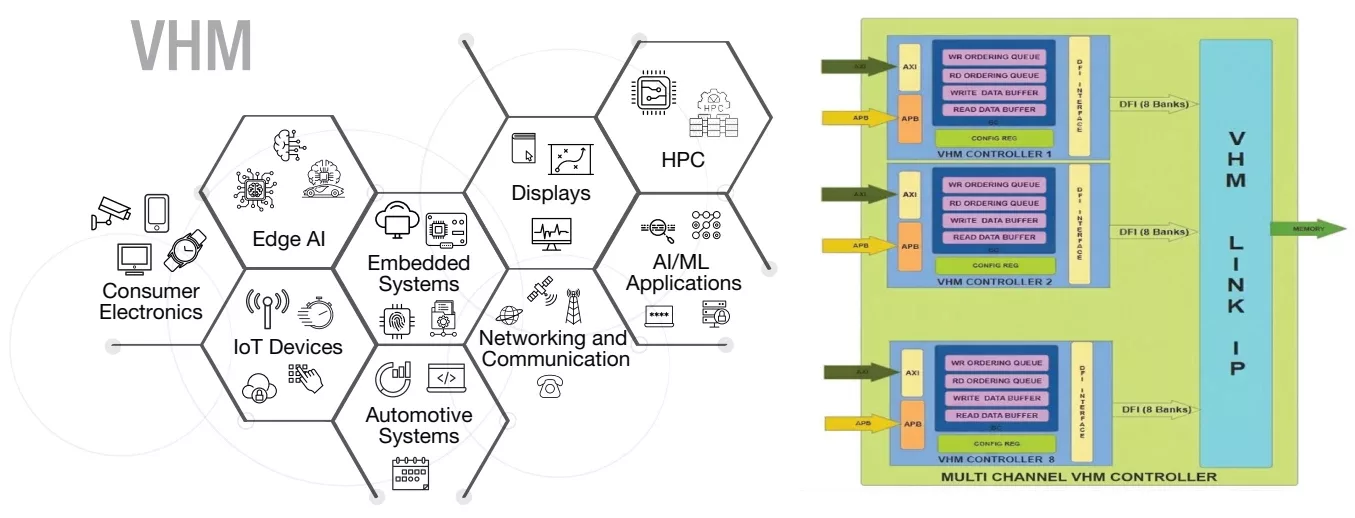
Mobiveil’s Controller for AP Memory VHM™ (Very High Bandwidth Memory) Technology is a high-Performance, ultra-low-latency IP solution engineered to harness the full potential. Optimized for 3D Wafer-on-Wafer (WoW) integration, the controller supports ultra-wide interface that delivers very high bandwidth directly to the processing unit. AP Memory VHM™ devices can support up to several TB/s when fully utilized. One such example is a small footprint memory solution that can provide up to 2TB/s with Mobiveil’s Controller instantiated multiple times for use in multi-channel architecture of VHM™. The solution is scalable for higher bandwidth beyond 2 TB/s as well. The VHM™ Controller is part of Mobiveil’s memory controller family of IP solutions. AP Memory VHM™ acts as a high-capacity scalable DRAM solutions. It provides 4GB multi-bank architecture that ensures superior timing and throughput. The controller features a highly configurable, layered architecture that is fully compliant with AMBA4 AXI4 and custom DFI 4.0 specifications, offering a low-risk path for integration into Edge AI accelerators, HPC processors, and networking engines. The controller’s configurable and layered architecture is independent of application logic, implementation tools, and most importantly, the target technology. Its flexible AXI system interface makes it easy to integrate into a wide range of applications. The VHM controller leverages Mobiveil’s years of experience in AP Memory ApSRAM™, DDR4, NVMe, and Rapid IO technologies, creating system-validated IP solutions with RTL, synthesis, simulation, board, and software elements to offer the lowest risk in terms of compliance and interoperability.
Learn more about HBM IP core
Mobiveil, Inc., a fast-growing supplier of silicon intellectual property (SIP), platforms and IP-enabled design services, today announced it has adapted its PSRAM controller IP to leverage the unique characteristics of AP Memory’s Ultra High Speed (UHS) PSRAM device.
GlobalLogic, a Hitachi Group Company and a leader in Digital Engineering, today announced that it has entered into a definitive agreement to acquire Mobiveil, a specialized embedded engineering services firm headquartered in the United States.
With the reintroduction of semiconductor integration into system development, standards-based chiplets promise more efficient, cost-effective designs.
Mobiveil, Inc., a fast-growing supplier of silicon intellectual property (SIP), platforms and IP-enabled design services, today announced a partnership with Winbond to deliver an IP controller targeting automotive, smart IoT, industrial, wearables, true wireless stereo (TWS), wireless headsets, smart speakers and connectivity applications.
Mobiveil, Inc., a fast-growing supplier of silicon intellectual property (SIP), platforms and IP-enabled design services, today announced successful inter-op verification of its production-proven Enterprise Flash Controller (EFC) Design IP and InPsytech’s ONFI 5.1 PHY IP.
Mobiveil, Inc., a fast-growing supplier of silicon intellectual property (SIP), platforms and IP-enabled design services, today announced it is working with AP Memory, a market leader in PSRAM devices, to bring new IP controller targeting modem, connectivity, smart IoT, edgeAI, display and wearables applications.