Vendor: Certus Semiconductor Category: GPIO

1.5V to 3.3V GPIO with Tri-State Output Driver in GF 180nm

A GlobalFoundries 180nm BCD Lite Wirebond GPIO library with tri-state out- put driver, schmitt trigger receiver and associated ES…

GlobalFoundries 180nm View all specifications

Overview

A GlobalFoundries 180nm BCD Lite Wirebond GPIO library with tri-state out- put driver, schmitt trigger receiver and associated ESD.

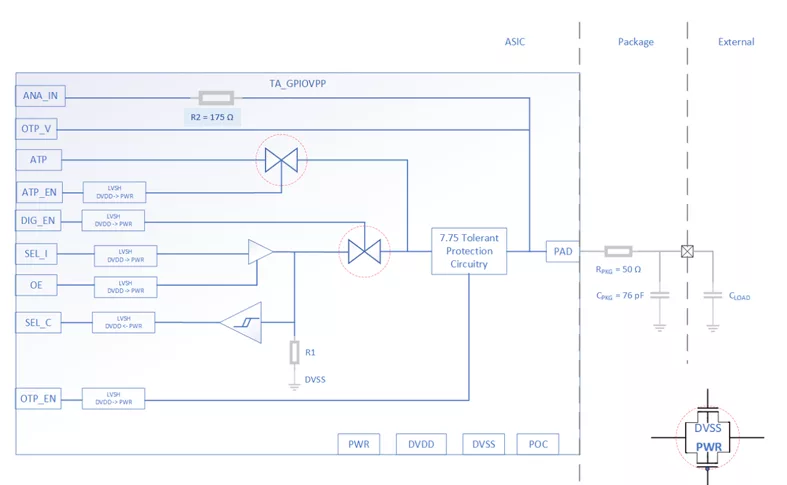
This silicon-proven, wirebond library in GlobalFoundries 180nm BCD lite is a specialty I/O similar to Soundwire. Featuring a 1.5V to 3.3V GPIO, as well as a tri-state output driver, an analog test point switch, and 7V OTP mode. The library is designed to be compliant with the following standards: I2C, I3C, DDC, CEC and SPI. ESD protection is include. ESD targets are 2kV HBM and 500V CDM. Library also features power and ground cells.

 Operating Conditions

Parameter Value
VDDIO 1.5V to 3.3V
Core VDD 1.45V
Tj -40C to 125C

 Cell Size and Metal Stack

Cell Size Metal Stack
125x153um (GPIO) 1P5M
115x130um (PWR/GND) 1P5M

 Library Cell Summary

Cell Type Feature
Supply 1.52V/1.6V/2.8V/3.3V
GPIO 250MHz Input, 10MHz Output

  Standards

  •   I2C and I3C
  •   DDC, CEC and SPI
  •   7V OTP pin
  •   Analog Test MUX

Key features

  • Multi-voltage 1.5V and 3.3V operation
  • Tri-state output driver
  • Schmitt Trigger Receiver
  • Analog Test Point Switch
  • 7V OTP mode
  • 2kV HBM, 500V CDM
  • 330 direct contact to housing item 18kV air discharge protection

Block Diagram

Silicon Options

Foundry Node Process Maturity
GlobalFoundries 180nm 180 1800 nm

Specifications

Identity

Part Number
TA18
Vendor
Certus Semiconductor
Type
Silicon IP

Files

Note: some files may require an NDA depending on provider policy.

Provider

HQ: United States

Learn more about GPIO IP core

One Platform, Five Libraries: Certus Semiconductor’s I/O IP Portfolio for Every Application on TSMC 22nm ULL/ULP Technologies

Certus Semiconductor’s I/O libraries for TSMC’s 22nm ultra-low leakage (22ULL) and 22nm ultra-low power (22ULP) technologies offer robust, high-performance solutions tailored to a wide range of SoC designs — from ultra-low power IoT nodes to demanding consumer and automotive systems. Whether you need low leakage, high drive strength, or analog compatibility, our production-proven IP covers it all.

GPIO Solutions for CERN’s Radiation-Hardened Applications

For over a decade, Sofics has collaborated with CERN, the European Organization for Nuclear Research. Sofics has delivered advanced GPIO cells tailored for radiation-hardened applications, supporting CERN’s groundbreaking particle physics experiments.

A Generic Solution to GPIO verification

This paper provides a complete solution to the GPIO Verification for any SoC. GPIO interface is available in every ASIC. To avoid duplicate efforts and (save) time to verify the GPIO interface, we have produced this Generic GPIO verification suite. It is a UVM-based verification environment, with all the necessary subcomponents that are required to verify any GPIO design.

How AI and Edge Computing Are Accelerating RISC-V Adoption

One of the critical problems in today’s computing is that transporting data can be more costly in energy and time than computing. With the growing complexity of AI models, SoC designers have shifted their focus toward optimizing memory hierarchies, increasing bandwidth in interconnects, and architecting based on workloads for improved efficiency.

Ensuring reliability in Advanced IC design

To complete our task as engineers we rely on the tools we use. We collaborated with Siemens EDA solutions back in 2025 on a webinar about how we use their tools to develop our designs and layouts.

Frequently asked questions about GPIO Pad Library IP cores

What is 1.5V to 3.3V GPIO with Tri-State Output Driver in GF 180nm?

1.5V to 3.3V GPIO with Tri-State Output Driver in GF 180nm is a GPIO IP core from Certus Semiconductor listed on Semi IP Hub. It is listed with support for globalfoundries.

How should engineers evaluate this GPIO?

Engineers should review the overview, key features, supported foundries and nodes, maturity, deliverables, and provider information before shortlisting this GPIO IP.

Can this semiconductor IP be compared with similar products?

Yes. Buyers can compare this product with similar semiconductor IP cores or IP families based on category, provider, process options, and structured technical specifications.

×
Semiconductor IP