AV1 Image File Format Specification Gets an Upgrade with AVIF v1.2.0

AVIF v1.2.0 includes support for sample transforms
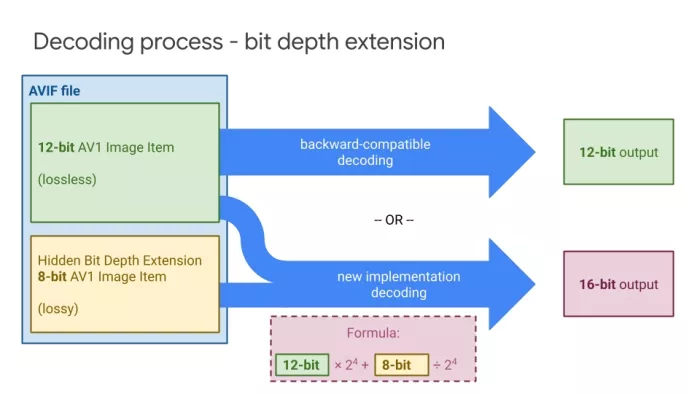
The files encoded with a bit depth extension relying on Sample Transforms are backward-compatible in the sense that they can be decoded for up to 12-bit precision by legacy implementations. They can also deliver the full 16-bit precision (or more!) with newer software.
AOMedia's Storage and Transport Format Working Group has released AVIF v1.2.0, a new revision of the AV1 Image File Format specification. The work is part of AOMedia’s broader effort to advance high-quality still image storage and ensure consistent mapping between codecs and container formats. The latest specification refines the format and introduces functional enhancements, most notably, support for sample transforms.
Key Features and Innovations
The addition of sample transforms makes it possible to use higher bit depths, even when the underlying codec does not natively support 16-bit or greater precision. This enhancement empowers creators to achieve superior image quality and greater flexibility in high-fidelity imaging workflows.
To try sample transforms, clone and build libavif, then use a command such as:
build/avifenc input_16bit.png --depth 12,8 output.avif
This produces an AVIF file that preserves the top 12 bits for compatibility, with the full 16-bit image retrievable during decoding
As an example, encoding the image [1] with avifenc --depth 12,8 --lossless --speed 0 leads to 10% file size savings over the source 16-bit PNG, with absolutely no quality loss. The encoded AVIF is also backward compatible for 12 bits out of 16 with legacy AVIF decoders. (Results may vary depending on settings.)
The release also strengthens conformance, clarifies the mapping between AV1 bitstream metadata and file-level signaling, and updates references and requirements to align with the latest HEIF, ISOBMFF, and MIAF specifications. Editorial Improvements include a new list of required boxes for AVIF files to help developers generate standard-compliant files.
Additionally, the new specification includes guidance on gain maps—tone map derived image items, which are a method for encoding AVIF HDR images that are backward compatible with SDR displays.
Ready to get started?
Review the AVIF v1.2.0 specification and try out sample transforms using the latest libavif implementation on GitHub. We welcome feedback and contributions—share your experience or questions in the libavif GitHub repository and help shape the future of open image formats with AOMedia.
Related Semiconductor IP
- AV1 Video Encoder IP
- Video CODEC - AV1, HEVC, AVC, VP9 (VP9: Decoder only)
- Video Decoder - AV1, HEVC, AVC, VP9
- Video Decoder - AV1, HEVC, AVC
- Video CODEC - AV1, HEVC, AVC, VP9 (VP9: Decoder only)
Related Blogs
- Tag it! Your customer will love using IP compliant with TSMC9000 IP Tag specification
- Specification Ambiguities of MIPI UniPro v1.41 clarified in MIPI UniPro v1.6
- Analysis: FPGA vendor to buy IC vendor Silicon Image
- Show report: Image Sensor Auto
Latest Blogs
- Ensuring reliability in Advanced IC design
- A Closer Look at proteanTecs Health and Performance Management Solutions Portfolio
- Enabling Memory Choice for Modern AI Systems: Tenstorrent and Rambus Deliver Flexible, Power-Efficient Solutions
- Verification Sanity in Chiplets & Edge AI: Avoid the “Second Design” Trap
- Embedded Security explained: Cryptographic Hash Functions