Simulation VIP for MIPI D-PHY, C-PHY and A-PHY
Cadence provides a mature and comprehensive Verification IP (VIP) for the D-PHY/C-PHY/A-PHY, which is part of the MIPI family.
Overview
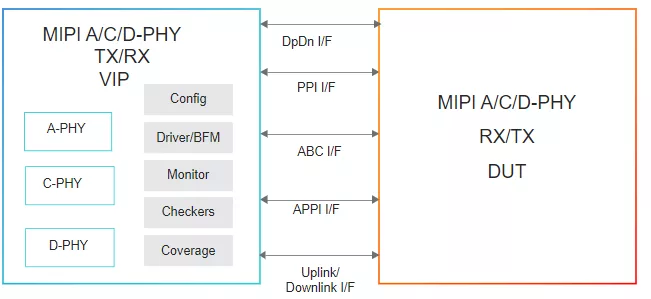
Cadence provides a mature and comprehensive Verification IP (VIP) for the D-PHY/C-PHY/A-PHY, which is part of the MIPI family. Incorporating the latest protocol updates, the Cadence Verification IP for D-PHY/C-PHY/A-PHY provides a complete bus functional model (BFM), integrated automatic protocol checks, and coverage model. Designed for easy integration in testbenches at IP, system-on-chip (SoC), and system levels, the VIP for D-PHY/C-PHY/A-PHY helps you reduce time to test, accelerate verification closure, and ensure end-product quality. The VIP runs on all major simulators and supports SystemVerilog verification language along with associated methodologies, including the Universal Verification Methodology (UVM) and Open Verification Methodology (OVM).
Supported Specification: MIPI specifications for D-PHY v2.1 and v2.5; C-PHY v1.2, v2.0, and v2.1; and A-PHY v1.0 and v1.1
Key features
- PHY Monitor
- Built-in scoreboarding between serial/PPI interface, also monitors error signal interface
- Reports any detected error on any lane on serial interface and is not reflected on PPI interface
- C-PHY and D-PHY
- PHY Interfaces
- Supports D-PHY 2.5 and C-PHY 2.0 with both PHY interfaces (Serial (DpDn for D-PHY and ABC for C-PHY) and PPI)
- Operation Mode
- Supports Control, HighSpeed, and Escape in LP and ALP operating modes
- Clock
- Supports continuous and non-continuous operation mode for DPDN
- Supports continuous TxWordClkHS and RxWordClkHS clock operation for PPI
- PPI Data Bus Width
- Supports 16- and 32-bit PPI data bus width over C-PHY
- Supports 8-, 16-, and 32-bit PPI data bus width over D-PHY
- Data Lanes
- Supports one to eight D-PHY/C-PHY data lanes
- Bi-Directional Data Lane Turnaround
- Supports Control Mode and Fast Lane Turnaround for D-PHY and C-PHY (Forward-to-Reverse direction or Reverse-to-Forward direction)
- Ultra-Low Power Mode (ULPM)
- Supports one to eight D-PHY/C-PHY data lanes
- Triggers
- Supports all four trigger commands, including low-power data after trigger transmission and low-power data pause
- HS-Idle
- Supports transmission and detection of HS-Idle state between two HS bursts for D-PHY
- Skew Calibration
- Supports Initial, Periodic, and Alternate Skew Calibration(PRBS9 generation) for D-PHY
- Prog-seq
- Supports injection and detection of optional user-programmable sequence as part of the HS preamble for C-PHY
- Sync Word
- Supports driving and detecting multiple sync words and its different types within HS burst for C-PHY
- Calibration Preamble
- Supports driving and detection of all three different formats of Calibration Preamble in HS burst for C-PHY
- Alternative Low Power
- Supports transmission and detection of ALP mode and different ALP Control codes for C-PHY and D-PHY
- Supports PHY initialization and its detection in ALP mode
- Memory Callbacks for Event Notifications
- Supports D-PHY and C-PHY (DpDn and PPI) event notifications (Trigger Detected, ESC Abort Detected, etc.)
- Error Injection
- Supports injection of errors at PHY level, for example, ERRSOTHS, and ERREOTSYNCHS
- Preamble Sequence
- Supports transmission and detection of Preamble sequence during Start Of Transmission (SOT) in D-PHY
- Test Debug pattern
- Supports C-PHY test debug patterns
- Dynamic LP-ALP operation
- Supports C-PHY dynamic LP-ALP operation
- 8b9b Encoding
- Supports D-PHY 8b9b encoding
- A-PHY
- APPI Data Bus Width
- 16-, 32-, and 64-bit APPI data bus width for all Link Rates. One to four APPI per A-PHY device
- Physical Coding Sub-Layer (PCS) and Gears
- Serial Port supported over 8b/10b and PAM PCS for all gears from G1 to G5. One to four Serial Ports per A-PHY device
- ReTransmission
- Supports Full RTS and RTS Bypass with configurable Single/Gap ReTransmission request
- Startup Procedures
- Mission Mode and Unidirectional are supported
- Operation mode
- Active/Non-Active mode with WUP protocol
- Data Link Layer
- Configurable Data Link Layer will full control of Multiport Routing and Duplication and Local Function
- Link Services
- Supports Remote Sleep Command, KeepAlive, and configurable BIST
- PAM Dual-Lane Downlink
- Support for driving PAM data on downlink using two lanes
- PAM/8b10b Reverse Downlink
- Support driving on reverse downlink using PAM/8b10b PCS
- Double-Rate Uplink
- Supports driving on uplink using double rate uplink
- Time Base Service
- Support to provide local A-PHY clock information in CFS packets, instead of native application clock
- Running Time Base Service
- Support to provide a generic way for adding time stamp information on tunneled traffic
- Extended BIST
- Support for sending/ receiving extended BIST packet with fields like MC, CRC, and TimeStamp added to payload as per configuration. Also support for sending PRBS data instead on Basic (0s) as payload for BIST packet
- Repetitive Scrambler Reset
- Supports resting scrambler seed to a definite value, once a configured count is reached
- Test Mode
- TM1 — Test mode pattern is generated for length (2^17 and 2^20 for SC2)
- TM-4 — Test mode pattern is generated for length 2^12 for NRZ and for PAM 2^15
- TM6 — Test mode to provide unidirectional startup support, based on T2K,T2I, and T2N timers configured
Block Diagram
Files
Note: some files may require an NDA depending on provider policy.

Specifications
Identity
Provider
Learn more about MIPI PHY IP core
MIPI DPHY Solution
Infineon Drives Automotive MCU Performance Higher with Synopsys Interface IP
Cadence First to Demo Complete M-PCIe PHY and Controller Solution at MIPI and PCI-SIG Conferences
Super Edge Medical SoC (SEMC)
D-PHY, M-PHY & C-PHY? First Look at Testing MIPI's Latest PHY
Frequently asked questions about MIPI PHY IP
What is Simulation VIP for MIPI D-PHY, C-PHY and A-PHY?
Simulation VIP for MIPI D-PHY, C-PHY and A-PHY is a MIPI PHY IP core from Cadence Design Systems, Inc. listed on Semi IP Hub.
How should engineers evaluate this MIPI PHY?
Engineers should review the overview, key features, supported foundries and nodes, maturity, deliverables, and provider information before shortlisting this MIPI PHY IP.
Can this semiconductor IP be compared with similar products?
Yes. Buyers can compare this product with similar semiconductor IP cores or IP families based on category, provider, process options, and structured technical specifications.