Vendor: Qbit labs Category: MIPI

MIPI CSI-2

MIPI CSI-2

Key features

  •  Fully MIPI CSI-2 standard compliant
  •  64 and 32-bit core widths
  •  Transmit and Receive versions
  •  Supports 1-8, 9.0+ Gbps D-PHY data lanes
  •  Supports 1-4, 6.0+ Gsym/s C-PHY lane (trio)
  •  Supports all data types
  •  Easy-to-use pixel-based interface
  •  Optional AXI interface (Rx only)
  •  Optional video interface
  •  Delivered fully integrated and verified with target MIPI PHY
  •  Complete FPGA-based demonstration system available
  •  Optional ASIL-B Ready safety deliverables

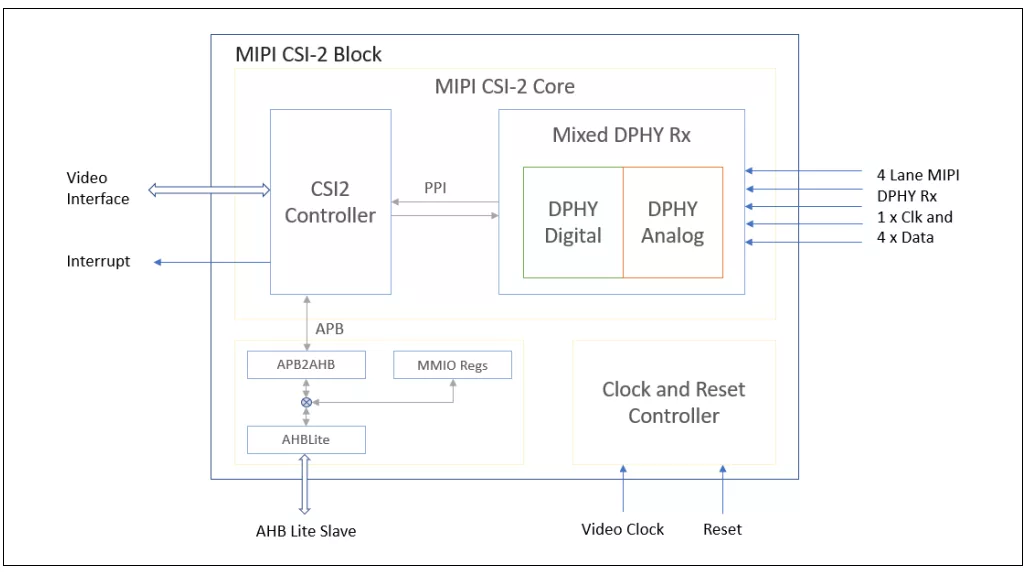
Block Diagram

Benefits

  •  Fundamental Features: High performance. Low electromagnetic interference (EMI)
  •  Physical Layer: MIPI D-PHY, MIPI C-PHY, MIPI A-PHY.
  •  Use Cases: Machine vision. Imaging
  •  High Bandwidth: MIPI CSI-2 provides high-speed serial communication, allowing for high data transfer rates between the camera and the    processor. This is crucial for handling high-resolution images and videos.
  •  Low Power Consumption: MIPI CSI-2 is designed to be power-efficient, which is crucial for mobile devices and other battery-powered    applications. It helps in minimizing power consumption during image and video data transfer.
  •  Reduced Cable and Connector Complexity: MIPI CSI-2 uses a high-speed serial interface, reducing the need for numerous cables and    connectors compared to parallel interfaces. This simplifies the design and reduces the overall size and weight of the system.
  •  Scalability: MIPI CSI-2 is scalable, accommodating different numbers of data lanes to support various bandwidth requirements. This    scalability makes it suitable for a range of applications, from low-power mobile devices to high-performance automotive systems.
  •  Interoperability: MIPI CSI-2 is an industry standard, promoting interoperability between different devices from various manufacturers.    This allows for a wide range of cameras and processors to work together seamlessly.
  •  Robustness and Reliability: MIPI CSI-2 is designed to be robust and reliable, even in challenging environments. This is particularly    important for automotive applications, where the system may be exposed to varying temperatures and vibrations.

Applications

  •  Mobile Devices: MIPI CSI-2 is extensively used in smartphones, tablets, and other mobile devices to connect cameras (rear and front-    facing) to the device's processor. It enables high-speed, low-power data transfer, which is essential for capturing and processing high-    resolution images and videos.
  •  Automotive: MIPI CSI-2 is used in automotive applications for connecting cameras used in advanced driver assistance systems (ADAS),    surround-view systems, and in-vehicle infotainment systems. It provides a standardized interface for efficient data transfer between    cameras and processing units.
  •  Industrial Cameras: MIPI CSI-2 is employed in industrial camera systems, such as those used in machine vision applications, robotics,    and surveillance. Its high-speed data transfer capabilities make it suitable for demanding industrial imaging requirements.
  •  Drones and UAVs: MIPI CSI-2 is used in camera systems for drones and unmanned aerial vehicles (UAVs). It allows for the transmission    of high-quality images and videos from the drone's cameras to the processing unit.
     

Files

Note: some files may require an NDA depending on provider policy.

Specifications

Identity

Part Number
MIPI CSI-2
Vendor
Qbit labs

Provider

Qbit labs
HQ: USA
We’re Qbit labs, an engineering services company made of smart people who provide solutions to the problems.

Learn more about MIPI IP core

MIPI CCI over I3C: Faster Camera Control for SoC Architects

Imagine a camera subsystem that responds in microseconds, consumes less power, and offers a more straightforward route to time-to-market. For SoC architects and IP integration teams, that vision is increasingly possible with MIPI Camera Control Interface (CCI) over I3C.

MIPI MPHY 6.0: Enabling Next-Generation UFS Performance

High-speed chip-to-chip data transfer is continuously evolving to meet increasing performance demands. MIPI MPHY is a high-speed physical layer interface developed by the MIPI Alliance. This protocol is used for high-speed chip-to-chip interfaces, mainly in mobile and automotive devices.

MIPI: Powering the Future of Connected Devices

From the first monochrome mobile displays to today’s ultra-high-definition automotive dashboards and immersive AR/VR headsets, MIPI technology has quietly become the backbone of modern data connectivity. Let’s explore how MIPI standards have evolved, the markets they serve, and why Rambus is at the forefront of this transformation.

Frequently asked questions about MIPI IP cores

What is MIPI CSI-2?

MIPI CSI-2 is a MIPI IP core from Qbit labs listed on Semi IP Hub.

How should engineers evaluate this MIPI?

Engineers should review the overview, key features, supported foundries and nodes, maturity, deliverables, and provider information before shortlisting this MIPI IP.

Can this semiconductor IP be compared with similar products?

Yes. Buyers can compare this product with similar semiconductor IP cores or IP families based on category, provider, process options, and structured technical specifications.

×
Semiconductor IP