Vendor: Codasip Category: CPU

Dual-issue Linux-capable RISC-V core

The A730 is a dual-issue, in-order, 64-bit application processor capable of running Linux.

Overview

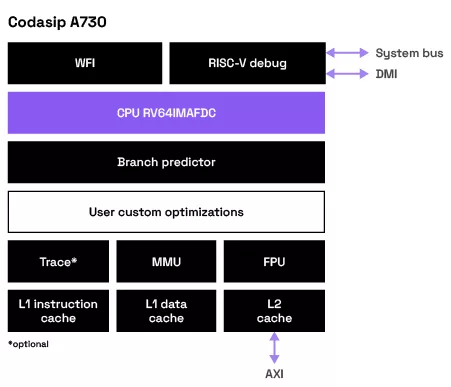
The A730 is a dual-issue, in-order, 64-bit application processor capable of running Linux. The core is compatible with the RISC-V RVA22 profile. The core includes a hardware floating point unit, L1 data & instruction caches, an L2 cache and an MMU. Tessent trace is available as an option.
The core supports wait for interrupt (WFI) and non-maskable interrupts (NMI) and works with a platform-level interrupt controller (PLIC). It has an AXI-5 128-bit bus interface.
The A730 core has a wide range of configuration options.

Key features

  • 64-bit RISC-V core
  • RVA22 profile
  • Linux capable
  • Dual-issue superscalar
  • In-order 7-9 stage pipeline
  • Interrupt controller options
    • WFI
    • NMI
    • PLIC
  • Dynamic jump prediction
  • FPU
  • L1 data and instruction caches
  • L2 cache
  • MMU
  • On-chip debugger
  • Optional trace

Block Diagram

Benefits

  • Standards compliance
    • RISC-V RVA22 profile
  • Code density
    • Zc extensions
  • High configurability with Codasip Studio

Applications

  • Communications
  • Industrial electronics
  • Automotive
  • Consumer electronics
  • Wearables
  • Advanced cameras

What’s Included?

  • Hardware development kit (HDK)
    • Human-readable System Verilog RTL
    • Synthesis scripts
    • Simulation testbenches
    • Debug support
  • Software development kit (SDK)
    • GCC C-compiler
    • Assembler
    • Disassembler
    • Linker
    • Instruction-accurate simulator
    • Cycle-accurate simulator
    • Profiler
  • Options for configuring A730
    • CodAL model for Codasip Studio
    • Full-feature Studio tool for configuring A730 core

Files

Note: some files may require an NDA depending on provider policy.

Specifications

Identity

Part Number
Codasip A730
Vendor
Codasip

Provider

Codasip
HQ: Germany
With semiconductor scaling failing, it is becoming necessary to design specialised cores optimised to a particular workload. With its open and modular ISA, RISC-V is a good basis on which to build a domain-specific accelerator. Codasip’s family of RISC-V cores covers the range from simple embedded applications to application processors capable of running Linux. The cores offer a variety of different pipeline lengths and computational options. These cores can be supplied in standard off-the-shelf configurations or can be extended using the Codasip Studio tool to achieve your unique processing requirements. Codasip Studio – used to develop the Codasip RISC-V cores – allows hardware and software design kits to be automatically generated from a high-level processor description language. Codasip began operations as a spinout from the Brno University of Technology/Faculty of Information Technology in 2014 based on 10 years of research. Codasip is a founding member of the RISC-V International and was the first company to offer a commercial RISC-V IP core in 2015. Today in addition to the original R & D centre in Brno, Czech Republic, Codasip has design centres in France and the UK. Codasip has sales offices in Europe, North America, China, Japan and Korea.

Learn more about CPU IP core

Announcing Arm AGI CPU: The silicon foundation for the agentic AI cloud era

For the first time in our more than 35-year history, Arm is delivering its own silicon products – extending the Arm Neoverse platform beyond IP and Arm Compute Subsystems (CSS) to give customers greater choice in how they deploy Arm compute – from building custom silicon to integrating platform-level solutions or deploying Arm-designed processors.

Encarsia: Evaluating CPU Fuzzers via Automatic Bug Injection

Hardware fuzzing has recently gained momentum with many discovered bugs in open-source RISC-V CPU designs. Comparing the effectiveness of different hardware fuzzers, however, remains a challenge: each fuzzer optimizes for a different metric and is demonstrated on different CPU designs.

Pie: Pooling CPU Memory for LLM Inference

Pie maintains low computation latency, high throughput, and high elasticity. Our experimental evaluation demonstrates that Pie achieves optimal swapping policy during cache warmup and effectively balances increased memory capacity with negligible impact on computation. With its extended capacity, Pie outperforms vLLM by up to 1.9X in throughput and 2X in latency. Additionally, Pie can reduce GPU memory usage by up to 1.67X while maintaining the same performance. Compared to FlexGen, an offline profiling-based swapping solution, Pie achieves magnitudes lower latency and 9.4X higher throughput.

Frequently asked questions about CPU IP cores

What is Dual-issue Linux-capable RISC-V core?

Dual-issue Linux-capable RISC-V core is a CPU IP core from Codasip listed on Semi IP Hub.

How should engineers evaluate this CPU?

Engineers should review the overview, key features, supported foundries and nodes, maturity, deliverables, and provider information before shortlisting this CPU IP.

Can this semiconductor IP be compared with similar products?

Yes. Buyers can compare this product with similar semiconductor IP cores or IP families based on category, provider, process options, and structured technical specifications.

×
Semiconductor IP