Vendor: TES Electronic Solutions Category: CPU

Configurable CPU tailored precisely to your needs

The TES µEngine concept enables complex digital circuit tasks to be created as software-defined functions executed by mini-comput…

Overview

The TES µEngine concept enables complex digital circuit tasks to be created as software-defined functions executed by mini-computers. Each task is assigned to a dedicated µEngine optimized for efficiency, deterministic behavior, and real-time performance.

CONCEPT

A µEngine is based on a configurable CPU called µCore. The µCore remains in source code until a generator creates its synthesizable HDL code according to a specific configuration. Only the required hardware components for the instruction set are generated, keeping the size minimal. Combined with memory and peripherals, the µCore forms the µEngine. Tasks can be defined in C language and are stored in ROM, making the µEngine a true “Software Defined Device”.

Advantages of this approach include decoupling hardware and software development, reducing time-to-market, and enabling late-stage software changes. Programmable ROM options (OTP, EEPROM, Flash) allow updates even after tape-out or in-field use.

RAISE SYSTEM

The RAISE system (Related Array of Independent Single-tasking µEngines) supports the parallel execution of different tasks, enabling the efficient implementation of complex operations. Each µEngine can be optimized for its specific function and disabled when not needed to save power.

An entire RAISE system with multiple µEngines operating in parallel, can be cycle-accurately simulated on a PC, ensuring predictable runtime and avoiding hardware dependency during early development.
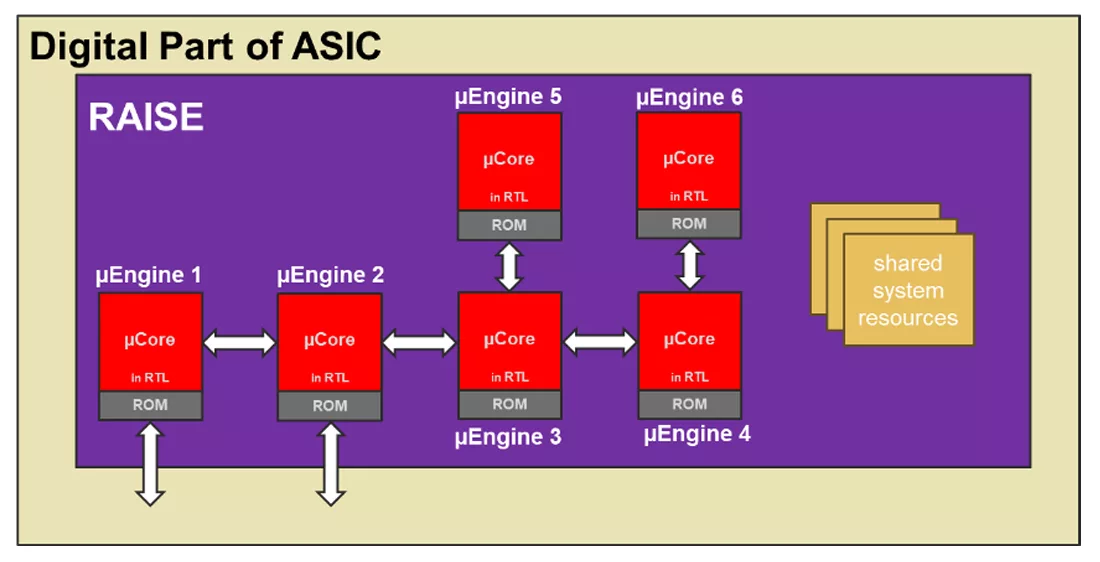

Block Diagram

Benefits

  • Increased efficiency by converting digital design into software development  
  • Hardware independent and parallel Software development  
  • Rapid system development and evaluation:  
  • Software debug and tests with RAISE Simulator  
  • Peripherals modeled as executable Python scripts   
  • Evaluation of system functionality during design and conception  
  • Cycle-accurate instruction simulation  
  • Ready-to-use: Verified IP block reuse reduces verification effort  
  • Reduced simulation effort – software changes do not require gate-level simulation  
  • Flexibility and maintainability through software updates without RTL changes  
  • Faster time-to-market via accelerated development  

Applications

  • Complex state-machines  
  • Digital filters  
  • Interface controllers  
  • Protocol converters  
  • Hardware accelerators  
  • Specialized embedded microcontrollers  
  • Specialized parallel processor structures  
  • Feedback loop controllers (PD, PI, PID)  
  • Brushless DC motor controllers 

Files

Note: some files may require an NDA depending on provider policy.

Specifications

Identity

Part Number
TES μEngine
Vendor
TES Electronic Solutions

Provider

TES Electronic Solutions
HQ: Germany
TES Electronic Solutions is a global electronic technology and services company offering innovative solutions and custom electronic design as well as a blend of hardware (for ASICs and FPGAs) and software IP. Besides designing customer specific systems or sub-systems that are optimized to customers’ applications, TES also develops licensable wireless, graphics,GUI, video-IO and multimedia IP accelerating time to market. From its design centers in Germany, and with its broad expertise in GUI concepts, industrial design, hardware-, software-, FPGA- and ASIC-development TES provides innovative solutions in the areas of RF / wireless, professional multimedia, embedded graphics and RF / mixed-signal ASICs. TES serves a wide range of customers from well-known highly specialized middle-size companies to global market leaders.

Learn more about CPU IP core

Announcing Arm AGI CPU: The silicon foundation for the agentic AI cloud era

For the first time in our more than 35-year history, Arm is delivering its own silicon products – extending the Arm Neoverse platform beyond IP and Arm Compute Subsystems (CSS) to give customers greater choice in how they deploy Arm compute – from building custom silicon to integrating platform-level solutions or deploying Arm-designed processors.

Encarsia: Evaluating CPU Fuzzers via Automatic Bug Injection

Hardware fuzzing has recently gained momentum with many discovered bugs in open-source RISC-V CPU designs. Comparing the effectiveness of different hardware fuzzers, however, remains a challenge: each fuzzer optimizes for a different metric and is demonstrated on different CPU designs.

Pie: Pooling CPU Memory for LLM Inference

Pie maintains low computation latency, high throughput, and high elasticity. Our experimental evaluation demonstrates that Pie achieves optimal swapping policy during cache warmup and effectively balances increased memory capacity with negligible impact on computation. With its extended capacity, Pie outperforms vLLM by up to 1.9X in throughput and 2X in latency. Additionally, Pie can reduce GPU memory usage by up to 1.67X while maintaining the same performance. Compared to FlexGen, an offline profiling-based swapping solution, Pie achieves magnitudes lower latency and 9.4X higher throughput.

Frequently asked questions about CPU IP cores

What is Configurable CPU tailored precisely to your needs?

Configurable CPU tailored precisely to your needs is a CPU IP core from TES Electronic Solutions listed on Semi IP Hub.

How should engineers evaluate this CPU?

Engineers should review the overview, key features, supported foundries and nodes, maturity, deliverables, and provider information before shortlisting this CPU IP.

Can this semiconductor IP be compared with similar products?

Yes. Buyers can compare this product with similar semiconductor IP cores or IP families based on category, provider, process options, and structured technical specifications.

×
Semiconductor IP