Vendor: Key ASIC Category: Single-Protocol PHY

DDR3 and DDR4 Controller and PHY on TSMC 12nm

This DDR3/4 IP combo solution presented, is meticulously designed for high performance and low power consumption, utilizing sophi…

TSMC 12nm FFC Silicon Proven View all specifications

Overview

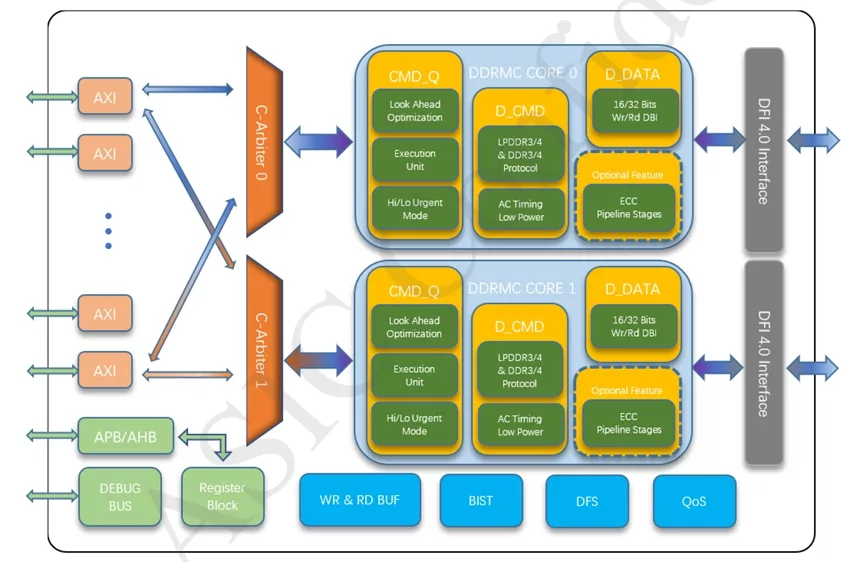
This DDR3/4 IP combo solution presented, is meticulously designed for high performance and low power consumption, utilizing sophisticated architecture and advanced technology. Fabricated in TSMC’s 12nm CMOS process, this solution includes both controller and PHY IPs, providing comprehensive support for DDR3 and DDR4 memory interfaces. The DDR4 interface achieves speeds of up to 3200Mbps. Architecturally, it features a Multiport AMBA AXI interface, with configurable port numbers and support for both asynchronous and synchronous AXI ports. The PHY interface integrates a DFI 4.0 compatible design, with three embedded de-skew PLLs to enhance jitter performance.

Key features

  • Support DDR4 up to 3200Mbps speed, DDR3 up to 2133Mbps 
  • Support Multiport AMBA AXI4 interface, port number, asynchronous or synchronous AXI port, data width,  FIFO depth, and command queue depth configurable; 
  • Support DFI4.0 compliant interface between controller and PHY; 
  • Support 2 ranks, max density up to 8GB; 
  • Support automatic temperature monitor and refresh rate adjust; 
  • Support CA, write, read VREF eye training and per-bit de-skew training, write leveling  training; 
  • Support Inline BIST and SIPI/LFSR/USER patterns; 
  • Support DDRPHY loopback test; 
  • Support fully pin-mux easy for PKG/PCB routing; 
  • Support mask write, write/read DBI; 
  • Support 2T CA timing, CA parity, and gear down mode; (DDR4) 
  • Support ECC (error correcting code), 32/64bit data+8bit ECC, correct 1bit-error and detect  2bit-error; (DDR4) 

Block Diagram

Benefits

  • Optimized for high bandwidth and low latency
  • Suitable for high-performance, low-power SoC integration
  • Simplifies DDR integration with pre-verified PHY and controller
  • Reduced risk with built-in training, BIST, and loopback features

Applications

  • AI SoC, Consumer Electronics, Networking, Industrial Control, Storage Controllers

What’s Included?

  • Datasheet with integration guidelines
  • Register Map, Timing Sheet
  • Encrypted RTL + Netlist + Layout (.LEF, GDS, SDF)
  • Verification environment & testbenches
  • SDC constraints

Silicon Options

Foundry Node Process Maturity
TSMC 12nm FFC Silicon Proven

Specifications

Identity

Part Number
KAT12DDR34
Vendor
Key ASIC

Provider

Key ASIC
HQ: Malaysia
Key ASIC was incorporated in the year 2005. In 2006, we were awarded Multimedia Super Corridor (MSC) Status by the Malaysia Digital Economy Corporation (MDEC). We started with the design of IP, ASIC, and SoC. In 2009, we were listed on the main board of KLSE. Khazanah and CIMB are our main investors. Key ASIC is not only a leading ASIC / SoC design service company, we are also a turnkey service company from spec-in to system module that focuses on AI chips, IoT, and medical applications. We are committed to providing customers with competitive SoC professional one-stop design services in terms of PPA (Performance, Power, and Area). Based in Kuala Lumpur, Malaysia with R&D Centers in Malaysia and Tai Yuen Hi-Tech Industrial Park Taiwan, Key ASIC provides ODM and OEM of ASIC design services from Specification, RTL, Netlist to silicon, as well as process migration from GDSII. Our experienced SoC designer and engineers combined with extensive manufacturing, logistics resources, and a flexible engagement model can provide Key ASIC customers with a comprehensive support system for modular ASIC innovation from IP development through prototype to production.

Learn more about Single-Protocol PHY IP core

UFS Goes Mainstream

UniversalFlash Storage (UFS) was created for mobile applications and computer systems requiring high performance and low power consumption. These systems typically use embedded Flash based on the JEDEC standard eMMC. UFS was defined by JEDEC as the evolutionary replacement for eMMC offering significantly higher memory bandwidth. The standard builds on existing standards such as the SCSI command set, the MIPI Alliance M-PHY and UniPro as well as eMMC form factors to simplify adoption and development.

Design IP Faster: Introducing the C~ High-Level Language

In this paper, we introduce a new high-level, dataflow programming language called C~ (“C flow”) that further increases productivity by raising the level of abstraction from behavioral descriptions, while overcoming the limitations of C for hardware design. We present the syntax and semantics of this language, and the framework that provides hardware and software code generation. This paper illustrates the benefits of using C~ for hardware design of a IEEE 802.3 MAC, synthesized for FPGA and for 90nm CMOS technology.

Universal Flash Storage: Mobilize Your Data

Universal Flash Storage (UFS) was created for mobile applications and computer systems requiring high performance and low power consumption. These systems typically use embedded Flash based on the JEDEC standard eMMC. UFS was defined by JEDEC as the evolutionary replacement for eMMC offering significantly higher memory bandwidth. The standard builds on existing standards such as the SCSI command set, the MIPI Alliance M-PHY and UniProSM as well as eMMC form factors to simplify adoption and development.

Can MIPI and MDDI Co-Exist?

Since MIPI and MDDI standards both target interfaces to cameras and displays on mobile devices, are two separate standards really needed?

Frequently asked questions about Single-Protocol PHY IP

What is DDR3 and DDR4 Controller and PHY on TSMC 12nm?

DDR3 and DDR4 Controller and PHY on TSMC 12nm is a Single-Protocol PHY IP core from Key ASIC listed on Semi IP Hub. It is listed with support for tsmc Silicon Proven.

How should engineers evaluate this Single-Protocol PHY?

Engineers should review the overview, key features, supported foundries and nodes, maturity, deliverables, and provider information before shortlisting this Single-Protocol PHY IP.

Can this semiconductor IP be compared with similar products?

Yes. Buyers can compare this product with similar semiconductor IP cores or IP families based on category, provider, process options, and structured technical specifications.

×
Semiconductor IP