Vendor:
Secure-IC
Category:
Post Quantum
Crypto Coprocessor with integrated Post-Quantum Cryptography IPs
The Crypto Coprocessors are a hardware IP core platform that accelerates cryptographic operations in System-on-Chip (SoC) environ…
Overview
The Crypto Coprocessors are a hardware IP core platform that accelerates cryptographic operations in System-on-Chip (SoC) environment on FPGA or ASIC.
Symmetric operations are offloaded very efficiently as it has a built-in scatter/gather DMA. The coprocessors can be used to accelerate/offload IPsec, VPN, TLS/SSL, disk encryption, or any custom application requiring cryptography algorithms.
Post-Quantum Cryptographic algorithms are including in the solutions to accelerate/offload security operations based on XMSS for FW verification, or on Crystals Kyber for secure Key Exchange, or also on Crystals Dilithium for Digital Signature.
Key features
- Scalable architecture and crypto engines for optimal performance/resource usage
- Configurable for perfect application fit
- 100% CPU offload with low latency and high throughput
- DPA countermeasures Full software/driver support
- Easy integration with AXI interfaces
- FIPS 140-2 validated: CAVP #C742
- Embedded DMA to optimize memory access
- Embedded TRNG for random seed generation
- Supported Traditional Cryptographic algorithms:
- AES/SM4
- SHA1/SHA2/SHA3/SM3 with HMAC
- RSA/ECC/SM2
- Chacha20-Poly1305
- ARIA
- Kasumi
- Snow3G
- ZUC
- DES
- Supported Post-Quantum Cryptographic algorithms :
- Crystals-Kyber/Crystals-Dilithium
- XMSS
- LMS
- SPHINCS+
Block Diagram
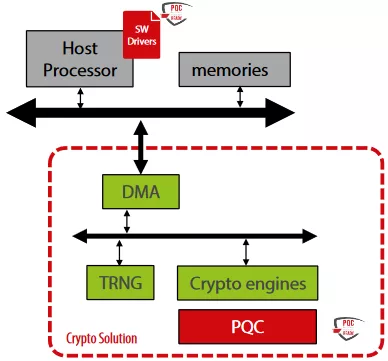
SCZ_CS_CW_PQC block diagram
Benefits
- The Coprocessors platform integrates your desired selection of our cryptographic IP cores (including our TRNG solutions), additional interfacing, DMA and software layers providing a complete solution.
- Depending on needs, the solution can be configured to embed only accelerators required for PQC algorithms, or a hybrid solution embedding both PQC algorithms and traditional cryptography.
Applications
- Secure Communication (TLS, IPSec, BLE, Zigbee, others…)
- Secure boot support
- Secure storage
What’s Included?
- Netlist or RTL
- SW drivers (Linux) & OpenSSL Scripts for implementations
- Self-checking RTL test-bench based on FIPS vectors
- Documentation
Specifications
Identity
Part Number
SCZ_CS_CW_PQC
Vendor
Secure-IC
Provider

Secure-IC
HQ:
France
With presence and customers across 5 continents, Secure-IC is the rising leader and the only global provider of end-to-end cybersecurity solutions for embedded systems and connected objects. Driven by a unique approach called PESC (Protect, Evaluate, Service & Certify), Secure-IC positions itself as a partner to support its clients throughout and beyond the IC design process. Relying on innovation and research activities, Secure-IC provides Silicon-proven and cutting-edge protection technologies, integrated Secure Elements and security evaluation platforms to reach compliance with the highest level of certification for different markets (such as automotive, AIoT, defense, payments & transactions, memory & storage, server & cloud).
Discover in preview of Secure-IC new Securyzr Server to manage the security of heterogeneous fleets of IoT devices throughout their lifecycle
Learn more about Post Quantum IP core
How to design secure SoCs Part IV: Runtime Integrity Protection
SoC designers are increasingly challenged to integrate robust security measures into their designs. Modern connected devices, such as automotive Electronic Control Units (ECUs), Internet of Things (IoT) nodes, and industrial control systems, face increasing susceptibility to cyberattacks. This escalating threat landscape underscores the critical importance of mandatory security requirements.
Nine Compelling Reasons Why Menta eFPGA Is Essential for Achieving True Crypto Agility in Your ASIC or SoC
Today’s world is already overly complicated to provide robust product security, with extremely motivated hackers creating novel threats exposing new vulnerabilities every day. But considering tomorrow’s world with the looming threat of quantum computing, expanding AI possibilities and rapidly evolving regional regulations and export control risk with severe financial penalties, this is a daunting challenge.
Deploying StrongSwan on an Embedded FPGA Platform, IPsec/IKEv2 on Arty Z7 with PetaLinux and PQC
The objective of this article is to present and analyze a concrete IPsec/IKEv2 deployment on an FPGA-based embedded Linux system. Using an Arty Z7 FPGA platform with PetaLinux and StrongSwan, the focus is on system-level integration rather than protocol theory: how the IPsec stack is built and deployed, how classical and post-quantum key exchange are integrated without modifying standardized protocols, and what architectural trade-offs arise when moving cryptographic operations into programmable logic.
A Comprehensive Post-Quantum Cryptography (PQC) Solution based on Physical Unclonable Function (PUF)
This article provides an in-depth analysis of the specific PPA challenges introduced by PQC and elucidates how PUF-PQC leverages its unique dualtrack strategy to deliver a robust and flexible Hardware Root of Trust (HRoT) across diverse application scenarios. Furthermore, it demonstrates the integration of Physical Unclonable Function (PUF) with a NIST SP 800-90B compliant True Random Number Generator (TRNG) to serve as critical components of PUFrt (Root of Trust), ensuring the security of post-quantum key generation starting from the entropy source.
Why Anti-tamper Sensors Matter: Agile Analog and Rambus Deliver Comprehensive Security Solution
If your device processes valuable data, controls a critical function, or connects to a wider network, it’s a target. Attackers don’t just try to break software; they increasingly physically tamper with hardware; probing, fault injecting, or opening enclosures to bypass protections and extract secrets. The consequences range from IP theft and fraud to orchestrated downtime across fleets of connected devices.
Frequently asked questions about Post-Quantum Cryptography IP cores
What is Crypto Coprocessor with integrated Post-Quantum Cryptography IPs?
Crypto Coprocessor with integrated Post-Quantum Cryptography IPs is a Post Quantum IP core from Secure-IC listed on Semi IP Hub.
How should engineers evaluate this Post Quantum?
Engineers should review the overview, key features, supported foundries and nodes, maturity, deliverables, and provider information before shortlisting this Post Quantum IP.
Can this semiconductor IP be compared with similar products?
Yes. Buyers can compare this product with similar semiconductor IP cores or IP families based on category, provider, process options, and structured technical specifications.