Vendor:
CAST
Category:
Post Quantum
ML-DSA Digital Signature Engine
The KiviPQC™-DSA is a hardware accelerator for post-quantum cryptographic operations.
Overview
The KiviPQC™-DSA is a hardware accelerator for post-quantum cryptographic operations. It implements the Module Lattice-based Digital Signature Algorithm (ML-DSA), standardized by NIST in FIPS 204. This mechanism realizes the appropriate procedures for securely generating a private/public key pair, digitally signing a message or a data block, and performing digital signature verification. The KiviPQC™-DSA supports all these procedures, making it suitable for both (signatory/verifier) sides.
The engine supports all three parameter sets for ML-DSA, i.e. ML-DSA-44, ML-DSA-65, and ML-DSA-87. It is based on a RISC-V-like SoC topology, including a 32-bit RISC-V based processor. Designed for straightforward integration, communication with the host is accomplished via an AMBA® AXI4-Lite Subordinate port.
Two versions are available: a Fast (F) and a Tiny (T) version. The Fast (F) includes hardware crypto accelerators, a hardware timer module, and a crossbar interconnect module for internal data routing. The Tiny (T) version is a more compact architecture, targeting low area, with no hardware crypto accelerators. Both versions are currently offered with a software implementation of a Random Byte Generator (RBG), however, they are able to be integrated with an external (third-party) entropy source and RBG, via a fully customized interface, depending on the entropy/RBG selection.
The KiviPQC™-DSA provides hardware acceleration for computationally intensive operations while maintaining a small footprint and can be integrated into any system-on-chip (SoC) for ASIC or FPGA implementation. Beyond that, it combines a minimal attack surface with modest resource requirements for future-proof and quantum-safe systems.
Key features
NIST FIPS Compliant
- Module Lattice-based Digital Signature Algorithm (ML-DSA)
- NIST FIPS 204
- All three ML-DSA parameter sets
- 44 / 65 / 87
Versions
- Fast (F): Enhanced performance, with balanced area
- Tiny (T): Compact architecture, targeting low area
Enhanced Security
- Self-contained engine with a minimal attack surface
- Protection against timing-based side channel attacks
Resource-efficient Acceleration
- Hardware offloading and acceleration of time-consuming PQC operations
- 600MHz, with 83k or less eq. gates in modern ASICs (F)
- Minimal logic utilization
- 35k or less eq. gates, at 100MHz in modern ASICs (T)
Straightforward SoC Integration
- Lightweight, simple-control AMBA® AXI4 Interface
- Re-usable design, LINT-clean
Block Diagram
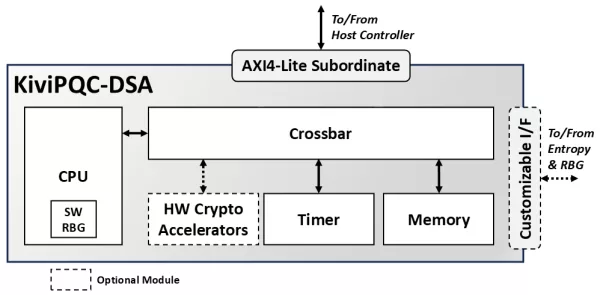
KiviPQC-DSA block diagram
Applications
- The KiviPQC™-DSA realizes a quantum-safe digital signature mechanism between two parties (signatory and verifier) communicating over a public channel. The signatory generates a private/public key pair. Next, using the private key, the signatory signs a message or data block (and optionally a context string). Then, the verifier, employing the public key (and optionally the context string) verifies the signature. Sending the signed message, accompanied with the signatory’s public key, to the verifier, as well as the context string, is not part of the ML-DSA quantum-safe digital signature mechanism.
- The ML-DSA mechanism is meant to replace RSA and ECDSA across the ecosystem wherever digital signatures are required — from websites, emails, and blockchains, to IoT, government ID systems, and secure updates. The KiviPQC™-DSA engine thus offers quantum-resistant security for a wide range of applications. It is suited for secure SoCs that need long-term protection against quantum attacks in critical applications such as TLS/SSL acceleration for secure web and cloud services, software and firmware signing for operating systems and IoT devices, secure VPN and messaging protocols, blockchain transaction signing, and digital identity solutions for e-government and enterprise systems.
What’s Included?
The core is available in RTL (System Verilog) source code.
Its deliverable package includes the following:
- Self-checking HDL testbench
- Hardware Abstraction Layer (HAL) and driver for the application processor
- Sample simulation & synthesis scripts
- User documentation
Specifications
Identity
Part Number
KiviPQC-DSA
Vendor
CAST
Type
Silicon IP
Security
Crypto Algorithm
CRYSTALS-Dilithium (ML-DSA)
Files
Note: some files may require an NDA depending on provider policy.
Provider

CAST
HQ:
USA
CAST is a silicon intellectual property (IP) developer, aggregator, and integrator providing IP cores and subsystems since 1993.
Our product line features both leading-edge and standards-based digital IP, including compression engines and image processing functions; 8051 microcontrollers and low-power 32-bit BA2X™ processors; industry-leading automotive interfaces; a complete family of SoC security modules; and a variety of peripherals, interfaces, and other IP cores.
Our goal is to maximize IP benefits for our customers by delivering high quality, easy to use, cost effective solutions for real system development challenges.
We minimize customer risk through rigorous development standards, complete deliverables with comprehensive documentation, and superlative customer support. We maximize customer value thorough competitive pricing and simple licensing—including royalty-free options—and long-term partnerships with all leading silicon providers and select technology leaders.
Our product standards and business practices have been uniquely honed through successful projects with hundreds of systems designers since the very beginnings of the IP industry, making CAST one of the best IP partners available.
Learn more about Post Quantum IP core
How to design secure SoCs Part IV: Runtime Integrity Protection
SoC designers are increasingly challenged to integrate robust security measures into their designs. Modern connected devices, such as automotive Electronic Control Units (ECUs), Internet of Things (IoT) nodes, and industrial control systems, face increasing susceptibility to cyberattacks. This escalating threat landscape underscores the critical importance of mandatory security requirements.
Nine Compelling Reasons Why Menta eFPGA Is Essential for Achieving True Crypto Agility in Your ASIC or SoC
Today’s world is already overly complicated to provide robust product security, with extremely motivated hackers creating novel threats exposing new vulnerabilities every day. But considering tomorrow’s world with the looming threat of quantum computing, expanding AI possibilities and rapidly evolving regional regulations and export control risk with severe financial penalties, this is a daunting challenge.
Providing protection against EMFI attacks
This Agile Analog blog post is focused on describing the dangers of Electromagnetic Fault Injection (EMFI) attacks and outlining the importance of EMFI sensors that are designed to provide protection.
Deploying StrongSwan on an Embedded FPGA Platform, IPsec/IKEv2 on Arty Z7 with PetaLinux and PQC
The objective of this article is to present and analyze a concrete IPsec/IKEv2 deployment on an FPGA-based embedded Linux system. Using an Arty Z7 FPGA platform with PetaLinux and StrongSwan, the focus is on system-level integration rather than protocol theory: how the IPsec stack is built and deployed, how classical and post-quantum key exchange are integrated without modifying standardized protocols, and what architectural trade-offs arise when moving cryptographic operations into programmable logic.
A Comprehensive Post-Quantum Cryptography (PQC) Solution based on Physical Unclonable Function (PUF)
This article provides an in-depth analysis of the specific PPA challenges introduced by PQC and elucidates how PUF-PQC leverages its unique dualtrack strategy to deliver a robust and flexible Hardware Root of Trust (HRoT) across diverse application scenarios. Furthermore, it demonstrates the integration of Physical Unclonable Function (PUF) with a NIST SP 800-90B compliant True Random Number Generator (TRNG) to serve as critical components of PUFrt (Root of Trust), ensuring the security of post-quantum key generation starting from the entropy source.
Frequently asked questions about Post-Quantum Cryptography IP cores
What is ML-DSA Digital Signature Engine?
ML-DSA Digital Signature Engine is a Post Quantum IP core from CAST listed on Semi IP Hub.
How should engineers evaluate this Post Quantum?
Engineers should review the overview, key features, supported foundries and nodes, maturity, deliverables, and provider information before shortlisting this Post Quantum IP.
Can this semiconductor IP be compared with similar products?
Yes. Buyers can compare this product with similar semiconductor IP cores or IP families based on category, provider, process options, and structured technical specifications.