Overview
The multi-lane Multi-Protocol 16G PHY IP is part of a high-performance multi-rate transceiver portfolio, meeting the growing needs for high bandwidth and low latency in enterprise applications. Using leading-edge design, analysis, simulation, and measurement techniques, the multi-protocol 16G PHY delivers exceptional signal integrity and jitter performance that exceeds the standards electrical specifications. The PHY is small in area and provides a low active and standby power solution that supports multiple electrical standards including PCI Express, SATA, Ethernet, OBSI/CPRI, JESD204, Serial Rapid I/O and other industry-standard interconnect protocols. The Synopsys Multi-Protocol 16G PHY IP is optimized to meet the needs of applications with high-speed port side, chip-to-chip, and backplane interfaces.
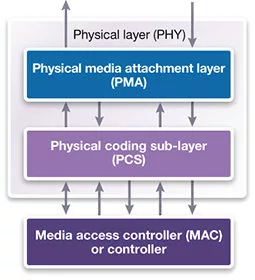
The configurable transmitter and receiver equalizers enable customers to control and optimize signal integrity and at-speed performance. Continuous Calibration and Adaptation (CCA) provides a robust performance across voltage and temperature variations during normal mode of operation. The PHY supports low standby power with advanced L1 substates and low active power with I/O supply under drive, decision feedback equalization (DFE) bypass and V-Boost off. The embedded bit error rate (BER) tester and internal eye monitor provide on-chip testability and visibility into channel performance. The PHY integrates seamlessly with the Synopsys Physical Sublayers and digital controllers/media access controllers (MACs) to reduce design time and to help designers achieve first-pass silicon success. These features reduce both product development cycles and accelerate time-to-market.
Learn more about Single-Protocol PHY IP core
UniversalFlash Storage (UFS) was created for mobile applications and computer systems requiring high performance and low power consumption. These systems typically use embedded Flash based on the JEDEC standard eMMC. UFS was defined by JEDEC as the evolutionary replacement for eMMC offering significantly higher memory bandwidth. The standard builds on existing standards such as the SCSI command set, the MIPI Alliance M-PHY and UniPro as well as eMMC form factors to simplify adoption and development.
In this paper, we introduce a new high-level, dataflow programming language called C~ (“C flow”) that further increases productivity by raising the level of abstraction from behavioral descriptions, while overcoming the limitations of C for hardware design. We present the syntax and semantics of this language, and the framework that provides hardware and software code generation. This paper illustrates the benefits of using C~ for hardware design of a IEEE 802.3 MAC, synthesized for FPGA and for 90nm CMOS technology.
Universal Flash Storage (UFS) was created for mobile applications and computer systems requiring high performance and low power consumption. These systems typically use embedded Flash based on the JEDEC standard eMMC. UFS was defined by JEDEC as the evolutionary replacement for eMMC offering significantly higher memory bandwidth. The standard builds on existing standards such as the SCSI command set, the MIPI Alliance M-PHY and UniProSM as well as eMMC form factors to simplify adoption and development.
Since MIPI and MDDI standards both target interfaces to cameras and displays on mobile devices, are two separate standards really needed?
Enter the Inner Sanctum of RapidIO: Part 1
Networking software key to PICMG 2.16 optimization