Quantifying Uncertainty in FMEDA Safety Metrics: An Error Propagation Approach for Enhanced ASIC Verification
By Antonino Armato 1, Christian Kehl 2, Sebastian Fischer 2
1 Functional Safety, Robert Bosch GmbH, Milan,Italy
2 Functional Safety, Robert Bosch GmbH, Reutlingen, Germany
Abstract
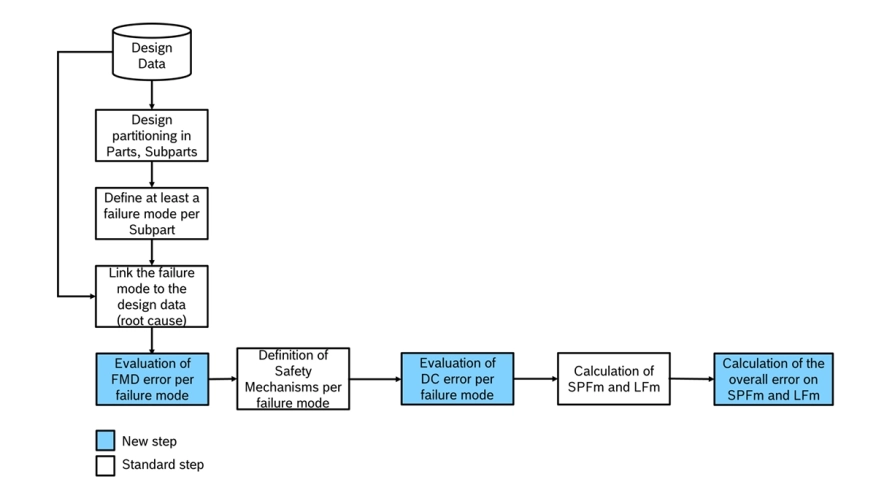
Accurate and reliable safety metrics are paramount for functional safety verification of ASICs in automotive systems. Traditional FMEDA (Failure Modes, Effects, and Diagnostic Analysis) metrics, such as SPFM (Single Point Fault Metric) and LFM (Latent Fault Metric), depend on the precision of failure mode distribution (FMD) and diagnostic coverage (DC) estimations. This reliance can often leads to significant, unquantified uncertainties and a dependency on expert judgment, compromising the quality of the safety analysis. This paper proposes a novel approach that introduces error propagation theory into the calculation of FMEDA safety metrics. By quantifying the maximum deviation and providing confidence intervals for SPFM and LFM, our method offers a direct measure of analysis quality. Furthermore, we introduce an Error Importance Identifier (EII) to pinpoint the primary sources of uncertainty, guiding targeted improvements. This approach significantly enhances the transparency and trustworthiness of FMEDA, enabling more robust ASIC safety verification for ISO 26262 compliance, addressing a longstanding open question in the functional safety community.
To read the full article, click here
Related Semiconductor IP
- UCIe D2D Adapter & PHY Integrated IP
- Low Dropout (LDO) Regulator
- 16-Bit xSPI PSRAM PHY
- MIPI CSI-2 CSE2 Security Module
- ASIL B Compliant MIPI CSI-2 CSE2 Security Module
Related Articles
- SV-LLM: An Agentic Approach for SoC Security Verification using Large Language Models
- Efficient methodology for design and verification of Memory ECC error management logic in safety critical SoCs
- Nine Compelling Reasons Why Menta eFPGA Is Essential for Achieving True Crypto Agility in Your ASIC or SoC
- How a Standardized Approach Can Accelerate Development of Safety and Security in Automotive Imaging Systems
Latest Articles
- RISC-V Functional Safety for Autonomous Automotive Systems: An Analytical Framework and Research Roadmap for ML-Assisted Certification
- Emulation-based System-on-Chip Security Verification: Challenges and Opportunities
- A 129FPS Full HD Real-Time Accelerator for 3D Gaussian Splatting
- SkipOPU: An FPGA-based Overlay Processor for Large Language Models with Dynamically Allocated Computation
- TensorPool: A 3D-Stacked 8.4TFLOPS/4.3W Many-Core Domain-Specific Processor for AI-Native Radio Access Networks