IPrium releases CCSDS 131.2 Turbo SCCC Modulator
FOGGIA, Italy -- September 08, 2022 - FPGA intellectual property (IP) provider IPrium LLC has today announced that it has expanded its family of CCSDS Modulator IP products with a new Turbo SCCC Modulator IP Core for space data systems.
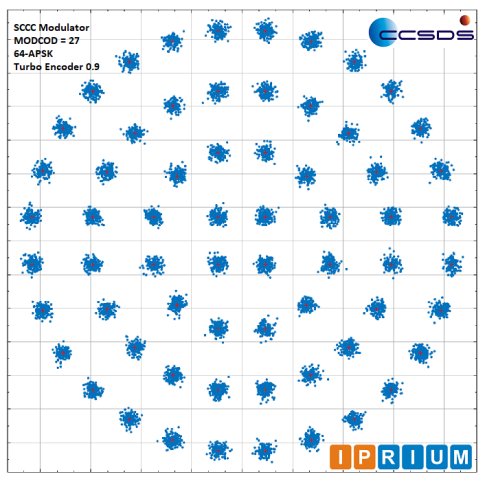
The IP Core is a complete digital QPSK, 8-PSK, 16-APSK, 32-APSK and 64-APSK modulator with an integrated Serially Concatenated Convolutional turbo Coding (Turbo SCCC), optimized for high-capacity satellite systems.
The Turbo SCCC Modulator is silicon-proven and is fully compliant with CCSDS 131.2-B-1 standard "Flexible Advanced Coding and Modulation Scheme for High Rate Telemetry Applications".
The IP Core provides a turnkey single-chip solution that can be used in both narrowband or wideband satellite applications.
Pricing and Availability
The Turbo SCCC Modulator IP Core is available immediately in synthesizable Verilog or optimized netlist format, along with synthesis scripts and a simulation test bench with expected results.
For further information, a product evaluation or pricing, please visit the IP Core page:
About IPrium LLC
IPrium Modem IP Cores allow designers of communication equipment to rapidly develop and verify their systems in a highly cost-effective manner. IPrium offers FPGA IP Cores for high-quality wireless and wireline modems. Visit IPrium at www.iprium.com.
Related Semiconductor IP
Related News
- Creonic Unveils CCSDS 131.2 Wideband Modulator IP Core Achieving 1 GSymb/s
- IPrium adds 128-APSK and 256-APSK support to QAM Modulator IP Core
- IPrium releases 32-channel J.83B Modulator
- IPrium releases 4-channel ATSC 8VSB Modulator
Latest News
- GF unveils roadmap to deliver the world’s most advanced FD-SOI platform for Physical AI
- GlobalFoundries marks Dresden expansion milestone, announces next-generation platform for Physical AI
- TSMC September 2026 Revenue Report
- Lattice Collaborates with Arm to Advance Secure, Adaptable AI Data Center Infrastructure
- ZLG Selects CAST CAN XL and TSN IP for Next-Generation Vehicle-Network Development and Test Tools