Verification IP for DisplayPort/eDP
The Verification IP (VIP) for DisplayPort provides a comprehensive set of protocol, methodology, verification and productivity fe…
Overview
The Verification IP (VIP) for DisplayPort provides a comprehensive set of protocol, methodology, verification and productivity features, enabling users to achieve accelerated verification closure of DisplayPort, VESA DSC, HDCP and eDP based designs.
Protocol Features
- DisplayPort 2.0
- DisplayPort 1.4, 1.3a and 1.2 support
- HDCP 2.2 and 1.x specifications
- eDP 1.4b specifications
- VESA DSC 1.2 and 1.1 specifications
- Serial interface
- 10 bit parallel interface(Bypass PHY)
- Main Link, 1,2,4 lanes
- Aux Channel
- Hot plug Detect (HPD)
- RGB, YCbCr Colorimetric formats
- 18,24,30,36,48 bpp
- Audio 2~8 channels
- Audio/Video info frames
- EDID/DPCD registers
- 3D Stereo Video
- SST data
- Clock recovery
- Scalable architecture to support MST
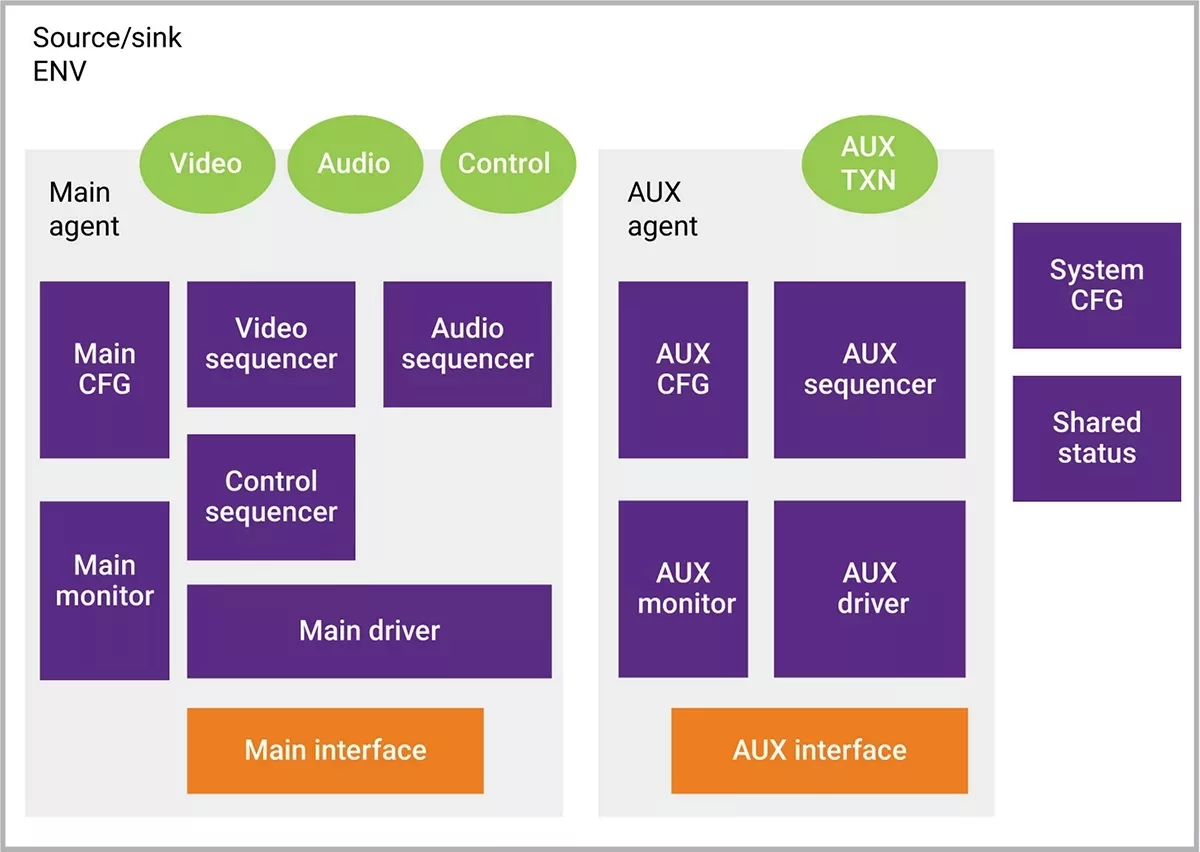
Block Diagram
Specifications
Identity
Files
Note: some files may require an NDA depending on provider policy.
Provider
Learn more about Displayport IP core
The Universe's first mobile phone with USB Type-C and DisplayPort
Combining USB Type-C and DisplayPort support in portable implementations
Industry's First Verification IP for Display Port Automotive Extensions (DP AE)
Addressing the Verification Challenges of Panel Self Refresh in eDP
New USB 80Gbps Specification Boosts Data Rate, Enables Four Protocols on One Bus
Frequently asked questions about DisplayPort IP cores
What is Verification IP for DisplayPort/eDP?
Verification IP for DisplayPort/eDP is a Displayport IP core from Synopsys, Inc. listed on Semi IP Hub.
How should engineers evaluate this Displayport?
Engineers should review the overview, key features, supported foundries and nodes, maturity, deliverables, and provider information before shortlisting this Displayport IP.
Can this semiconductor IP be compared with similar products?
Yes. Buyers can compare this product with similar semiconductor IP cores or IP families based on category, provider, process options, and structured technical specifications.