Vendor:
T2M GmbH
Category:
USB
USB 3.0 High/Full/Low-Speed Host + Device Controller IP
USB 3.0 Dual Mode Controller IP Core uses a high performance DMA engine based on the xHCI specification and presenting either an …
Overview
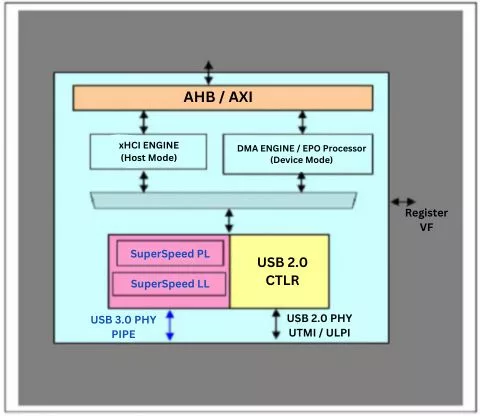
USB 3.0 Dual Mode Controller IP Core uses a high performance DMA engine based on the xHCI specification and presenting either an AHB or AXI interface, this controller offers host and device capabilities. With a very simple application interface that can be easily adapted to standard on-chip-bus interfaces like AXI, AHB, and OCP as well as other standard off-chip interconnects, the Dual Mode Controller core is carefully partitioned to support standard power management schemes, including extensive clock gating and multiple power wells for aggressive power savings. This makes it easy to be integrated in a wide range of applications.
Key features
- Host functionality is compliant with xHCI Rev1.0
- Compliant with USB3.0 Specification Rev1.0
- Compliant with USB Specification Rev 2.0
- Compliant with USB2 Link Power Management
- Supports Aggressive Low Power Management
- Configurable core frequency: 125, 250, 500 Mhz.
- Configurable PIPE Interface for USB3.0 PHY: 8,16, 32 bit.
- Configurable USB2 PHY Interface : 8/16 bit UTMI,8-biot ULPI interface
- Optional DMA engine for device mode functionality.
- Optional endpoint zero processor block for processing standard requests for device mode functionality
- Flexible User Application Logic
- Can be adapted by any SoC / OCB interface / offchip interconnects – such as AHB, AXI, PCIe
- Configurable Datawidth: 32, 64, 128 bit
- Optional native packet interface
- Simple Register Interface for internal Register
- Access – AHB Slave or GDA PBUS Interface
- Pin or register bit to select between host/device
Block Diagram
USB 3.0 Dual Mode Controller IP block diagram
Benefits
- Highly modular and configurable design
- Layered architecture
- Fully synchronous design
- Support for both sync and async reset
- Clearly demarcated clock domains
- Extensive clock gating support
- Multiple power well support
- Software control for key features
Applications
- Scanners
- Digital cameras
- Removable media drives
- Mass storage devices
- Display and docking applications
- Cloud computing
- Automotive applications
- Consumer applications
What’s Included?
- Configurable RTL Code
- HDL based test bench and behavioral models
- Test cases
- Protocol checkers, bus watchers and performance monitors
- Configurable synthesis shell
- Documentation :
- Design Guide
- Verification Guide
- Synthesis Guide
- FPGA Platform for Pre-Tape-out Validation
- Reference Firmwarell
Specifications
Identity
Part Number
USB 3.0 Dual Mode Controller IP
Vendor
T2M GmbH
Type
Silicon IP
Files
Note: some files may require an NDA depending on provider policy.
Provider
Learn more about USB IP core
Exploring USB Applications and the Impact of USB IP
Understanding USB IP and Its Role in SOC Integration
What Designers Need to Know About USB Low-Power States
In addition to performance and interoperability, achieving low power has been one of the requirements for industry standards specifications. Some of the key specifications like Universal Serial Bus (USB), PCI Express (PCIe), and MIPI have defined power saving features for burst traffic. This whitepaper explains how Synopsys USB IP offers low power using various low power states that go beyond the basic features.
New USB 80Gbps Specification Boosts Data Rate, Enables Four Protocols on One Bus
Gervais Fong, Synopsys
New USB Device Class Specification Broadens Use Cases for I3C and I3C Basic
Sharmion Kerley, MIPI Alliance
Frequently asked questions about USB IP cores
What is USB 3.0 High/Full/Low-Speed Host + Device Controller IP?
USB 3.0 High/Full/Low-Speed Host + Device Controller IP is a USB IP core from T2M GmbH listed on Semi IP Hub.
How should engineers evaluate this USB?
Engineers should review the overview, key features, supported foundries and nodes, maturity, deliverables, and provider information before shortlisting this USB IP.
Can this semiconductor IP be compared with similar products?
Yes. Buyers can compare this product with similar semiconductor IP cores or IP families based on category, provider, process options, and structured technical specifications.