Vendor: Key ASIC Category: Oscillator

USB 2.0 On-chip oscillator, termination resistors, and DP/DM short circuit protection (0.18u)

The KA18USB20 consists of the digital and analog blocks of the USB Transceiver Macrocell (UTMI) specifications.

Overview

The KA18USB20 consists of the digital and analog blocks of the USB Transceiver Macrocell (UTMI) specifications. This macrocell is certified and compliant with USB 2.0 specifications.

Key features

  • On-chip oscillator, termination resistors, and DP/DM short circuit protection.
  • Low pin count
  • Minimum number of external
  • components
  • Low power & small area
  • Supports bus-powered devices
  • UTMI compliant
  • Certified for compliance
  • Test modes to facilitate production test
  • 0~125°C operating junction
  • temperature
  • Silterra 0.18u CMOS process

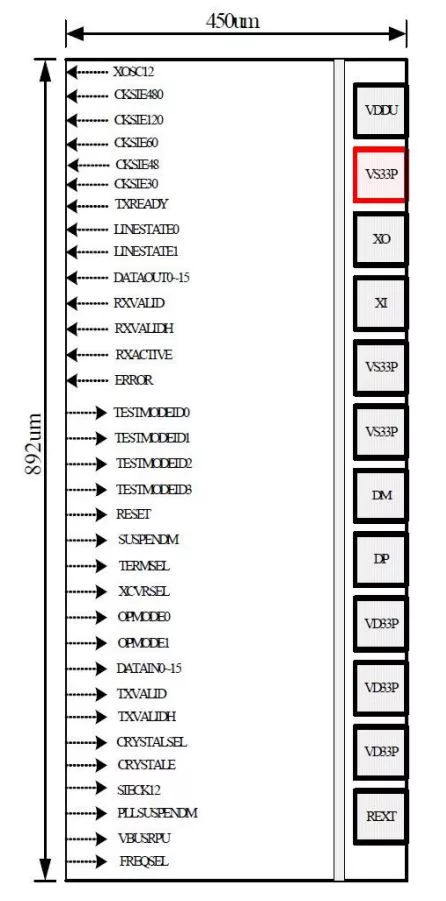
Block Diagram

Benefits

  • On-chip oscillator, termination resistors, and DP/DM short circuit protection.

Applications

  • Consumer
  • Industrial Electronics

What’s Included?

  • Phantom GDSII
  • .lef model
  • Encrypted Verilog model
  • Specification and User Guide documentation

Specifications

Identity

Part Number
KA18USB20
Vendor
Key ASIC
Type
Silicon IP

Provider

HQ: Malaysia

Learn more about Oscillator IP core

Securing SoC Reliability with Precision Power-On Reset IP for 0.8V Industrial Designs

As process nodes continue to shrink and core voltages drop to around 0.8V, the margin for noise in logic levels has become extremely small. Traditional RC-based reset circuits simply don’t have the precision needed to reliably tell the difference between a normal power-up sequence and a risky voltage fluctuation. That’s where Key ASIC’s Integrated Power-On Reset (POR) IP comes in.

A Systematic Approach to Robust LVDS Integration in Advanced Node ASICs

Across the semiconductor industry, a great deal of attention is currently directed toward 112G SerDes and next-generation memory interfaces like DDR5. These developments are important to meet the growing demand for high-speed interfaces, but veteran SoC engineers who have taken over 100 designs into mass production often see the picture differently.

Why 6.4 Gbps DDR5 Designs Fail and How to Avoid It

As we push beyond the 6.4 Gbps threshold with DDR5, the margin for error has essentially disappeared. For engineering leads and decision-makers, the goal is no longer just a simulation that looks functional. What we really need is First-Pass Silicon Success—a stable, high-yield product that works right from the very first tape-out.

Three Ethernet Design Challenges in Industrial Automation

As factories, process plants, and robotics platforms become increasingly intelligent and interconnected, the demand for stable, low-latency data links has pushed Ethernet deeper into embedded systems. However, since designing Ethernet connectivity into industrial chips comes with its technical and logistical hurdles, engineers may face challenges when implementing Ethernet in industrial designs.

Maximizing SoC Longevity with PCIe 3.0: A Designer’s Guide

As PCIe 5.0 and 6.0 dominate headlines in the semiconductor industry, it’s tempting for every SoC design team to reach for the newest protocol available. But not every application needs blazing-fast 32GT/s throughput—and not every market segment can afford the power, complexity, and cost penalties that come with bleeding-edge PHYs.

Frequently asked questions about Oscillator IP cores

What is USB 2.0 On-chip oscillator, termination resistors, and DP/DM short circuit protection (0.18u)?

USB 2.0 On-chip oscillator, termination resistors, and DP/DM short circuit protection (0.18u) is a Oscillator IP core from Key ASIC listed on Semi IP Hub.

How should engineers evaluate this Oscillator?

Engineers should review the overview, key features, supported foundries and nodes, maturity, deliverables, and provider information before shortlisting this Oscillator IP.

Can this semiconductor IP be compared with similar products?

Yes. Buyers can compare this product with similar semiconductor IP cores or IP families based on category, provider, process options, and structured technical specifications.

×
Semiconductor IP